
Bureaucracy: No Replacements, State to Rely on AI
Another day, more glimpses into the likely future of western society: as boomers retire, more stuff will be automated while population decline will result in massive cuts

About a year ago, we learned about the first open introduction of AI™ into public administration in my home country of Austria:

The key take-away—among many, including, most prominently, grand assurances of ‘your data will be protected’ (lol, sure)—in that piece, to my mind, was this paragraph:
AI Cushions the Wave of Retirements
Artificial intelligence could also be used to compare, analyse and summarise expert opinions, decisions, and legal texts [which is, as of now and in my view, its only really useful application in administration; I wouldn’t bet on AI to reduce pork spending and grift, though]. This is all against the background that around 40% of state employees will retire in the next ten years—and some of their work will be taken over by AI [read this once more: four out of every ten state bureaucrats will retire before 2035, and I’d bet that most of them will not be replaced].
So, a year later, let’s see how that experiment in AI™-assisted governance has worked so far, shall we, specifically the ‘predictive’ aspect concerning the rapid-onset decline of available human labour.
Translation, emphases, and [snark] mine.
Bureaucracy: No Replacements, State to Rely on AI
Via [state broadcaster] kaernten.orf.at, 11 Jan. 2026 [source; archived]
For a year now, the Carinthian state administration has been using artificial intelligence. This relieves the workload of employees and provides greater data protection, it is said [now that’s a massive claim, eh?]. In the long term, AI is intended to take over some of the work of employees who retire and whose positions are not replaced [this is the core issue, and my hypothesis would be: AI, robotics, and other advances would have been quite fine offsetting population decline and the problems deriving from boomer retirement, but the powers-that-be had decided, some decades ago, that mass/replacement migration was the way to do, which is both insane and not working (see below)].
With the development of its own in-house AI application, the state has also strengthened data protection. Employees can use the artificial intelligence, for example, to compare and summarise documents or to perform analyses [their words, not mine; analyses must be done based on a priori reading and understanding, yet if AI™ summarises files, analyses becomes performative].
The advantage is that we don’t have any data protection issues. All data that is uploaded remains within our data centres. This means that employees don’t have to worry about whether they are allowed to do this [use AI™] or not.
Thus Christian Inzko, the IT manager in the state government.
AI Supports the Processing of Grant Applications
Artificial intelligence is now also being used in the processing of certain grant applications: ‘The strategy is strongly focused on AI agents, and we have now succeeded in developing the first AI agent that automates the “get rid of oil” subsidies [orig. Raus-aus-Öl-Förderung; this means up to 35% of your new heat pump or some other system will be paid for by the taxpayer (up to max. 17,500 euros, which tells you just how much these new heating units costs)]. The solution ensures that application files related to decommissioning of oil and gas-powered units are uploaded and checked by AI for completeness and accuracy, and then presented to the case worker for final approval.’ [does this signify the end of human agency? Also, it seems that using AI™ is actually adding layers of bureaucratic, IT-related, and technical requirements—and with the incoming wave of retirements plus the persistent labour shortages (while we are importing sub-par, illiterate people from the Third World) makes this a cul-de-sac if there ever was one].
Goal: Rethinking Processes
Over the next five years, 300 positions in the state civil service are to be eliminated, primarily through retirement. The workload must be managed with fewer people. The systems would help to rethink and simplify processes:
Ideally, they would also be automated, either completely or in certain areas. If this automation is implemented well and reliably, it contributes to reducing workload. Then, for certain steps, you probably won’t need the same level of human capital expenditure as before.
Thus, once more, the head of the IT department in the state government.
Bottom Lines: AI™ is Coming (for your jobs)
The federal state (Land) of Carinthia is approx. 3,600 square miles large and has a population of around 570,000 inhabitants (Wikipedia). In popular culture, its residents are treated by people living in the hip™ metro areas akin to how Los Angelenos and Manhattanites consider, e.g., Iowans or people from rural Montana: sometimes in a manner of less-than-friendly country bumpkins, plus loads of condescension.
Funny that, though, that Carinthia’s purely administrative staff numbers about 3,500 people (full-time-equivalents) plus almost 4,700 teaching staff (for unrelated reasons, the latter, at virtually all levels, are publicly employed but not by the federal gov’t, hence this distinction is necessary), hence the 300 positions in the administrative apparatus that are to be cut in the next five years constitute about 8.5% of the administrative workforce.
Funnier still, budget plans for 2025 indicate around 3,833 positions for administrative staff, which looks like an increase by about 10%.
So, what is this going to accomplish and what are its likely bigger implications?
Well, for starters, the retirement of the boomers is coming, nay, it’s already begun, and if one dares to look at the age distribution without blinking, it’s going to get worse before…well, things change again (the green line indicates the official retirement age of 65, but in reality it’s around 63-ish for men and a tad lower for women):
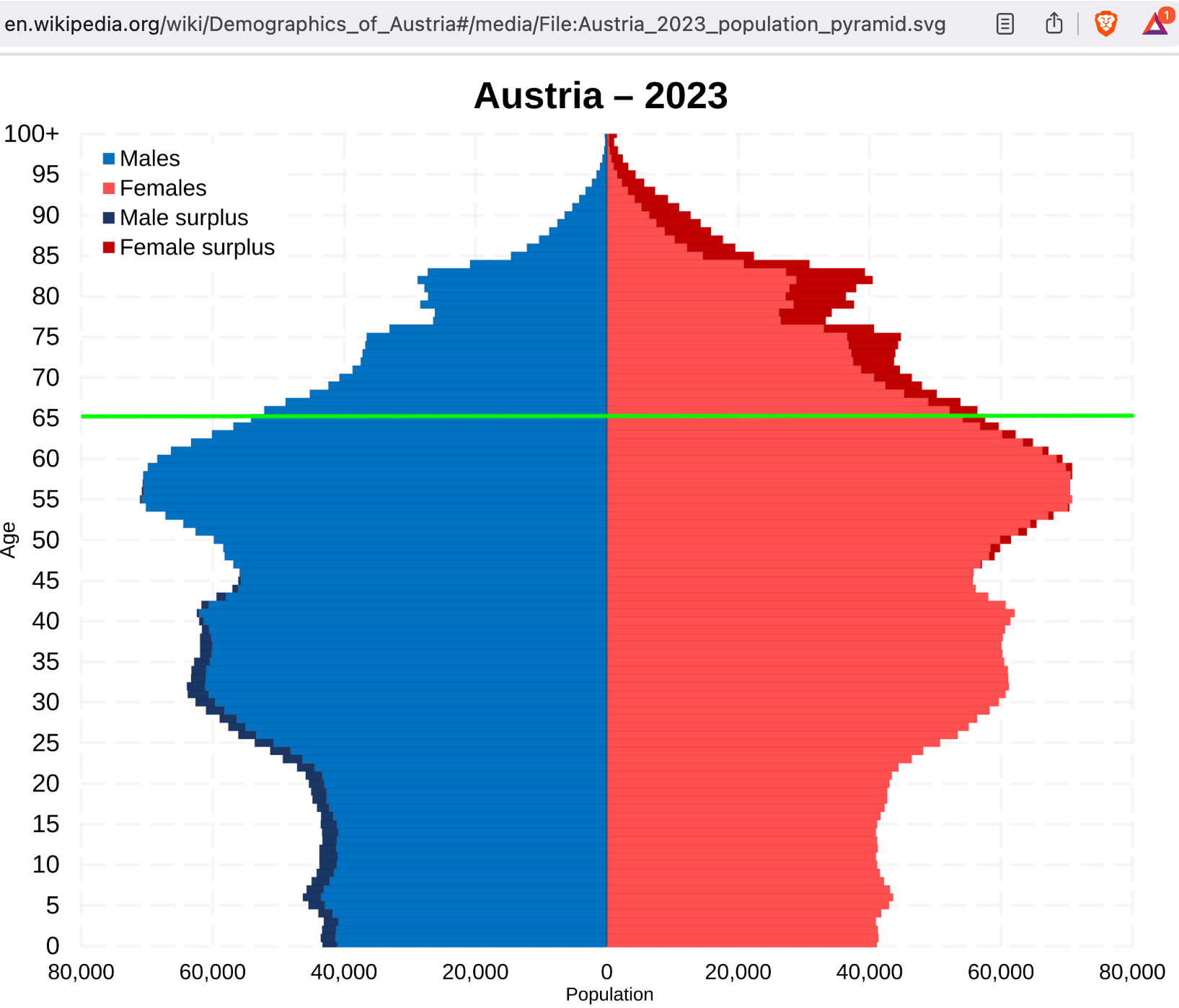
This looks basically very much alike in other western countries, hence we’re only witnessing the onset of the retirement tsunami—and it’s hard to fathom how much, if any, forethought, let alone planning, has gone into downstream costs, ranging from the obvious (pension payouts) to the less-talked about anticipated explosion of healthcare and assisted living facilities (as a rule of thumb, the overwhelming majority of such costs are due in the last two years of one’s live).
This brings us to the next big-ticket issue, which the turn to AI™ can, and will, never address: if the workforce is poised to shrink, what kinds of pressures will that place on those who are (still) working?
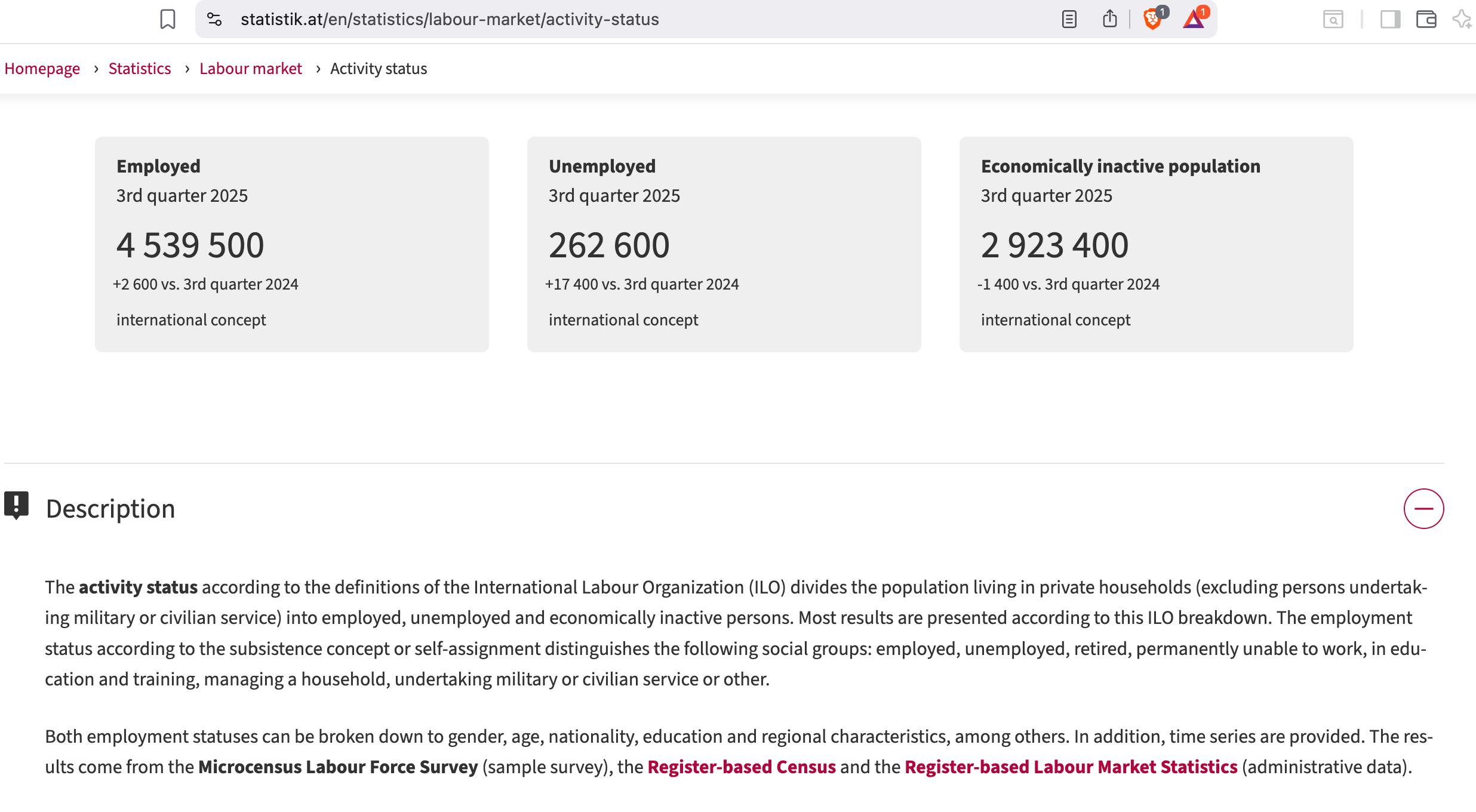
These numbers add up to 7,725,500 people in the total labour force, of whom about 58.8% are employed and support the other roughly 41.2% (it’s 62.5% in the US, according to Federal Reserve statistics).
Shift this ratio by a few percentage points from the former to the latter category, and you’ll see the problem: the US had about the same labour force participation rate in the 1950s, incl. higher taxes, Jim Crow laws, segregation, and everything else that characterised the Eisenhower era.
So, having a lower labour force participation rate isn’t necessarily a bad thing; it does come with strings attached, and I presume that once western countries move more forcefully towards 1950s-era conditions in the terms outlined above, we’ll probably simplify™ our tax system away from individual filings (as is true in Scandinavia, by the way) towards household filings or the like.
The main problem, demographically speaking, is something else: mass immigration, replacement or otherwise, has failed. As we’ve discussed two weeks ago, fertility rates of recent (2000-) arrivals in Austria are falling even faster than the native population’s post-1960s (birth control) rates:

I’m writing so much about the Austrian case because I’m from there and I know my way around the Byzantine bureaucracy etc. But there’s also another aspect—it’s a small, landlocked country that took in 3.34m (!) immigrants since 2000, and that’s a massive number relative to the roughly 8m people who lived there in 2001.
Yet, the above-linked piece from 31 Dec. 2025 shows, conclusively I’d add, that due to rapidly falling birth rates among immigrants (they are now at 1.87 children per woman), mass immigration isn’t going to solve the demographic problem. It might buy a few years extra time, but remember: every scheme that requires new people signing up to pay for those already in the system is—a Ponzi scheme.
Hence, it’s quite obvious what comes next:

Tomorrow, we’ll likely grant full citizenship to many recent arrivals, if only because they’ll prop up the system a tad longer.
Beyond that, well, it really depends on what kinds of people one takes in, and in this regard, the future looks bleak (no pun intended), as virtually every place one cares to look at indicates; take Norway for example:

And that’s not an extreme case, as documented here:

Please don’t misconstrue this as a xenophobic commentary: I’ve lived abroad (as a migrant, if you like) since 2010, and I’m the last person to advocate a kind of blood & soil simpleton’s argument.
But.
Dutch researchers have done the math on the costs/benefits associated with mass immigration from certain places, and replacing highly productive natives with less-motivated welfare recipients for live doesn’t strike me as a viable policy prescription:

That is, if one’s motives would be to keep the present system going.
Ai cant even follow along w a short Bible reading w/o getting quite s lot WRONG! Wonder how this is going to play out- not well.
Aborted away our next generation. Our livelihoods. Yes, children belong in and to communities