
After 'Replacement Migration' is Before 'Stakeholder Democracy'
As official data shows that recent immigrants' fertility rates are collapsing even faster than those of the native populations, we must ponder its implications--and it surely ain't pretty

At the end of 2025, your humble correspondent updated you on ‘replacement migration’ in Austria, citing the latest data available that showed drastic drops in fertility rates for both native/ethnic Austrians (Germans) and immigrants alike, with the total fertility rate for Austrian women standing at 1.22, which is significantly lower than that of mothers with foreign citizenship, which stood at 1.58 children per woman:

I hyperbolically labelled these data the not-so-tacit admission that ‘replacement migration’, although a UN-endorsed policy position from 2001, has both happened and failed. Here’s the key paragraph from that report to understand my claim:
Population decline is inevitable in the absence of replacement migration. Fertility may rebound in the coming decades, but few believe that it will recover sufficiently in most countries to reach replacement level in the foreseeable future…
The numbers of immigrants needed [by whom and for what purpose?] to prevent the decline of the total population are considerably larger than those envisioned by the United Nations projections. The only exception is the United States.
And now we are at the point where we see hard data of immigrants’ fertility rates collapsing even faster than that of the native populations, which points squarely to both replacement migration as a policy to stave off population decline has happened (due to low fertility rates among the natives) and failed to provide a durable solution™ to falling fertility rates among immigrants.
Talk about Catch-22 here for a moment.
Yet, the main issue I’ll mention today isn’t all of the above (though it would be a massive game-changer in terms of policy discussions that we’re not having; we’re stuck at let’s not have all that many immigrants all at once).
Where will this situation, and I’d add almost inevitably so, lead to?
It’s the topic of today’s musings, and here we go—my translation, with emphases and [snark] added.
40 Percent of Newborns Not Austrian Citizens
The number of children born in Austria without Austrian citizenship is increasing. In Vienna, according to 2024 figures, this figure was 40 per cent of newborns. This also has an impact on the electorate [do tell].
Via wien.ORF.at, 31 Dec. 2025 [source; archived]
Twenty years ago, around 20 per cent of newborns were not Austrian citizens; this proportion has risen steadily over the years to its current level of 40.5 per cent. This is shown by data from Statistics Austria, which was recently published by the federal government. In some districts [of Vienna], such as Favoriten, Rudolfsheim-Fünfhaus, and Ottakring, over 50 per cent of newborns do not have Austrian citizenship.
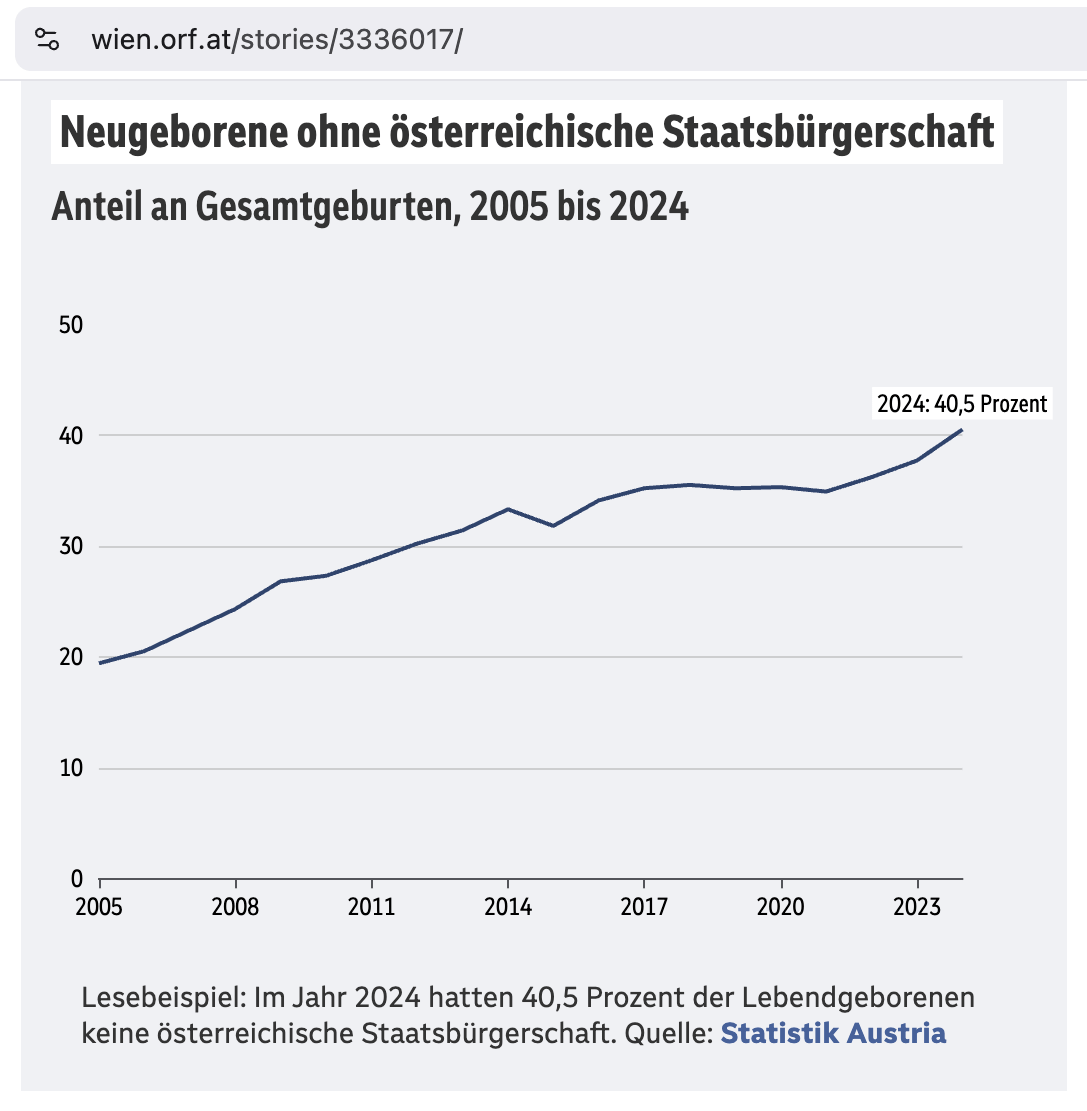
In 2024, 40.5 per cent of newborns had no Austrian citizenship.
While naturalisation is possible in principle, it is only at a much later stage and involves many bureaucratic hurdles, criticises migration researcher Judith Kohlenberger [faculty profile]:
It also means that for a very long time, this form of political participation and belonging—because active and passive voting rights depend on citizenship—is unavailable. [well, it’s the law™, eh?]
Expert Proposes Legal Change
For Kohlenberger, this is a cause for concern from a democratic perspective [nevermind the issue of having immigrants decide for themselves if they want to become citizens]:
At some point, especially in Vienna, we have to ask ourselves: how strong is the legitimacy of our elected representatives when an ever-increasing share—over 50 per cent of the voting-age population in some districts—is not eligible to vote? [for those who read this in the US: yep, the expert™ just called your elections—with participation/turnout rates a it higher than 50%—a sham].
The researcher from the Vienna University of Economics and Business therefore proposes that children of parents without citizenship—‘who have already been legally residing in Austria for a certain period of time, are employed, and pay taxes’—should receive citizenship at birth [line break added].
The federal government, which is responsible for citizenship law, rejects such a change [at least something]. The city government also opposes any fundamental change.
The Trojan Horse of Stakeholder Democracy™
Don’t be fooled by Ms. Kohlenberger’s demeanour and appearance—for she’s one of legacy media’s most trusted experts™ to always argue in favour of mass immigration.
A trained sociologist, her CV checks all the boxes (warning lights): she’s affiliated with several institutions, such as the Jacques Delors Centre of the Hertie School in Berlin (a major pro-EU think-tank), appears so frequently on TV that her faculty profile notes she’s not accepting any new students to supervise at this time, and has received several prizes for her work, including the Dr. Kurt Rothschild Prize of the social-democratic Karl Renner Institute (the policy think-tank of the Social Democratic Party) in 2019 and the Anes Shakfeh Prize for the promotion of democracy, human rights, and the rule of law (see her German Wikipedia profile). Her LinkedIn profile holds this gem:
In 2025 I published 3 books and countless articles, habilitated, founded an institute, gave umpteen interviews, participated in a movie, deleted hundreds of hate emails, survived the worst root canal treatment of my life, had a godchild ( 💗 ), celebrated 20 years of high school graduation, and my last 30s, laughed a lot and out loud, overcame my reluctance to travel, said ‘always the same’ (quoting Margarita Tsomou) on too many podiums, and was allowed to have many inspiring, moving and encouraging encounters.
Please forgive me for running out of energy for a review of the year. Cheers to 2026!
I haven’t found (and less cared about) whether Ms. Kohlenberger has children on her own; I personally doubt it, but hey, why bother with such things, right?
Well, here’s why—because of the above-endorsed policy proposals of changing from citizenship by descent (ius sanguinis) to birthright citizenship (ius solis). Here’s a Wikipedia map showing which countries to the former vs. those that practice the latter:
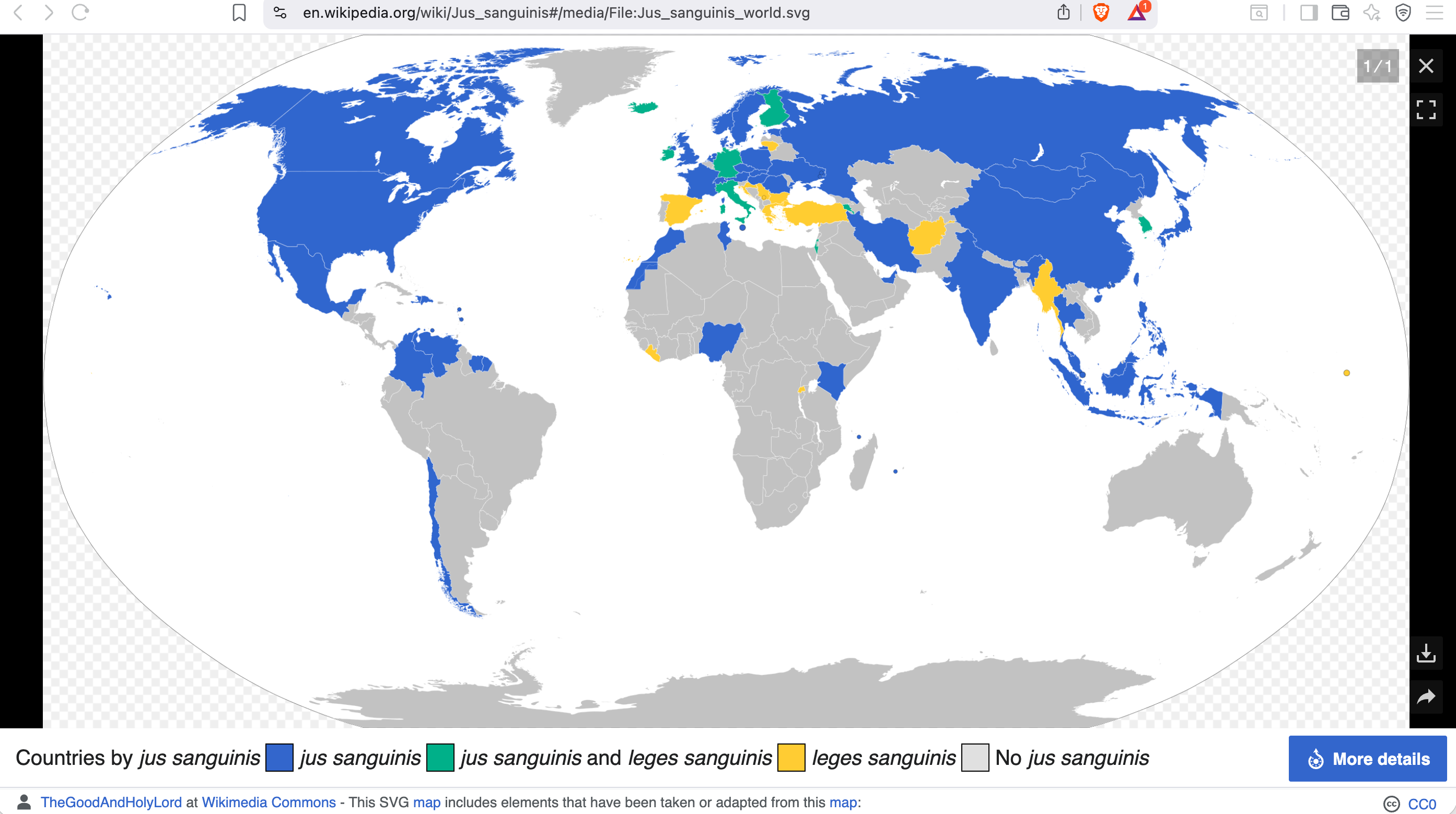
What follows isn’t an argument for or against either of these meta categories, nor is it about my personal opinions what I find ‘good’ or even ‘better’ (for these you are referred to the footnote1).
What follows is a dissection of the train of thought (sic) of Ms. Kohlenberger and her ilk as regards the stuff she’s been saying.
At some point, especially in Vienna, we have to ask ourselves: how strong is the legitimacy of our elected representatives when an ever-increasing share—over 50 per cent of the voting-age population in some districts—is not eligible to vote?
The researcher from the Vienna University of Economics and Business therefore proposes that children of parents without citizenship—‘who have already been legally residing in Austria for a certain period of time, are employed, and pay taxes’—should receive citizenship at birth
Translation from the (stupid) academese: those who pay taxes should also vote in elections.
While I technically agree with that sentiment, we must consider its implications before a verdict: what is advanced here is something I’ll call ‘stakeholder democracy’, that is, a concept and idea that derives from how joint-stock corporations and voting rights are set-up (and why, if you hold but one share of, say, Apple, Google, or what have you, may attend their annual shareholder meetings).
Once you understand that underlying concept, it becomes obvious where this train-of-thought (pun intended) leads to: the same biased and lopsided structure we find in transnational mega-corporations where, technically, everyone with the means to acquire (one or more) shares has the right to participate in annual shareholder meetings but it’s totally obvious that he or she who holds one share possesses way less voting powers than, say, those who hold a million shares.
There’s but a small step from advocating for ‘everybody who pays taxes shall vote’ (which is, as I said, something I support in principle) to, once achieved, advocate, and logically so, that ‘those who pay more taxes shall have a greater say’.
Once you see it, you cannot un-see this connection, or, as the World Economic Forum would have it,
Stakeholder capitalism is a form of capitalism in which companies seek long-term value creation by taking into account the needs of all their stakeholders, and society at large.
Klaus Schwab discusses its history and relevance in this excerpt from the book Stakeholder Capitalism: A Global Economy that Works for Progress, People and Planet…
That is the core of stakeholder capitalism: it is a form of capitalism in which companies do not only optimize short-term profits for shareholders, but seek long term value creation, by taking into account the needs of all their stakeholders, and society at large.
This approach was common in the post-war decades in the West, when it became clear that one person or entity could only do well if the whole community and economy functioned. There was a strong linkage between companies and their community…
But as a global organizing principle for business, the stakeholder concept competed head-on with Chicago University economist Milton Friedman’s notion of “shareholder primacy”. It held that “the business of business is business” (or, as he literally wrote: “the social responsibility of company is to make profits”) —and the stakeholder approach ultimately lost out.
Shareholder capitalism became the norm across the West as companies globalized, loosening their ties with local communities and national governments, and focusing instead on maximizing short-term profits for shareholders in competitive global markets…
Today, the stakeholder concept is ready for a comeback, albeit in an updated, more comprehensive form…
The same interconnectedness can be observed for the people who live on the planet. The well-being of people in one society affects that of those in another, and it is incumbent on all of us as global citizens to optimize the well-being of all.
So, I dunno if, or whether she does so consciously or not, Ms. Kohlenberger and her ilk are in cahoots with Klaus Schwab, the WEF, or whatnot, but it does sound eerily similar to the occultist gobbledygook coming out of the mouth of Klaus Schwab whose above-cited ramblings are accompanied by this totally meaningful visualisation:
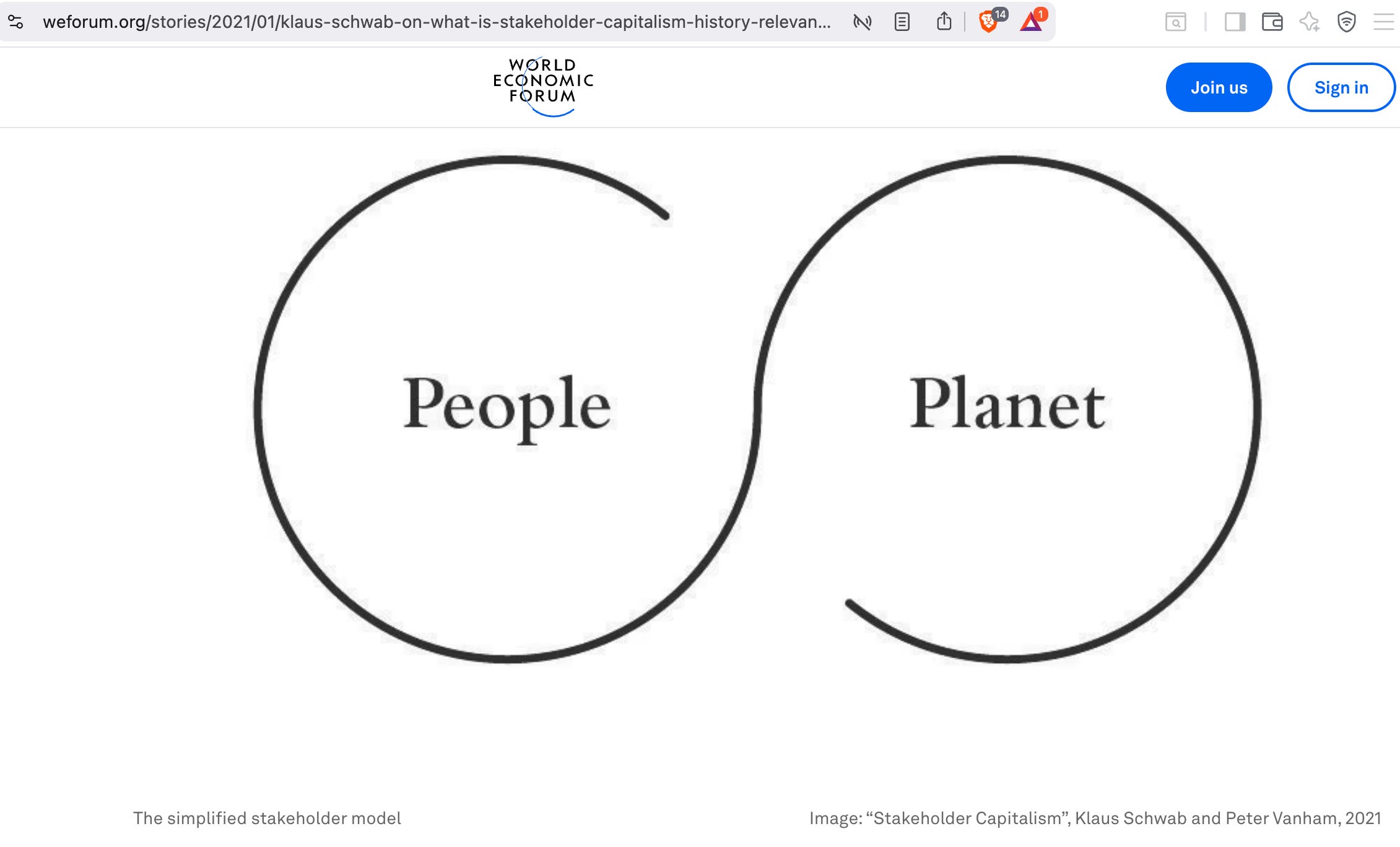
Change my mind, Ms. Kohlenberger.
Bottom Lines
Needless to say, the term ‘stakeholder democracy’ isn’t available in Wikipedia, and neither are its drastic implications, which include, in no particular order,
both the American and French revolutions were, in effect, at least partially a conflict over voting rights (‘one person, one vote’) and representation (‘no taxation without representation’)
there is absolutely nothing (except felony convictions) that prevent anyone from applying for citizenship in Austria or elsewhere (with perhaps the exception of Israel, that is, provided you’re not Jewish [I’m not])
to infer that something (citizenship and voting rights) should be given for nothing, I’d argue, also impinges on the golden calf of women’s liberation™, that is, the debates over universal suffrage (that would be the 19th Amendment in the US context) which didn’t bestow any duties—such as, most prominently, conscription in wartime—on women in exchange for full participatory rights
That listing could continue for some time, and if I’d have to add one more bullet point, I’d mention the abrogation of household tax filings in favour of individual = separate filing obligations for both husbands and wives. That is, for starters.
As to mass immigration and its discontents, well, there are many.
So far, the gov’t doesn’t want to change the Citizenship Act of 1985, which clearly holds that descent (orig. Abstammung, §§ 7, 7a, and 8) is the primary factor establishing citizenship.
Yes, it’s possible to apply for and receive citizenship upon documented fulfilment of several criteria (§§ 10 through 24), but that’s besides the point.
What Ms. Kohlenberger and her ilk are also arguing for isn’t merely a change of legislation (which is human-made after-all) but also a backroom door into ‘stakeholder democracy’.
No-one is prevented from applying for citizenship if one doesn’t reside in the country of one’s birth (as your humble correspondent has done in three different such countries since 2010). Yes, there would be civics courses and exams to take, the payment of fees, provision of documents, and fulfilment of additional criteria (such as, e.g., no felony charges prior to citizenship application), but that’s all fine with me.
But it’s been my experiences as an (im)migrant in several countries (Switzerland, the US, and Norway) that a sizeable chunk of the immigrant population doesn’t want to spend time and money on the stuff outlined in the preceding paragraph. (My experience is also that, the further down one climbs the socio-economic ladder, time and money are preferentially spent on, say, big cars and expensive S.M.A.R.T. phones.)
While I think a fair argument can be made that Western societies already set the precedent of giving away voting rights in exchange for nothing (to women, that is, in the aftermath of the First World War), this suggests that, at some point in the near future, insane and ill-informed commentary such as the one offered (sic) by the resident expert™ Kohlenberger, will change citizenship legislation before too long.
Whatever one thinks about that aside, it also means that this is the logical next step once ‘replacement migration’ has already occurred, as we can observe in the present.
It also follows, albeit even more logically so, we shall discuss the implications of ‘replacement migration’ as a fact—and most prominently so, its failures to provide a solution for falling birth rates.
Given the sheer length of today’s posting, however, these musings will have to wait for another day. In the meantime, I welcome all your comments.
Personally, I found my term as a visiting professor in NYC back in autumn 2018 very interesting: not only professionally (I was at a prestigious fancy-name place holding a named professorship) but in terms of sentiment—nowhere in Europe have I found such a welcoming environment among my interlocutors, incl. during lecturing trips to Tennessee and California, and these may be best summed up as the sentiment of ‘well, since you’re here (legally), welcome: do you like it here and could you imagine staying’ was basically the sentiments I encountered *everywhere*. The difference to, say, European countries is palpable—with these sentiments being extended to academics typically only by their peers in socially much-more constrained settings.
Option One:
Allow Western nations to grow continously more efficient to the point that once the demographic hump caused by the generation born 1940s is passed, shrinking population is not a problem. Technology will compensate for lower population numbers. Basic standard of living can be made comfortable even for those unable to work. Social problems can be solved in several different ways tailored to each case.
Consequences: lowered profits over time for the capitalists, lowered power-levels over time due to fewer and fewer administrators and politicians needed to make things run. Greater autonomy and freedom for the citizenry means they will have a great ability to tell capitalists and governments alike "No" to a lot of things the citizenry doesn't approve of, without fear of loss of standard of living, comforts, and so on. This will lead to forther loss of power.
Option two: increase population by artificial means to create a market to offset superfluous products from financing it with punitive taxes turning at least 80% of the population into de facto tax-serfs with little to no real freedom. This will keep profits in an ever-increasing loop for the capitalists while the collateral - whatever infrastructure and order built by said nations from 1945 to present (1970s) - is increasingly broken down via cost cuts with no corresponding lowering of taxes, said taxes financing migration as a vessel for transfering the taxes to the capitalists. This will also necessitate the permament administrative state's continous growth, making it more and more intrusive and controlling of all aspects as tensions and conflicts within a multicultural state grow.
---
And this is pretty much what they actually wrote, but using less direct language, in various reports and articles between the 1970s (RAND Corp. f.e. or Swedish SAF, now called Timbro-SNS), and made people believe in as a good thing.
Makroscale events such as invasion-migration do not happen by chance.
Appreciation and blessings from Sydney Australia