
'What the Perceived Temperature Tells Us'
In the depths of winter, the Science™ informs us about models based on different variables and averages may tell you whatever you wish to feel

We’ll stay within German-speaking Europe for this posting (or what’s left of it, anyways), and today I’d like to share some supreme nonsense I found a weeks ago on the website of the Austrian state broadcaster about, well, more woke BS.
Do enjoy this, dear readers, for this is the steady drip of horse manure people are fed—and which is eagerly gobbled up by the elites and the hoi polloi alike.
Bon appetit! (Translation, emphases, and [snark] mine.)
What the Perceived Temperature Tells Us
Feels like minus eleven, but it is actually minus two degrees Celsius: in winter, the perceived temperature is often significantly lower than the measured temperature. The culprit is the wind: it is largely responsible for how quickly we cool down.
By Tobias Mayr, science.ORF.at, 22 Jan. 2026 [source; archived]
Unlike the measured temperature [i.e., whatever is empirically observable], the perceived temperature is not a physical measurement, but a calculation [who does that model, by the way?]. In winter, meteorologists refer to this as the wind chill effect, which is responsible for people perceiving windy weather as much colder than the same temperature in calm conditions.
‘The higher the wind speed, the colder a temperature feels’, says Geosphere [that would be Austria’s main climate catastrophist think tank ahem, I mean, of course, the Federal Meteorological Institute] meteorologist Judith Gerighausen to ORF Science. At a wind speed of 20 km/h, a temperature of minus five degrees Celsius feels as cold as minus twelve degrees in calm conditions, she says [it might interest you that Ms. Gerighausen received her master’s degree in meteorology from the Karlsruhe Institute of Technology in spring 2024 and has been working at the Geosphere for less than 1.5 years, according to her LinkedIn profile—we note, once more, the recourse of the peddlers of agit-prop to young, hardly experienced experts™].
Early Warning Against Hypothermia
This is because a layer of air, warmed by body, forms on the skin outdoors. When the wind picks up, this layer of air is blown away. ‘As a result, the body has to expend more energy, and this manifests itself in us as feeling cold’, says Gerighausen.
Although wind chill, or the perceived temperature, is given in degrees Celsius, it is actually a unit of measurement for the loss of body heat, explains the meteorologist. The greater the wind chill effect, the more energy the body loses in the cold environment. However, the perceived temperature provides a more precise indication than the actual temperature of how quickly a body is at risk of cooling down under given weather conditions. ‘This isn’t just “nice to know”’, emphasises Gerighausen [who conveniently omits, like, all of human history that provides ample evidence of people having coped with this problem™ without knowing about ‘perceived temperature’ at-all].
The wind chill effect can be calculated using a formula that was empirically determined through experiments [this is hilariously stupid, for that link doesn’t take you to, say, a scientific paper but to another ORF article from January 2021]. It should be noted, however, that this formula is not entirely precise because, for example, the power of the sun is not taken into account [not only that, this is what the 2021 ORF piece noted:
The power of the sun is not taken into account, nor is the fact that wind is officially measured ten metres above the ground. The calculation uses the average wind speed, not the strongest gusts.
Funny that, it’s a bit like calculating™ whatever using averages and other arbitrary variables, such as wind speed, https://fackel.substack.com/p/climate-activism-as-the-sciencehttps://fackel.substack.com/p/climate-activism-as-the-sciencewhich is ‘officially measured ten metres above the ground’ (which is, of course, where everybody walks on sidewalks); add to that the factoid how and where ambient surface air temperature is measure (as per the US NIST website):
The bottom of the enclosure is situated between 1.2 and 2 meters (4.1 to 6.5 feet) above the ground, which should be grass or dirt (if it’s grass, it should be kept short). The area around the enclosure should be free of trees, and preferably there should be a good view of the horizon. The enclosure should be kept away from buildings and pavement, which capture heat from the Sun throughout the day and can make the thermometer artificially warm. All this is meant to ensure that the thermometer is getting the true temperature with unobstructed air flow and without interference from radiating heat. Some enclosures, and all MMTSs, are outfitted with a fan to maintain a consistent air flow no matter the ambient conditions, further enhancing the accuracy of the air temperature measurements.
Isn’t it amazing that the windchill is measured 10m above ground but the surface temperature is measured ‘between 1.2 and 2 meters’ above ground level? So, if you’re wondering about the true™ ‘felt temperature’, just remember that all the following variables aren’t really in relation to each other (as in: the same) and always relate to the nearest temperature measurement station]. For those who still want to calculate it themselves: The actual temperature (T) in degrees Celsius and the wind speed (V) in kilometers per hour must be inserted into the formula; the result shows the wind chill (W) in degrees Celsius: W = 13.12 + 0.6215 × T – 11.37 × V^(0.16) + 0.3965 × T × V^(0.16).
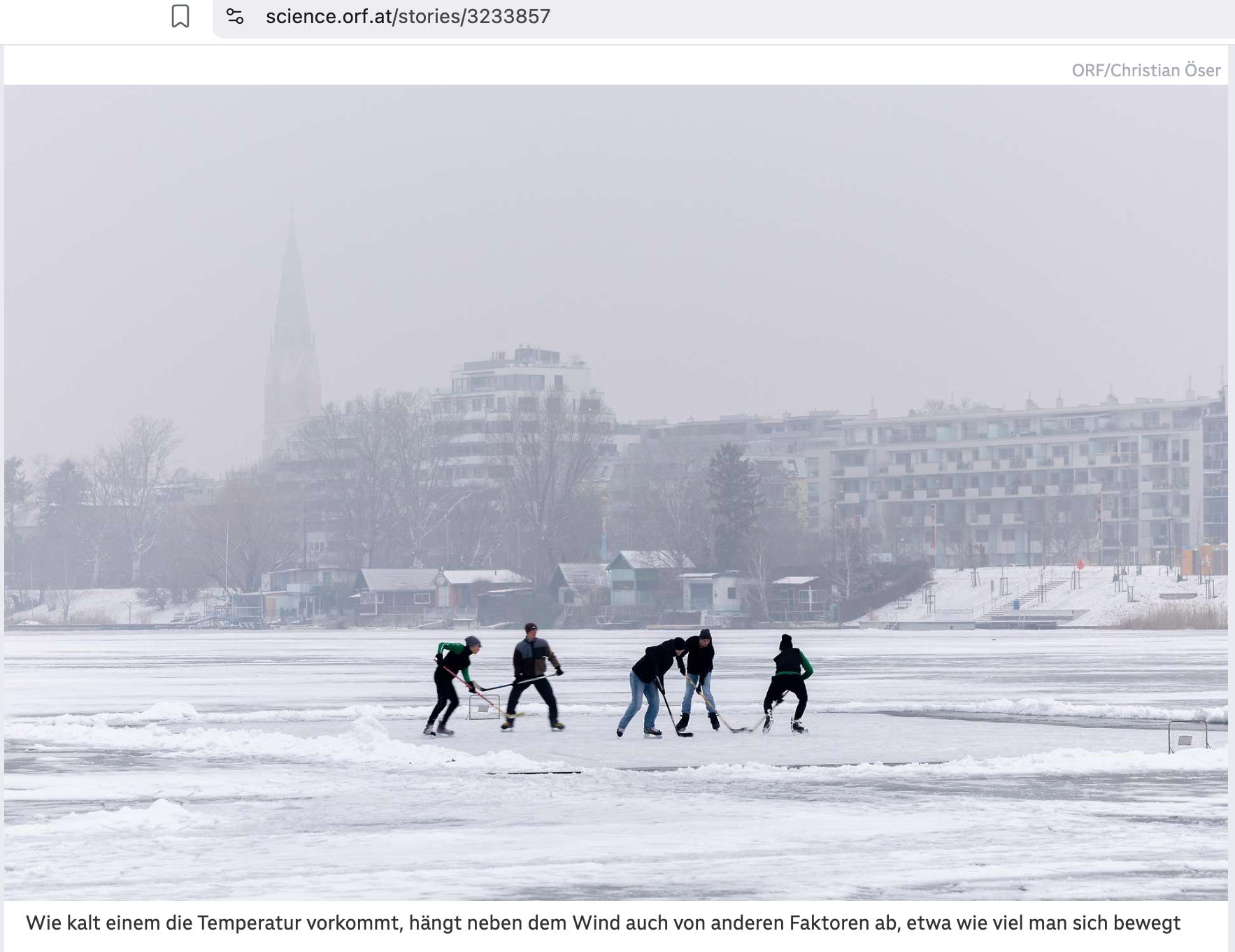
[caption] How cold a temperature feels depends not only on the wind but also on other factors, such as how much you move [on top of that, but do use the above-related formula and perhaps you feel a tad less stupid?].
Individual Comfort Can Vary [do tell]
Gerighausen recommends keeping an eye on the perceived temperature, especially when participating in winter sports in the mountains, and adjusting your equipment accordingly [humans have never done so in the past, hence this is top-notch expert™ advice]. However, the values provided by weather services are averages. How cold the weather conditions actually feel depends on individual comfort and physical condition, Gerighausen emphasises [too bad all that is nonsense, eh?].
Incidentally, humidity plays hardly any role in temperature perception in winter, says the meteorologist [well, if it’s very cold, the odds of extra-low humidity are high: high-school physics tells us that]. At cold temperatures, the air can hardly hold any water anyway. In summer, on the other hand, humidity, along with the intensity of the sun’s radiation and the wind, is one of the main factors in how hot the weather feels. Then the rule is: the higher the humidity, the more people suffer from the heat.
Bottom Lines
If your brain hasn’t melted away by now, you might wish to follow-up on the summer heat wave aspect (we’re all gonna die!) by checking out what the very same state agit-prop peddlers meteorologists have done here in Norway a few years ago:

And the same shenanigans have been done with respect to (drum roll):

Quality Journalism™ and Scientism™ have their price, obviously.
Hence, we’ll conclude with a few lines from the WEF’s ‘climate anxiety’ website I mentioned before:
The fear of our once relatively stable climate breaking down is threatening people’s emotional and mental well-being all around the world.
In the largest survey of climate anxiety, conducted in 2022, climate anxiety was associated with negative mental well-being in 31 out of 32 countries. In a 2021 survey of 10,000 sixteen-to-twenty-five-year-olds spanning ten nations, three-quarters of respondents affirmed that “the future is frightening,” and a majority agreed that “humanity is doomed” [I’m no psychiatrist or psychologist, but isn’t ‘affirming’ someone’s negative emotions a kind of ‘no-go’ in therapy?].
For more of this nonsense, please see this piece:

Morons, all of them.
The IgNobel prize came to be for a good reason.