
The German Question Morphs into the EUropean One
'Nie wieder must be a contribution to European peace. So we must rearm.' ∽ Franziska Brantner at Oxford U, 14 May 2026

Before you read on, consider taking a look at this piece from two years ago:

In it, there’s this revelatory notion: the TU Dortmund’s researchers asked ‘which party do you think journalists are most likely to support in the Bundestag’?—And ‘45% of polled journalists declared that they presume their fellow journalists lean towards the Greens’.
Translation, emphases, and [snark] mine.
Why the Greens Want to ‘Limit’ the ‘Unpredictable Germany of 2035’ in Advance
At Oxford University, the Green Party leader spoke of growing unease in Europe about German rearmament—also in light of the AfD. From this, Brantner derives far-reaching demands for the Germany of tomorrow.
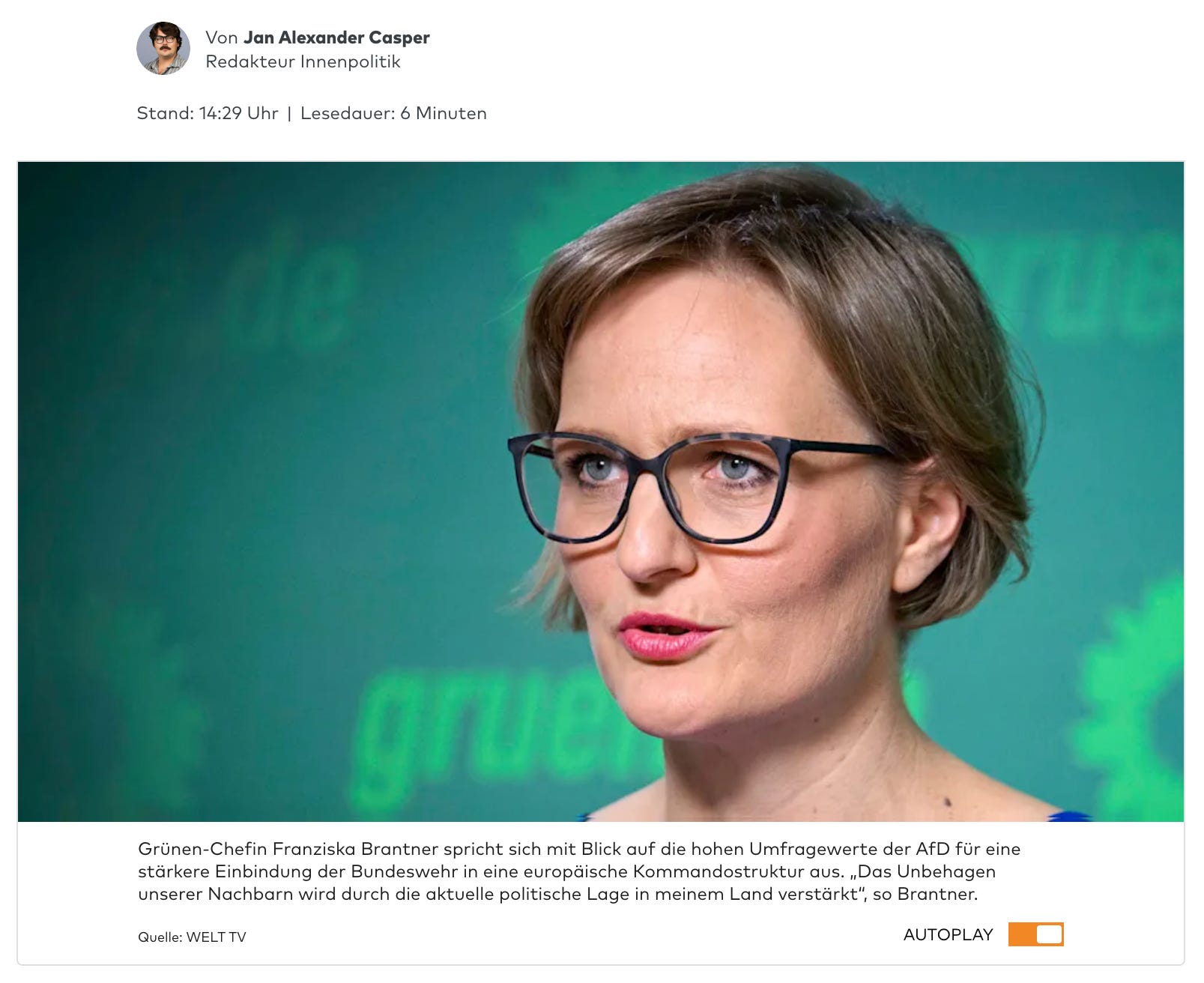
By Jan Alexander Casper, Die Welt, 15 May 2026 [source; archived]
Could the AfD one day control the Bundeswehr—and what would that mean? Both Green Party leaders commented on this this week: Felix Banaszak spontaneously and unprepared on YouTuber Tilo Jung’s show, suggested ‘desertion’ as a possible course of action for soldiers in such a case [needless to say, Mr. Banaszak, born in 1989, did ‘civil service’ instead of military service and is thus uniquely qualified to comment on that stuff (see his Wikipedia profile; and here’s a write-up of that kerfuffle in the Merkur]: ‘In the very long conversation’, Banaszak told Die Welt, ‘it was about a hypothetical scenario, and my response to it was emotionally charged’. His statement should not be misunderstood as ‘a call to action’. However, he added that the idea that ‘right-wing extremists could gain political responsibility over security agencies or the Bundeswehr’ deeply worries him [setting aside the ideological blinders for a moment, the unresolved tension of Germans after 1945/89 comes to the fore: who to be loyal to, the people (which one?), the state (if in doubt), whoever runs™ the gov’t (of, by, and for the people, right?), or the small, if excessively loud nutjobs on the one end of the political spectrum (the Greens’ desire)].
The same applies to Franziska Brantner [who also didn’t serve because she’s a woman; fun factoid: one may change his or her legal gender™ once a year in Germany, but such a male-to-female switch would not keep a ‘Trans woman’ from being conscripted if push came to shove (he would be possibly excluded from serving with a gun on mental health grounds, but I suspect that’s a different issue)]. A lecture given by the Green Party co-leader Franziska Brantner on Thursday evening at Oxford University in England [event] revolved around the question of what it means—especially for Germany’s European neighbours—that Germany is investing hundreds of billions in rearmament while the AfD leads the polls. She also came to Oxford ‘to say things that are difficult to say to my fellow Germans on German soil’, according to her 19-page speech manuscript, which Die Welt has obtained [you see, this is a magnificent piece of cantankerous journo-dom™: Mr. Casper ‘obtained’ Ms. Brantner’s notes—which are found online at her website (but I’m unable to confirm that this is what she actually said; moreover, I’m going out here on a limb noting the following:
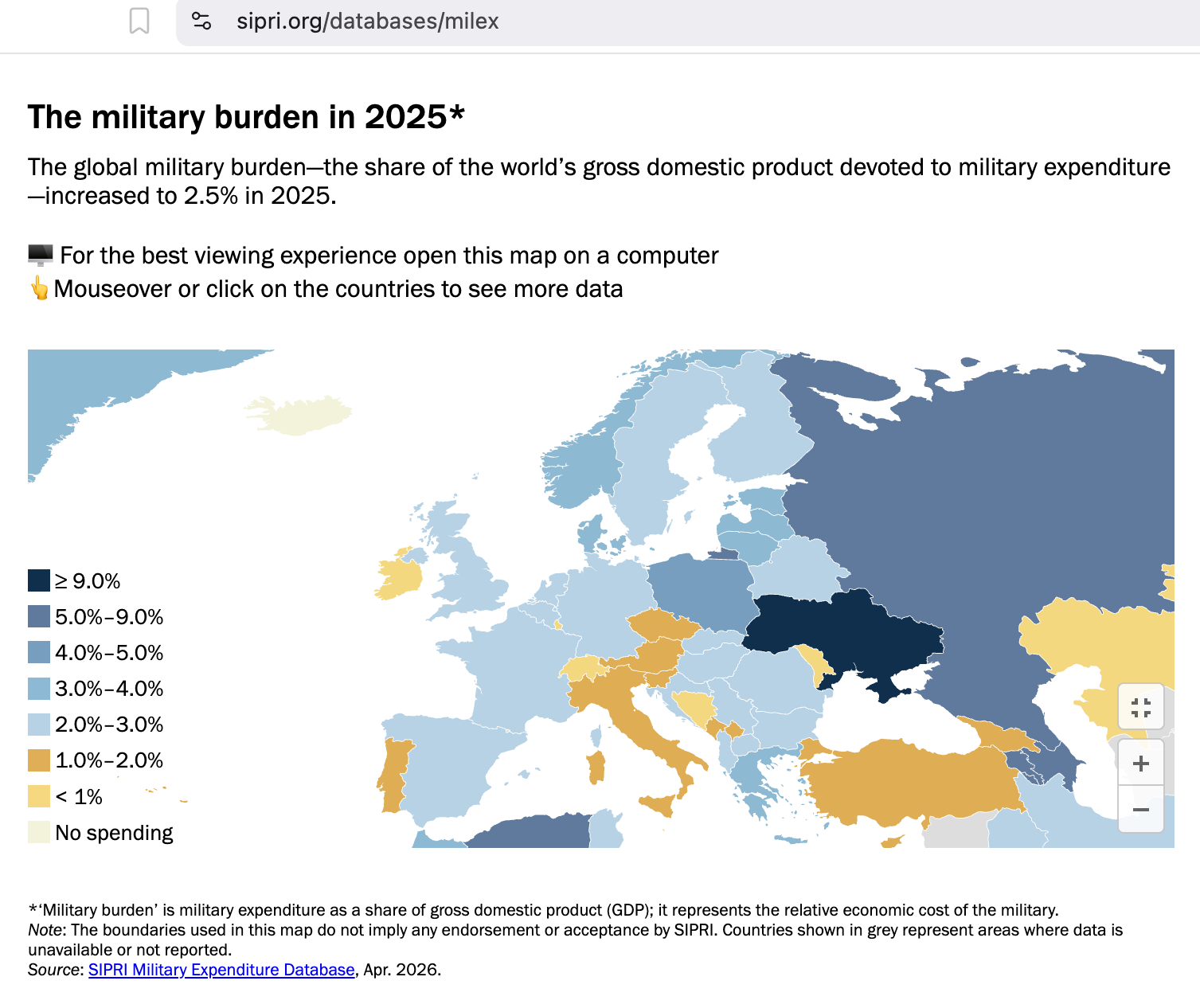
Poland spends about twice (4.5%) as much as Germany (2.3%) expressed in terms of military spending as share of GDP, while Denmark (3.3%), too, spends more; the US (3.1%) isn’t that far ahead. Note that Algeria (8.8%) is way ahead of that curve and likely a yuuuuuuuge threat to its neighbours—and what to say about Israel’s defence (sic) spending (7.8%)? Better not talk ‘bout these things, I suppose.]
Franziska Brantner on ‘The Burden of Self-Defence’
Brantner delivered the lecture at the invitation of historian Timothy Garton Ash. He is a Fellow Emeritus at the European Studies Centre of St. Anthony’s College, where Brantner spoke and where she spent part of her studies. She returned there for the so-called ‘Annual Lecture’. Previous speakers have included Tony Blair and Recep Tayyip Erdoğan. The only Germans on the list of previous speakers so far are: Joschka Fischer of the Green Party, historian Jürgen Kocka, Wolfgang Schäuble (CDU), and Sigmar Gabriel (SPD) [let’s not mince words here either: Ms. Brantner did a lot of very interesting things in her career, incl. a year working for the (Green Party) Heinrich Böll Foundation in Tel Aviv, some time in Washington, D.C., studied at Columbia School of Int’l and Public Affairs—and that was before Ms. Brantner did the following for her Ph.D. dissertation:
In 2010 she received her doctorate from the University of Mannheim with a thesis for which she conducted an interview with John Bolton[2] on the reformability of political institutions using the United Nations as an example.
While I’m supremely tempted to obtain said dissertation and read it, I’ll note that Ms. Brantner is also a Trustee of the European Council of Foreign Relations (as if that surprised anyone), served on the board of the Jacques Delors Institute (until 2023), and is a member of several other pro-EU think tanks, NGOs, and the like; as an aside, her Party co-chair, Mr. Banaszak, is more open about his affiliation as a member of the German Bundestag’s Deutsch-Israelischen Parlamentariergruppe, or German-Israeli MPs’ Group, though I doubt that his views differ from those of Ms. Brantner on that issue]
Brantner chose a dramatic premise: ‘The Lonelier Continent: Europe and the Burden of its Own Defence’ was the title of her presentation. ‘The deserted continent’ and ‘the burden of its own defence’ would be the better translation [notes Mr. Casper, though the original wording chosen by Ms. Brantner intimates the first reading as the more correct one; as an aside, albeit an irritating one, is that the calendar entry for the same event gives the title of her intervention as ‘Reinventing liberalism: Europe’s project of freedom in an age of crisis’, which transpired on 14 May 2026 at 5 p.m. local time—and I’m unsure what Ms. Brantner actually spoke about].
Her premise was this: the 70-year period in which ‘Never again’ after Auschwitz served as the guiding principle for Germany’s correspondingly extremely cautious foreign policy, and especially its defense policy, is over. ‘It doesn’t end’, Brantner stated, ‘because we have changed our stance, but because the world around us has changed.’
The old ‘never again’—Germany’s reference to its NATO allies on military matters—is ‘no longer compatible with “never again” in its deepest meaning, namely the commitment that the catastrophes of the 20th century must not be allowed to repeat themselves on this continent.’ Restraint in military matters for Germany, ‘in the face of an aggressive, nuclear-armed Russia and an unreliable America, is no longer a contribution to European peace’, but rather an ‘obstacle’ to its preservation [note that these passages are Mr. Casper’s rendering of what Ms. Brantner may or may not have said on 14 May 2026 at Oxford; for your convenience, I’m reproducing these passages in the footnote1].
Therefore, rearmament is necessary, Brantner concludes, unsurprisingly; her party was instrumental in making the current exemption for armaments under the 2025 debt brake possible. What most in the room likely already knew, and what she doesn’t explicitly state, is that Chancellor Friedrich Merz (CDU) wants to make the Bundeswehr the ‘strongest conventional army in Europe’ [yeah, too bad that in doing so, Berlin is violating a crucial part of its foundational charter, the 2+4 Treaty, which is—surprise, surprise—absent from Ms. Brantner’s remarks or polite discussions in Germany].
What ‘almost no one’ in Germany is saying openly, according to Brantner, is this:
Our neighbours are watching this rearmament with great concern. And most of us in Germany aren’t even aware of it.
While Europeans are certainly relieved that Germany is now fulfilling its defence responsibilities more effectively, ‘behind this relief, these same partners who welcome a stronger Bundeswehr also harbour feelings they don’t voice out of politeness: a quiet, persistent, historically rooted unease at the prospect of a continent where Germany is once again the dominant military power by a considerable margin’.
This unease is expressed more loudly in Poland, but also, albeit less so, in ‘Prague, Paris, The Hague, Athens’, and Great Britain. It is the memory of the war of annihilation that originated in Germany that is being voiced here, Brantner believes [the key word here is ‘believes’, for surely Ms. Brantner is entitled to her own stupidity, albeit she may be abusing that privilege here quite a bit].
The AfD’s success in the polls has exacerbated this. ‘The unease of our neighbours’, said the Green Party leader, ‘is being amplified by the current political situation in my country. The Alternative for Germany is currently leading our national polls.’ [fun factoid, albeit one that one must never speak about in polite society: while I don’t claim to have undertaken a lot of enquiries about the origins and funding of the AfD, I note that in 2019, the Alternative for Germany was the only political party in Germany that expressed its unconditional support for Israel’s refusal to accept a Palestinian state, as the party’s German Wikipedia entry notes].
While the ‘most likely course of action’ for a government led by the AfD would currently be ‘ironically more a policy of appeasement towards Moscow than an aggressive deployment of German military power’, Ms Brantner continued:
The planning horizon of the new German military strategy extends to 2035. No one in this room would seriously attempt to predict German politics in 2035. The new Bundeswehr we are building today will be inherited by political coalitions we don’t yet know, under geopolitical conditions we cannot yet foresee.
This, according to Brantner, should give every German pause for thought:
And the fact that most of us don’t feel this way today is in itself a danger.
[I’ll briefly note that Ms. Brantner accepts the fact that the future is fundamentally un-known—followed by her ‘feeling’ that this is ‘itself a danger’. Being of German mother-tongue myself, I do note the absence of correct rules and guidelines for the future as, of course, deeply troubling etc., but I’m very much in disagreement on letting myself be guided my ‘feelies’ about stuff in ten years.]
What conclusion does Brantner draw from this? The ‘never again’ phase, she says, must now be followed by one of ‘never again alone’. This means: ‘of course’, Germany must have national armed forces. However, there is a significant caveat. The ‘major decisions’, according to Brantner—‘what is built, what is deployed, where it is sent, under whose command, and for what purpose’—must be made ‘jointly, within structures and binding frameworks, together with allies who have a genuine say and are not merely consulted out of courtesy’. ‘We’, meaning Germany, must ‘propose corresponding concrete mechanisms ourselves before our neighbours feel they have to demand them of us’. [Germany should afford its neighbours and whomever else ‘a genuine say’ in its own national interests, thereby giving Germany’s neighbours something that is denied to ordinary Germans: make it make sense].
For this reason, firstly, Germany must not succumb to the temptation of channeling its billions in defence spending solely into its own arms industry for the purpose of economic stimulus. Instead, these funds must also serve the ‘integration’ with the arms industries of France, Poland, Italy, Sweden, and Great Britain [the Green party hack Brantner is calling for a public-private partnership across borders with transnational funding decisions with Germany’s ‘public’ appropriations going to ‘partners’, some of whom, like the UK, aren’t even (sic) EU member-states, technically speaking: I suppose that the WEF is cheering Ms. Brantner on].
Secondly, Germany must not strive to develop all weapons systems itself but must also procure them within Europe.
Thirdly, Brantner demands—here her AfD motives resonate again—that Germany must ‘impose limits on itself in advance’. ‘Never again alone’ therefore means
integrating the new German armed forces into multinational structures that cannot simply be dissolved by a future government in Berlin—whose orientation is still unknown. Permanent multinational corps. Integrated air defence. Pooled strategic capabilities. Forward deployments in the east that represent commitments, not mere gestures.
The point is that
the Germany of 2026—with a clear vision, aware of its history, conscious of its own political fragility—imposes limits in advance on the unpredictable Germany of 2035. We should welcome these limits. We should propose them ourselves.
And ‘fourthly—and most critically’, Brantner argues, ‘never again alone’ must be extended to include ‘nuclear deterrence’. The discussion about extending British and French nuclear protection eastward is ‘long overdue’ [fun factoid: the Greens once were a political faction opposed to nukes, and let’s not get into the weeds of being pro-nuclear weapons but against nuclear power plants while we’re pondering the whole ‘bend them swords into ploughshares’ notion].
‘Never again alone’, Brantner explains in her concluding remarks, means, in short, preserving the ‘deepest meaning’ of ‘never again’—preventing wars of annihilation within Europe—for a time when the German military restraint previously required under this concept would be considered irresponsible. In short, it means: massive rearmament without alarming neighbours through a voluntary commitment to integration.
Bottom Lines
If your head hurts, well, misery loves company.
Here’s an excerpt from Ms. Brantner’s talk:
I recently read — and many of you will have seen it — Helena Rosenblatt’s book The Lost History of Liberalism. Rosenblatt’s argument is that the political tradition we now call liberalism was not, in its origins, the Anglo-American doctrine of individual rights and free markets that we have come to associate it with. It was, for most of its existence, a continental tradition — French, German, Swiss, Italian — preoccupied with civic virtue, with duties to the community, with the moral and educational formation of citizens capable of self-government. The word “liberal” itself, in its modern political sense, was coined in the early nineteenth century not in London or Boston but in Paris and Madrid and Berlin. The liberalism of Constant, of Tocqueville, of Guizot, of the German Rechtsstaat tradition was not principally about getting government off the citizen’s back. It was about making citizens fit to bear the freedom they had won…
A strong Europe is not the end of the project. It is the platform from which the next project begins: building coalitions, around the world, with everyone who shares a stake in the civic conception of freedom this lecture has tried to describe. A continent that has rebuilt its own defence, recovered its own confidence, and remembered its own intellectual tradition is a continent that has something to offer such coalitions — and an obligation to seek them out. The post-American world is not a world in which Europe replaces America as a single guarantor. It is a world in which guarantee itself has to become plural.
Lofty words, indeed, very much removed from reality.
But they fit very well with the chattering classes subservient to the masters of mankind.
Ms. Brantner closes thus:
The French philosopher Élisabeth Badinter has spent a lifetime insisting that the Enlightenment is not a period of history but a project — not something we inherit, finished, from the eighteenth century, but something each generation must take up, defend, and carry forward, or watch erode. She is right. The Enlightenment is a project. Liberalism is a project. Europe is a project. Freedom, in the civic sense in which Rosenblatt and Arendt understood it, is a project. None of these things can be possessed. All of them must be practised.
We have, on this continent, in this hour, been handed the practice. May we prove worthy of it.
This is to absurd, it boggles the mind—and the most important take-away is that these inane phrases are stitched together in ways that beg the question: a motley assembly of set-pieces don’t make for an argument, let alone a coherent view.
I suspect that the coming decade will see the fracturing of these notions, if only because they were never a coherent whole. All that these lackeys of empire give us are more or less empty phrases, which boil down to this:
Rearmament is peace.
Slavery to the state is freedom.
Nuclear deterrence is good, nuclear energy is bad.
Let’s not forget the 2-minute hate vs. ze Rooskies, perhaps the one thing that has the potential to both unite the European peoples and drag in the Americans.
To our American frenemies, don’t be sad; Europeans also hate you, but they know you’re the conqueror of 81 years ago, and you may still have some use in the afore-mentioned case.
Realpolitik never went away after 1945; it merely lay dormant as the politicos™, experts™, and planners™ changed their shirts and hats in spring of 1945 and continued as before.
Further reading includes:

Plus ça change, plus c'est la même chose.
From Ms. Brantner’s website:
The lack of historical acumen Chancellor Merz showed in the way he spoke about German military power — and, of all weeks, in the week of the eighth of May, without sparing a thought for what those words mean and still mean in the collective memory of this continent — is, at best, surprising. I was born on the border between Germany and France. I am a child of the Franco-German reconciliation project, and I find myself wondering how quickly my fellow citizens “forget” the scars that German imperialism and Nazism have left all over Europe. Those words have meant Verdun and the Somme. They have meant Warsaw and Coventry, Lidice and Rotterdam. They have meant Auschwitz. The post-war German republic — and I say this with the gratitude of someone whose entire adult life has been lived under its protection — was constructed precisely on the recognition that this should, and could, never happen again. Nie wieder. The simplest and most powerful two words in modern German political language. Never again.
For the past seventy years, nie wieder has meant restraint. To this day it implies a constitutional reluctance to use force. It has meant the deliberate cultivation of a strategic culture so cautious that it sometimes infuriated our allies. It has meant deferring, on hard questions of military power, to Washington, to Paris and to London. That restraint, embedded first in NATO and then in the European Union, is a foundational achievement of the post-war order. It was the price we had to pay to be admitted into a community of nations that had every reason to be wary of us.
But nie wieder in that form — restraint, deferral, a smaller army than circumstance demanded — is no longer the nie wieder that today’s world requires. Today’s nie wieder must be, in its deepest form, Germany’s commitment that the catastrophes of the twentieth century shall never return to this continent. Restraint, in the face of an aggressive nuclear-armed Russia and an unreliable America, is a misinterpretation of nie wieder. It risks no longer being a contribution to European peace. It risks becoming a subtraction from it.
Nie wieder must be a contribution to European peace.
So we must rearm. The question is not whether, but how. And the how is, in the most serious sense, a question about German self-understanding.
The most revealing part of all of this is exact wording used. Watch how they frame the country based on how useful it is for them to show an all-of-a-sudden bout of "patriotic" utterances ("My country ...")
This exact phrasing is usually not used unless it fits their narrative.
What happened to no borders, no nations?
Must be a special case of selective Alzheimer's.
The ur-typical position of a modern liberal progressive:
Anti-nuclear power but pro-nuclear weapons. Someone else's weapons, at someone else's cost.
"Someone else" could be said to be the core feature of such a person.
Tangent: Algeria had a weak military, has internal potential problems, and borders several regions with problems or low-key warfare. And it is not out of the question to suspect Algeria is preparing for a potential future where European nations fed up with the invading peoples try to shovel said people back to their points of departure.
Better have a military making it possible to say "No!" instead of being forced to accept millions of undesriables from foreign nations.