
Immigration Failure: Norway Reports Migrants' Fertility Rates Now Lower Than That of Norwegians
'In 2025, the fertility rate among immigrant women was 1.44, which was lower than the overall fertility rate in Norway for the first time.' ∽ Karstein Sørlien, Statistics Norway, 12 March 2026

About a year ago, we discussed at-length what the Norwegian gov’t was doing in regard to declining birth rates: they appointed a blue-ribbon Birth Rate Committee, or fødselstallutvalg. Here are some of their core findings:
Norwegian family policies provide incentives to postpone family formation: 40 per cent of young men and over 60 per cent of young women pursue higher education, and they will receive significantly better compensated leave if they postpone childbearing…
In the short term—in demography, one generation—fewer children will allow the welfare state to save money because fewer attend kindergarten and school. In the medium term, when today’s children are fully grown adults, the declining birth rates of today will lead to fewer and older people in work, and a smaller population. Institutions must shift from supporting families with children to caring for the elderly, which can result in fragmentation of the institutional support for families with children.
Please read the rest here:

And then there is the forecast by Statistics Norway, which is updated regularly, and back in June 2026, this is what I found:
SSB’s forecasts indicated that fertility will ‘rise again to 1.57 in 2030 and stabilise at 1.66 in the longer term’—this is how NRK closes its piece [dated 3 May 2025, asking™ ‘why do we have so few children?’; archived].
What they don’t tell you is that these were prognostications related to ‘high net immigration’. In the ‘low net immigration’ scenarios, fertility rates decline to 1.22 in 2030 and remain at this level (which I personally doubt as this appears implausible given that fewer and older parents beget fewer children who, in turn, will have even fewer offspring).
Hence, today we’ll look at how fertility has changed since then; tomorrow, I’ll go through the Birth Rate Committee’s main report (which, if you’re interested, may look up for yourself here).
As always, translations of non-English content, emphases, and [snark] mine.
Birth Rates Increased in 2025
The number of births continued to increase in 2025. Preliminary figures show that 55,847 children were born in Norway last year. The largest increase was observed in Southern and Eastern Norway and in Northern Norway.
Via the Institute of Public Health, 22 Jan. 2026 [source; archived]
There was an increase in births of 2.5 per cent in Norway in 2025 compared to 2024.
The increase in births we saw in 2023 continued in 2024, and figures from the Medical Birth Register show that birth rates in Norway will also increase in 2025.
‘The increase was greatest in Northern Norway and Southern Norway, but the number of births also increased in Central Norway and Western Norway’, says Senior Consultant Liv Cecilie Vestrheim Thomsen at the Medical Birth Register at the National Institute of Public Health
In Northern Norway, birth numbers increased by 4.6 per cent, while in Southern Norway they increased by 2.9 per cent. In Western Norway and Central Norway, 1.5 and 1.6 per cent more children were born in 2025 than in 2024, respectively.
Ullevål Hospital: Large Increase, Most Births in Norway
A full 31 of the 43 maternity institutions in Norway had increasing birth numbers this year.
Of the maternity institutions in Norway with more than 3,000 births, Ullevål Hospital at Oslo University Hospital has the largest increase [easy to do so in the capital’s metro area], explains Liv Cecilie Vestrheim Thomsen at the Medical Birth Register at the Norwegian Institute of Public Health:
At Ullevål Hospital, an average of 1 extra child was born per day last year, and thus 6 per cent more children in 2025 compared to figures from 2024. We also see a relatively large increase in birth rates at many hospitals, and from 2024 to 2025 the number of births increased by over 13 per cent at several of the smaller maternity institutions such as Kongsberg, Narvik, Sandnessjøen and Voss.
Intermission: Whose Births are Going Up?
At this point, it might be a good idea to revisit some of my reporting from yesteryear, specifically, the notion of birth rate increases in Northern Norway, long the country’s fastest-shrinking region.
Here’s how the gov’t managed to get these awesome results™:
Companies pay no employer’s national insurance contributions (regular rate would be 14.1% of the salary per full-time equivalent)
Write-down of student loans by up to 20% of the original loan amount, limited to a maximum of NOK 30,000 per year (plus 20K more if you’re a primary school teacher)
Additional savings on taxes levied on electricity consumption
The tax on general income is 22% in 2024, in the measures zone it is 18.5%
You don't pay for a kindergarten place [other taxpayers pay]
Yet, for reasons totally unknown™, the only reason the resident population went up is (drum roll) ‘population increased by 1,064 people in the entire measures zone. During the same period, the municipalities in Nord-Troms and Finnmark settled 1,017 refugees’. There you have it: if it weren’t for refugees settled there by the gov’t, there’d be 47 (!) people who’d be attracted by the above-listed measures.
See this NRK piece for the source (archived), dated 25 Feb. 2024, and the below-linked content for the full translation:

Yet, there is something else to consider in all these notions, which is the stuff no-one wants to talk about—and that’s who’s getting children and who isn’t.
We briefly alluded to this conundrum—really: expertdom’s eternal bafflement—above, yet there are indications here and there that provide a few glimpses:
Births in Austria have continued to decline. This is shown in the study ‘Familien in Zahlen’ [trans. ‘Families in Figures’, the annual report for 2025 by the Austrian Institute for Family Studies at the U of Vienna; text in German only], published today by the Federal Chancellery. According to the study, there were only 77,238 births in 2024, which is about 370 fewer than the number in 2023. The historical low was in 2001 with 75,458 births.
Nevertheless, the trend has been downward in recent years. Accordingly, the fertility rates have also continued to fall. While it was 1.44 in 2023, it dropped to 1.31 last year. The rate for Austrian women, at 1.22, is significantly lower than that of mothers with foreign citizenship, at 1.58.
In this briefest of all paragraphs, a bombshell admission™ lurks: remember that we were propagandised for decades that an ageing society must have mass immigration to stave off catastrophe—looks like, as per official gov’t data, this ain’t gonna happen.
For a long-form discussion of these issues, please see the below-linked piece:

For right now, we’ll move on to corroborating official data from Norway.
Fertility Continues to Increase
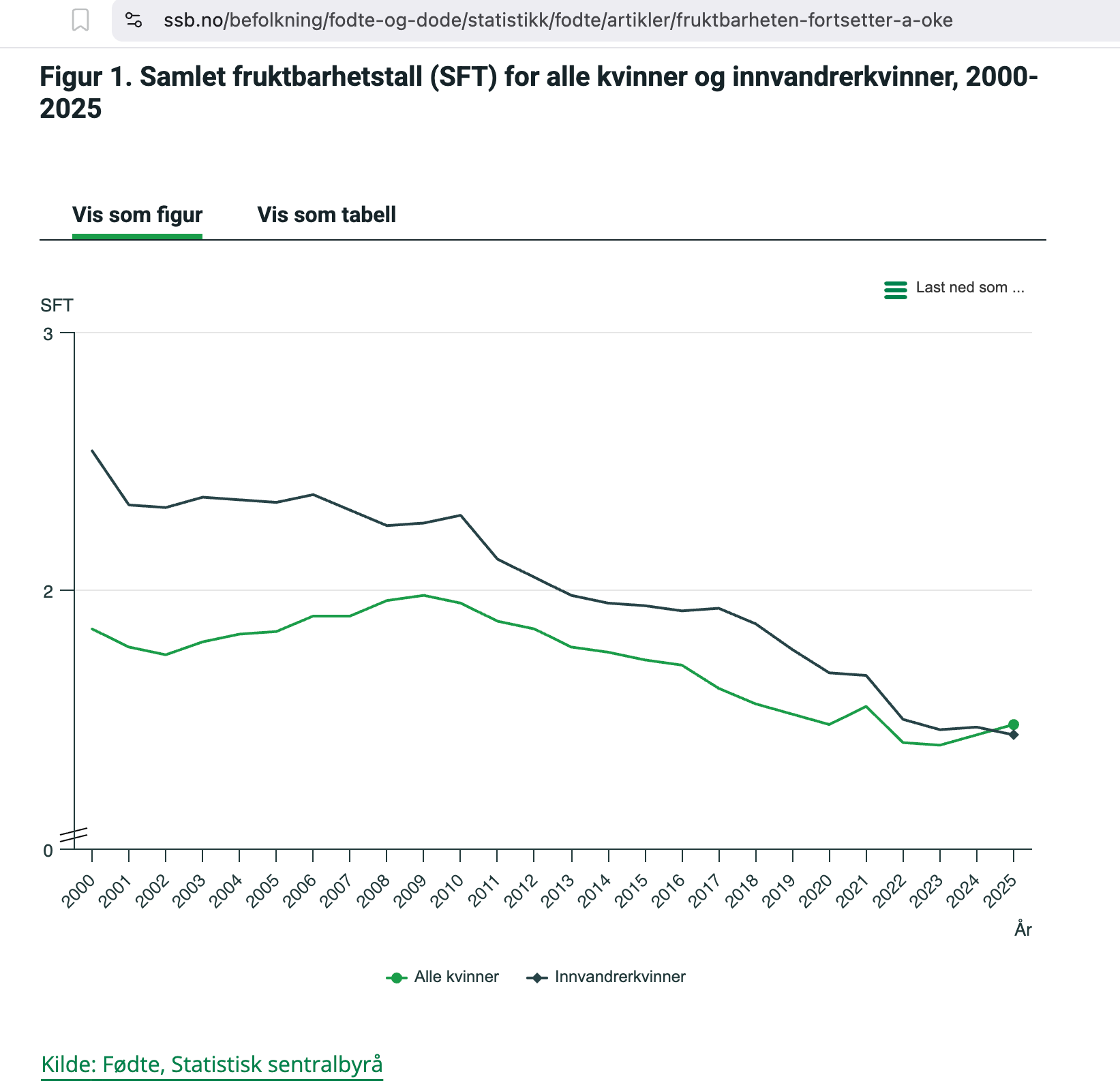
The total fertility rate (TFR) increased to 1.48 children per woman in 2025, an increase from 1.44 the previous year.
By Karstein Sørlien, Statistics Norway, 12 March 2026 [source; archived]
There were 55,400 children born in Norway in 2025, which was 1,400 more than the previous year, new figures from the birth statistics show.
Based on the total number of births, Statistics Norway calculates the total fertility rate (TFR). After three years of growth, it now stands at 1.48, but this is still low in a historical perspective.
‘It was particularly women aged 30–34 who contributed to last year’s increase, while fertility was relatively stable for the other age groups’, says Espen Andersen, senior adviser at Statistics Norway.
Since 2009, first-time mothers have been getting older, but in 2025 this trend stopped [gee, I wonder as to why™ that might be: biology, by chance?]. The average age of mothers at first birth remained at 30.4 years, just like the previous year. The age of first-time fathers was also unchanged from the previous year, with an average of 32.3 years [setting aside mistaking the weather (one year) for the climate (the trend), if true, that would be quite a thing, eh? As always, I doubt these claims will be borne out by events, but it’s certainly too soon to tell …].
Immigrant Women Pull Down the Fertility Rate
Fertility has long been higher among women who have immigrated to Norway than among women elsewhere, but the difference has gradually decreased in recent years. In 2025, the fertility rate among immigrant women was 1.44, which was lower than the overall fertility rate in Norway for the first time. Among Norwegian-born women with immigrant parents, the figure was 1.40. If these two groups are excluded from the calculation, the TFR would have been 1.51 [oh, would you look at this—corroboration of the data from the Statistics Austria: how ‘bout that ‘mass immigration must be because of labour shortages’ argument now?].
The large decline in fertility among immigrant women in recent years is particularly related to the large immigration from Ukraine. There are big differences between different groups: Ukrainian women had a fertility rate of 0.88 last year, while women from Syria and Eritrea had 2.34 and 2.81, respectively. Thus Andersen:
Fertility among immigrant women has been declining for several years, and in 2025 it was lower than among the rest of the population for the first time. The decline is mainly due to Ukrainian women giving birth to few children, but also to the fact that fertility is generally declining among immigrant women.
Almost Six out of Ten 30-year-olds are Childless
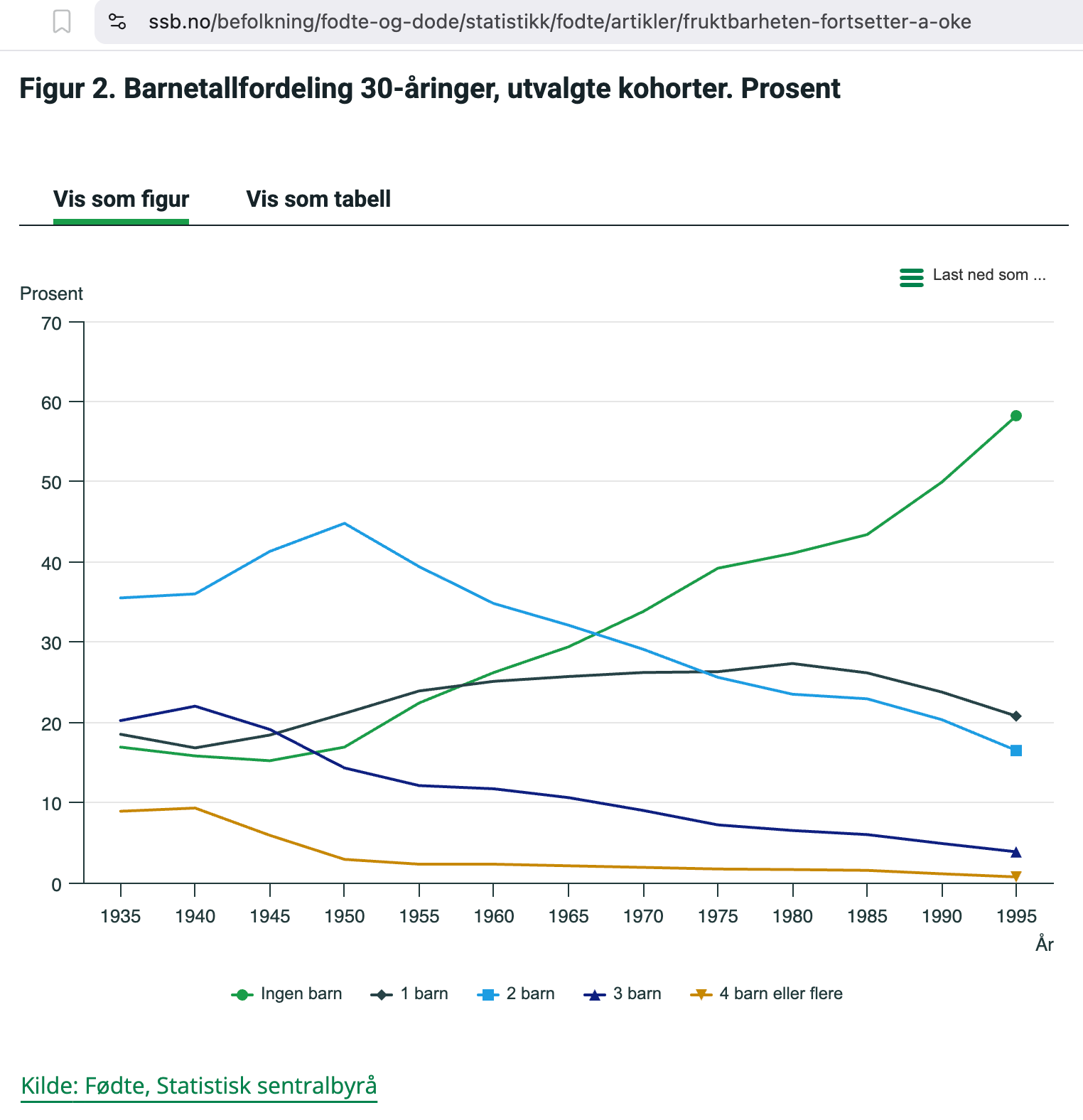
TFR provide a picture of birth rates as they looked last year. Another way to measure fertility is to look at how many children different cohorts have actually had. Among women who turned 30 in 2025—i.e., the 1995 cohort—58 per cent had not yet had children. Ten years ago, the corresponding proportion was 43 per cent. Andersen:
When so many 30-year-olds are still childless, it is unlikely that today’s women will have as many children as previous generations. Although this group is having more children after the age of 30 than was common before.
Bottom Lines
The trends are clearly visible, the writing is on the wall.
There is very little, if not (less than) zero indication that the trend of childless women—now at around 60% for women aged 30 in Norway—will slow down.
If the above official data isn’t an indictment of what the Birth Rate Commission had pointed out, I don’t know what is (or could be, for that matter).
We have seen, specifically, that increased welfare statism in the form of massive subsidies—and herein, Northern Norway’s otherwise depopulating special economic zone—serve as a kind of natural experiment: despite massive tax breaks and transfer payments, as well as settling the one population group that’s specifically mentioned in the Statistics Norway piece (Ukrainians) up north, gov’t policies fail to show results beyond the short term.
In the medium term, when today’s children are fully grown adults, the declining birth rates of today will lead to fewer and older people in work, and a smaller population. Institutions must shift from supporting families with children to caring for the elderly, which can result in fragmentation of the institutional support for families with children.
If this weren’t all too stupid, it’s basically obvious for everyone with more than one functioning brain cell to consider:
welfare statism is failing, hence we must change
if we change to keep welfare statism in place, we’ll alienate the remaining families
if families are alienated, support for welfare statism will end, for the simple reason that there’s no future
I know that, as per Keynes, ‘in the long run, we’re all dead’, but this is a recipe for medium-term disaster. The above quote is from the top-linked piece.
I’ll leave you with the conclusions I wrote on 31 Dec. 2025 from this posting:
Once one places birth and fertility rates (plus, of course, feminism), mass immigration, and welfare statism into the same analytical framework, there are but two conclusions to be drawn that, moreover, can no longer be considered tentative:
whatever specific gov’t measures were taken from the early-to-mid 1970s —and let’s leave out the reasons as to why these were taken; I think this was the case—it is obviously the biggest policy failure in recorded human history (from the point of view of John & Jane Q. Public, that is, not from the powers-that-be and discounting whatever happened before Noah built the ark)
I’m not arguing to totally check out and become apathetic, esp. if you have (grand)children, it is a clarion call to re-take the gov’t that rules you ostensibly in your name and make it work in the favour of the people
Let’s not forget that the majority of foreigners that came to Western countries is rapidly adapting to Western mores (of reproduction), which also calls into question ‘mass remigration’ as a viable policy position (while disregarding, for the time being, pertinent issues if this is logistically possible)—but note that this doesn’t mean that the worst of the worst shouldn’t be put behind bar ASAP (here’s looking at El Salvador).
You might also find this piece worth your time:

Tomorrow, we’ll look at what the gov’t proposes to do™.
The solution is already underway, with Spain leading the charge and Sweden among others opening the door to infinte Indians. I don't know if there's a fancy "Someone's Law"-name for it, but politics when failing always invites doing what doesn't work even more and harder for as long as possible. Just look at Germany's "Energie-elände".
Or Sweden's insane asylum-tax system.
However, lowered reproduction rate among migrants is the interesting thing here. If 2nd gen women also have under 2.0 reproduction numbers and become mothers late, then there is a chance for actual assimilation/integration, and a slow reversion towards normality over time.
The key there would be hammering a wedge between the 2nd and subsequent generations and their home nations (shuttering mosques and ban migrant schools would go a long way towards this, as would forcibly breaking up the ghettos).
But comparing 2025 to 2024 and essentially saying: "Look! Things are shifting for the better because we can see a 0.04 increase!" is embarassing. Why wouldn't the official or the journalist include a graph showing data at twenty-year intervals? Statistics Norway has data from 1905 onwards I'm betting, and could provide a chart showing fertility rates from 1905 to 2025 if asked to. And even better, they could do so while creating a lot of sub-scharts: regional, age, origin, income & education (the dreaded class-concept), the difference between family-lines when it comes to migration to USA in the 1800s vs families with no such migrants, age of fathers, vaccine-status, et cetera.
Heck, they could create an AI-assisted homepage where you simply feed it a search-string and it puts together what it can find from official records:
"No. children per woman, age 20-25 at first births, smokers, compared to same question but non-smokers" for example.
It's a shame people who need data to do their job seem so bent on not creating as comprehensive data-sets as they can.
Brings to mind the Mice Utopia study by Calhoon.
https://www.smithsonianmag.com/smart-news/this-old-experiment-with-mice-led-to-bleak-predictions-for-humanitys-future-180954423/