
EU Opens Accession Negotiations with Moldova, Ukraine
'By bringing our nations closer together, we strengthen peace, security and prosperity across our continent.' ∽ from the EU Commission's bespoke press release, 12 June 2026

This happened on Friday, 12 June 2026, while many were not paying attention due to … I dunno, the world up matches, Mr. Trump’s antics, or whatever
From the EU Commission’s media desk:
All Member States agreed to open the first accession negotiations cluster with Ukraine and Moldova.
At the first Intergovernmental Conference on Monday [15 June 2026], we will open the cluster on fundamentals; the backbone of the accession process.
It covers the core values and principles on which the EU is built, from the rule of law to strong democratic institutions [lol, sure, do see this:
And when you’re done, see this, too:
I suppose democracy™, EU style, is a wee bit different (but to be fair, the statement said ‘democratic institutions’, which, per se, I suppose must not be legitimised by elections or an independent judiciary, but I digress)].
This is a recognition of the determination, courage and hard work shown by both countries in advancing reforms, even in the face of immense challenges.
And a signal that the EU’s offer of peace, stability and opportunity is unmatchable.
Enlargement is a strategic choice.
By bringing our nations closer together, we strengthen peace, security and prosperity across our continent.
In a world marked by growing uncertainty, a larger European Union is in our common interest.
Enlargement remains one of the EU’s greatest success stories and our best investment in our shared future.

At this point, since the EU Commission is double-talking about ‘strategic choice’ and ‘our common interest’, these two pieces may be interesting:


And then there’s tabloid/legacy media rah-portin’ about all of this, and I’ve hand-picked a particular gem from Austrian tabloid Heute, which I’ll provide you with below to round off your Monday morning.
Translation, emphases (as above, so below; pun intended), and [snark] mine.
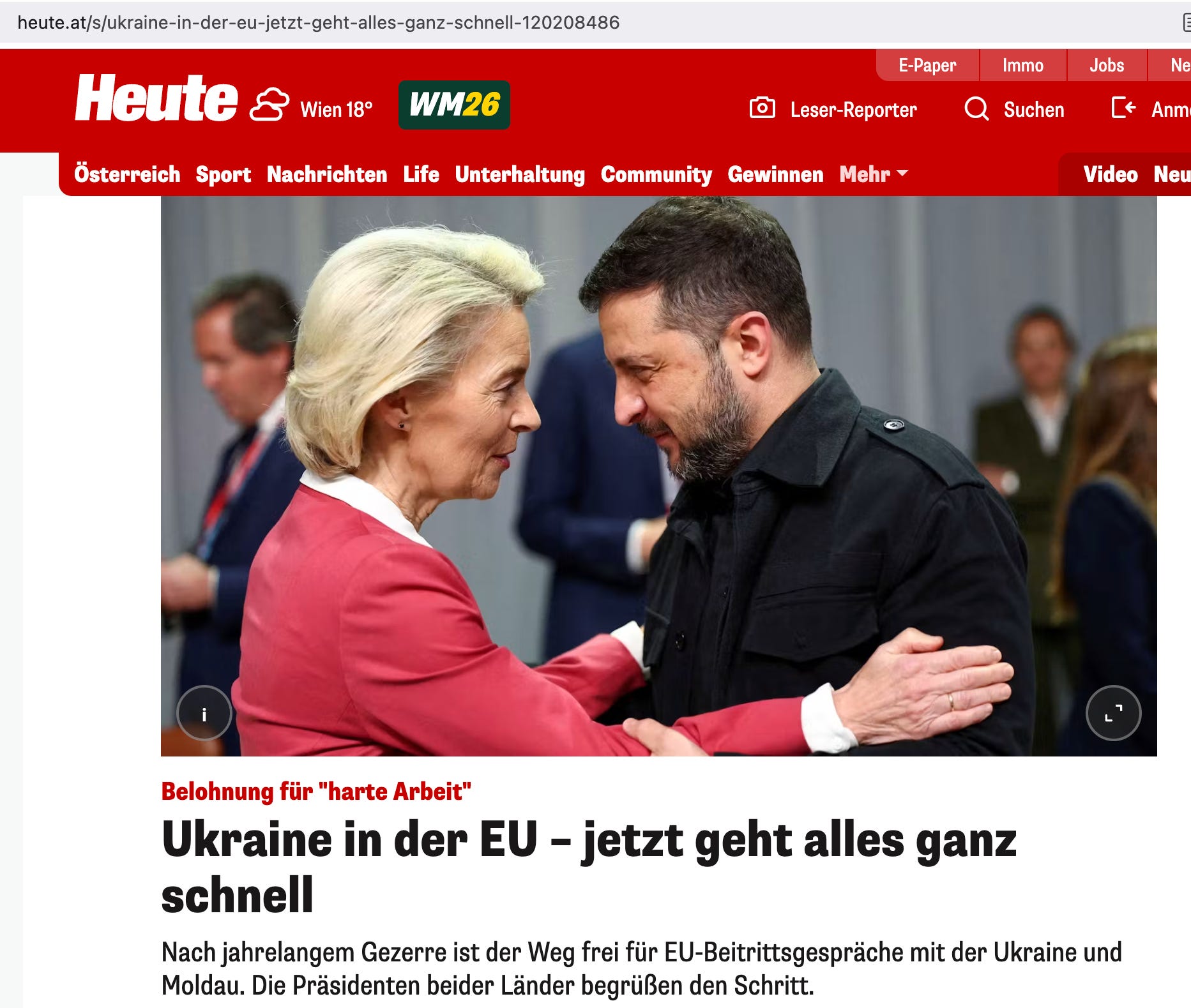
Via Heute.at, 13 June 2026 [source; archived]
Reward for ‘Hard Work’: Ukraine into the EU—Now Everything is Moving Very Fast
After years of wrangling, the path is clear for EU accession talks with Ukraine and Moldova. The presidents of both countries welcome the move [fun factoid: only one of them—Mr. Zelenskyy isn’t meant—actually was (s)elected].
It took more than two years, but now it’s official: the EU will begin its accession talks with Ukraine and Moldova as early as Monday [15 June 2026] This was recently announced by the Cypriot Presidency of the Council.
Hungary Ends its Blockade
According to the announcement, following the end of the Hungarian blockade, the member-states have agreed on a common position regarding the first phase of negotiations, thus completing the necessary preparations.
Only after the change of government in Budapest did the stalled talks begin to move forward. Last week, the new Hungarian Prime Minister, Peter Magyar, announced that an agreement had been reached with Ukraine to strengthen the rights of the Hungarian minority in the west of the country. Budapest had previously made such an agreement a prerequisite for its approval of the EU accession talks.
Here’s What Happens Next
In the upcoming first phase of negotiations—the so-called first cluster—Ukraine must demonstrate, among other things, that its judiciary and public administration meet European Union standards [good luck; given that the Covid shitshow destroyed a lot of what was arguably not perfect but at least better than the nonsense one enjoys now, that’s one aspect of what in EU lingo is called ‘convergence’ (see this incredibly tiring website: there’s beta, sigma, and delta convergence, for instance, and since this is all very, very complicated™, I’m sure a good deal of these criteria will be scrapped and memory-holed to accommodate Moldova and Ukraine—more on this below). The accession process is divided into six thematic clusters with a total of 33 negotiating chapters.
EU accession negotiations are considered a lengthy process and usually last for many years. Moreover, a successful conclusion is by no means guaranteed. Türkiye is a case in point: accession talks with Ankara have been ongoing since 2005, but have been stalled for years due to persistent shortcomings in democracy, the rule of law, and fundamental rights [at least Türkiye has no unresolved territorial conflicts, right?].
Von der Leyen: ‘Recognition of hard work’
‘The start of the first round of accession negotiations is a recognition of the determination, courage, and hard work that both countries have shown in implementing reforms, even in the face of enormous challenges’, declared European Commission President Ursula von der Leyen together with European Council President António Costa. EU enlargement is a ‘strategic decision’, a larger EU is in ‘our common interest … in a world characterised by growing uncertainty’.
Bottom Li(n)es
The people who made these decisions are either deluding themselves or they don’t give a shit.
Even the priors—such as no unresolved territorial issues with neighbours—speak against these notions, in particular as ‘the process can take years’ is meant literally, as well as contingent as EU accession means two things:
all the ‘paperwork’ etc. to join the EU
accompanied by adoption of the Euro thereafter, which brings with it a set of additional criteria
These Maastricht + Copenhagen criteria are summarised quite well in this Wikipedia entry:
The euro convergence criteria (also known as the Maastricht criteria) are the criteria European Union member states are required to meet to enter the third stage of the Economic and Monetary Union (EMU) and adopt the euro as their currency. The four main criteria, which actually comprise five criteria as the “fiscal criterion” consists of both a “debt criterion” and a “deficit criterion”, are based on Article 140 (ex article 121.1) of the Treaty on the Functioning of the European Union.
Perhaps one day we’ll look at that particular Art. 140, but not today.
As part of the EU treaty, all of the EU Member States are obliged to adhere to the Stability and Growth Pact (SGP), which serves as a framework to ensure price stability and fiscal responsibility, has adopted identical limits for governments budget deficit and debt as the convergence criteria. As several countries did not exercise a sufficient level of fiscal responsibility during the first 10 years of the euro’s lifetime, two major SGP reforms were subsequently introduced. The first reform was the Sixpack which entered into force in December 2011, and it was followed in January 2013 by the even more ambitious Fiscal Compact, which was signed by 25 out of the then-27 EU member states.
Countries are expected to participate in the second version of the European Exchange Rate Mechanism (ERM-II) for at least two years before joining the Euro.
Good luck to esp. Ukraine to meet the ERM-II criteria, which is the proverbial icing on the cake (more on this below), for the ‘regular’ Euro accession criteria look … well, judge for yourself:
Let’s Talk About Inflation, Briefly
As regards price stability (HICP inflation rate), the EU’s target for applicants is to not exceed the average of the three best-performing EU states +1.5 percentage points (that would be ~2-4% in recent years).
Ukraine: inflation has fluctuated due to war (e.g., around 7.6-15.9% in 2025 periods; projected ~7.5-8.5% for 2026), which is a tad above these above-related reference values (as per the World Bank’s Macro Poverty Outlook, April 2026).
Moldova: more moderate inflation, i.e., it averaged ~7.8% in 2025; projected to return toward 5% target (sic); it is elevated but closer to manageable levels than Ukraine (which is, I suppose, the equivalent of ‘everyone gets a medal; these data come via the IMF).
On to Gov’t Budget Deficits
Here, the EU’s criterion is debt ≤3% of GDP (with limited exceptions for temporary/excess reasons as determined by the unelected and unaccountable EU Commission, e.g. Covid).
Ukraine: massive war-driven deficits of around ~18-23% of GDP in 2025; projected high into 2026), this far exceeds these limits, but this can and, in my view, will be waived (data via the OCED’s World Economic Outlook)
oecd.org +1
Moldova’s deficits are around 3.9-5.1% of GDP (e.g., ~3.9% in 2025), which are closer but often exceeds 3% (as per the World Bank’s ‘Moldova Economic Update’, Nov. 2025)
Bottom line: neither meets these criteria, and Ukraine is so far off due to the ‘excess’ or ‘exceptional’ reasons (which I anticipate to be waived).
These are but the two main criteria here, and I’ll abridge the remaining three:
As regards gov’t debt-to-GDP ratios (EU target: ≤60%), Ukraine stands at ~98–108% of GDP (2025), which is well above that threshold and projected to rise further; Moldova is better off with around ~36–39% ratio, but their problems are equally severe: labour force outflow, declining productivity, and an artificially propped-up economy™ due to foreign troops (US) helping to protect™ Moldova, I expect this ratio to change rapidly once the strategic outlook changes.
In regards to exchange rate stability—remember: EU accession candidates must participate in the ERM II for at least 2 years without severe tensions or devaluation before adopting the euro, virtually the same qualifications apply; personally, I suspect Moldova to be permitted entry before Ukraine, if only to permit Kyiv to inflate away the war-debts; in addition, both currencies show volatility risks.
Finally, long-term interest rates (as noted above, these shouldn’t exceed the average of the three best-performing states +2%): I consider this an essentially meaningless category as all EU member-states have PHEIC numbers there, are highly exposed to the world-wide cabal of too-big-too-fail financial institutions—in normie-speak, these are labelled ‘primary dealers’ (see below)—and all the above issues apply in particular to Ukraine whose gov’t has been ensnared by Western backers™ whose funds are often earmarked to go to Western creditors first—in short, it’s a kind of Ponzi scheme.
Further particulars on the main switchboard of Western capital—all big Western central banks (Wall Street, Band of England, ECB, Bank of Japan) are using the same ‘primary dealers’—are found and detailed here:

And all of the above doesn’t include, so far, the following items, all of which have the potential to blow up in one’s face at a moment’s notice:
The resolution, however temporary, of the current conflict in/over Ukraine: will Kyiv renounce claims to Donetsk, Lugansk, the Crimea, and the other areas taken over by Russia?
There are about 1,200 or so Russian troops stationed in parts of Moldova, specifically, in Transnistria, and they have been there since the USSR collapsed.
What about the possible NATO accession of Moldova, Ukraine, and/or both? NATO, too, stipulates that no country may be permitted to join that has unresolved territorial conflicts (re-read the preceding two bullet points, if needs be).
As regards Moldova, there’s also the long-standing option to simply resolve all of these issues by ‘unification’ with Romania, which would throw a gigantic monkey-wrench into both Ukraine’s ambitions and into NATO.
I would humbly submit, dear readers, to draw up a list of things that can go wrong—and then ask yourselves: what can and will go wrong?
We do live in interesting times. Sigh.
I notice the EU doesn't mention Moldavia's atrocious score on the corruption index, or that over 40% of Moldavian's states that they have had to bribe a government official in the last year.
Transpareny dot org tracks these things, and is usually the go-to place for journalists and people interning for politicians.
The CIA World Factbook was sadly ended in February this year, otherwise it would also have been a good source on Moldavia and its issues.
I've met people from Noldavia. They make Gypsies seem upstanding and ivilised.
who benefits form the rise of/to fascism in europe?
who is behind it?