
The New Model Economy
‘The GDR received handouts and created millionaires in West Germany’—An East-West Accounting, as per the Nordkurier, 26 June 2026

Time to follow-up on the nostalgia for ‘the best Germany of all time’ that ever existed, namely the German Democratic Republic (that is, in some reader comments to Germany’s Nordkurier).
Why Does the GDR Get More and More Beautiful?
Historian Stefan Wolle directed the GDR Museum in Berlin for almost 20 years. He says the defunct state becomes more beautiful in the memories of many with each passing day that it no longer exists …
Two opposing versions of the GDR now exist: on the one hand, the evil dictatorship with the Stasi, automated shooting devices at the border [the former Iron Curtain, incl. the Berlin Wall], and dead [sic; that should be killed] people along the Wall. On the other, the version of the GDR that has emerged from memory. In it, people were nicer and friendlier, less concerned with possessions, and family and friends played a greater role—a lost, more comfortable world. ‘This latter image doesn’t stand up to empirical evidence in any respect’, Wolle argues. But it’s about a feeling [the word in German to relate it is—Ostalgie, which is a portmanteau/wordplay deriving from East = Ost and nostalgia = Nostalgie]. It can’t be addressed with facts about deaths at the Wall, inmates of GDR prisons, or the economic figures of the workers’ and farmers’ state [and as such, perhaps this escapist quality—feelings—is why far-left nonsense has such a powerful hold over the ‘woke’?].
Read the rest about this here:

For we shall move on to a highly curated selection of reader comments about that latter aspect of the German Democratic Republic now.
Translation, emphases, and [snark] mine.
‘The GDR received handouts and created millionaires in West Germany’—An East-West Accounting [orig. Abrechnung]
The past through the reader’s eyes: A Nordkurier reader settles accounts with exploitation, expropriation, and the consequences of reunification. His central accusation is directed at the Treuhand era [by which is meant the gov’t-owned company tasked with the ‘privatisation’ of ‘the people’s property’ of the GDR upon so-called ‘reunification’ from 1990-94; Wikipedia; don’t miss the footnote1].
Via Claudia Marsal in the Nordkurier, 26 June 2026 [source; archived]
The GDR’s past remains a major topic among Nordkurier readers, with frequent comments on related articles. Holger Smolengo also contacted the editorial staff with his thoughts [so the below content is from Mr. Smolengo].
Excluded From World Trade
‘I enjoy reading the articles about the GDR, but something bothers me. You always write about the shortages in the GDR, but never about how they arose. Isn’t it true that the entire Eastern Bloc was excluded from world trade by the capitalist countries? In order to obtain essential products, the Eastern Bloc had to exchange its own prohibited currency for a currency that was accepted on the world market. For example, the Deutsche Mark. This allowed the GDR to offer its goods in exchange for Deutsche Marks.’ [at no point, apparently, did it dawn on Mr. Smolengo that a) the GDR’s currency was overvalued relative to its underlying worth and b) by the late 1980s, there was very little that the GDR could competitively offer; there were exchanges with esp. West Germany in place (via Intershop, for instance), but given a) and b), virtually all such exports had to be subsidised to be of interest for Western importers].
‘Unfortunately, the GDR received so little money from the capitalist countries that it didn’t even cover production costs. They received pennies. However, the buyers of GDR products earned billions from their sale. Over 6,000 companies in West Germany alone profited handsomely from this trade. Little GDR received handouts and created millionaires in West Germany. Exploited for over 40 years. And when the GDR citizens achieved their freedom with reunification, a democracy called West Germany took away the property they had built up over 40 years and gave the entire country away to the rich in West Germany. Before, they were owners, and now they were free, but servants. Over 90 per cent of the land registry entries in the GDR now list so-called investors from the West.’ [two bits here: as to the former, see the comment in the preceding paragraph; as to the ‘we’ve been exploited for 40 years’ part—it’s a classic bit of nonsense, for the West German gov’t didn’t exploit the GDR’s citizens (sic), which was done by the GDR gov’t primarily; the notion that GDR citizens were ‘owners’ (of what?) is curious, for everything belonged to ‘the people’ (Volkseigentum); yes, that ‘people-owned property’—some 8,000 concerns—was sold off to bidders via the Treuhand but ‘reunited’ Germany has poured approx. 2 trillion euros into the former GDR since then, a sum that increases by about 100 billion annually, as Wikipedia summarises this in the aptly-named entry ‘Costs of Reunification’ (orig. Kosten der Einheit, in German), and note that the 2t price tag is from 2014]
‘That was the greatest expropriation.’
‘That was the greatest expropriation ever perpetrated by a democratic state [so, the GDR wasn’t? I mean, it carried that moniker in its formal name (the ‘D’ in GDR stands for ‘Democratic’]. That’s how democracy works. The citizens of the GDR were forced to sell their livelihoods, and then everything they owned was taken from them. In the end, they were insulted as a lazy, uneducated, and ungrateful people who first needed to learn what work meant. To this day, the entire GDR is still labeled a rogue and unjust state. What a disgrace [the claim is true and the verdict, well, it’s accurate, too]. This is not how the citizens of the GDR envisioned their freedom [I’m sure that’s true, too]. They have regressed 40 years. Now they are free, but they have no money to travel [talk about first-world problems]. They have now had to experience firsthand all the advantages of capitalism that they never knew existed: unemployment, homelessness, hunger and misery, and child poverty. Poor education, existential fears, drug addiction, hardly any prospects, and warmongers who will hopefully be punished.’ [that last bit is 112% correct].
Bottom Lines, or: the Limits of Fan Fiction
Yeah, the 1990s weren’t exactly fun for many people in the former Soviet Bloc, I get it. There was much abuse and chaos, but, perhaps owing to West Germany’s higher standard of living (relative to its East German neighbour), and the tally is clearly quite ambivalent—but guess what: there are some rather inconvenient facts to consider, too.
First up, how much money did the West Germans pay for ‘reunification’? As per the above-related German Wikipedia piece ‘costs of German unification’:
Estimates for the total costs (as of 2014) of German unification, including social transfers, are between 1.3 and 2.0 trillion euros, rising by around 100 billion euros annually.[1] A large part of these are social benefits that are financed through transfers from pension and unemployment insurance. The pure development aid from specific programs to improve the infrastructure and to promote companies in the new federal states, the reconstruction of the East, amounts to between 250 and 300 billion euros.[2]
The 1.3-2 trillion number is from 2014, to which 100b would have to be added annually; irrespective of associated issues, such as inflation, we’re talking about payments in the range of 2.5-3.2 trillion euros.
What’s often under-rated in all of this isn’t how much money flowed into one or the other project (or how much was siphoned off by nefarious actors), West Germany exchanged the GDR Mark to very favourable conditions for the Deutsche Mark:
Given the systemic differences, it is not possible to determine how high the real value ratio was between the D-Mark and the GDR Mark. On the free market, the exchange rate fluctuated widely—between 1:9.17 in October 1989 and 1:2.86 in June 1990. However, if you take into account the purchasing power of the two currencies, which can be determined using shopping baskets, you get a rate of approx. 1:1. In the 1980s, labor productivity in the Federal Republic was around five to six times higher than in the GDR.
The exchange rate within the monetary union of 1.8:1 between the GDR mark and the German mark for assets and 2:1 for debts as well as 1:1 for wages, salaries, scholarships, pensions, rents and leases followed political rather than economic considerations.
As regards the bottom line here, so-called ‘reunification’ conveyed shock therapy and cultural tensions, but the West provided enormous financial solidarity. Claims of ‘alms’ pre-1990 ignore the GDR’s systemic failures; post-1990 claims of theft ignore the trillions in support.
I suppose two addition points must be made at this point, one about the GDR’s literal big brother, the former Soviet Union, and the other about West Germany.
As regards the Soviet-to-Russia transition (another one of these problematic assumptions here, but stay with me for a moment; I know that post-1992 Russia isn’t the only Soviet successor state),
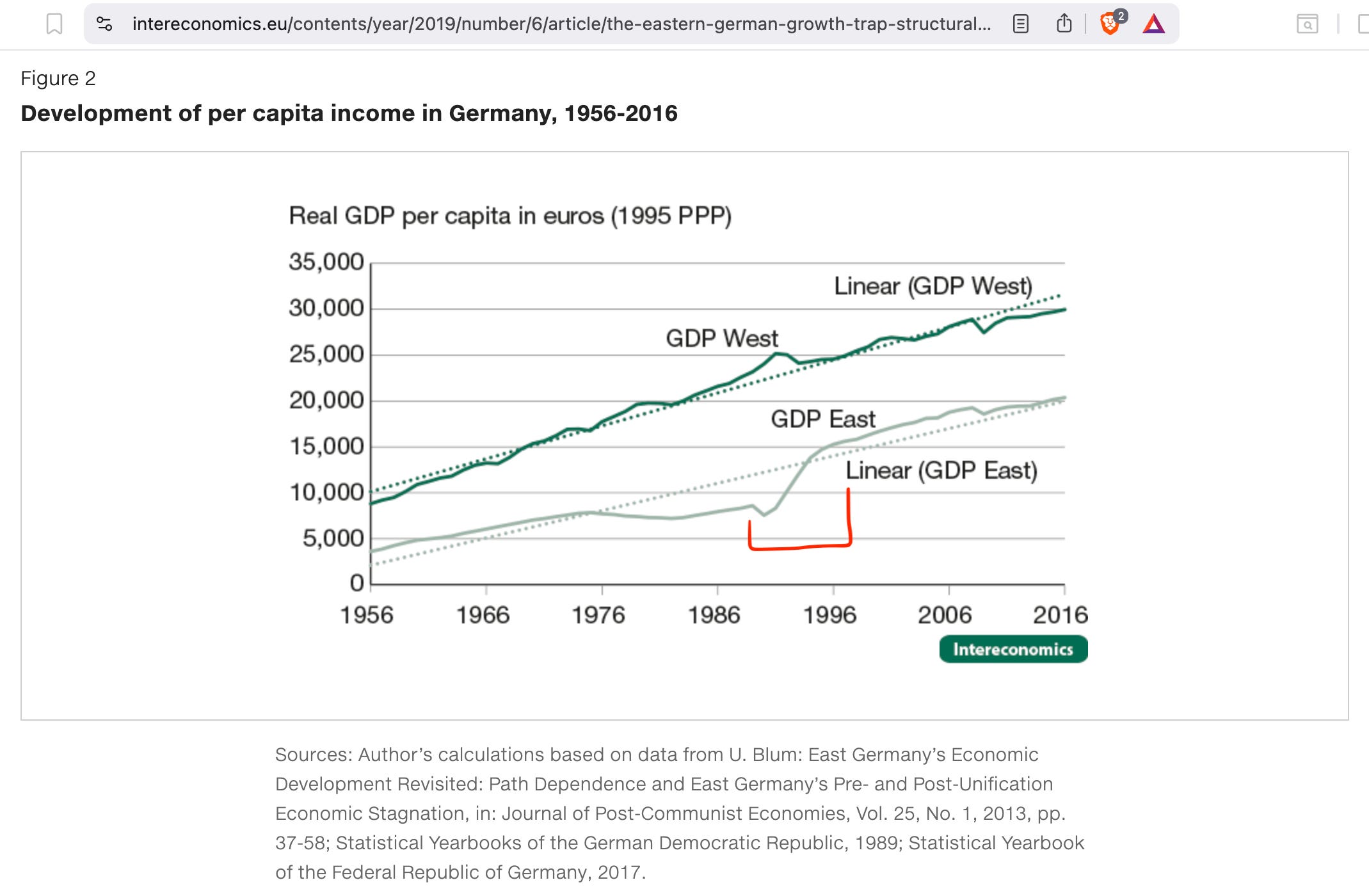
If you’re interested in the long-term effects of 40 years of Soviet-style communist rule, consider Ulrich Blum’s ‘The Eastern German Growth Trap: Structural Limits to Convergence?’ who notes the following:
The ‘Honecker years’ [in office 1971-89], were characterised by massive expropriations of medium-sized enterprises and the destruction of the remainder of the middle class, lead to stagnation and a loss of competitiveness in this self-declared ‘sixth largest industrial economy of the world’. The rapid convergence after the unification was just able to offset these losses and put Eastern Germany back onto the former East German growth track.
In other words, there is evidence that productivity and growth—on average, the West German economy grew by 4.6% vs. the 4% growth rates for the GDR, as per Blum’s piece—produced the typical rising gap of geometric functions.
The comparison to Boris Yeltsin’s Russia in the 1990s is perhaps even more instructive: upon the dissolution of the USSR, the new Russian Federation experienced greater GDP collapse, oligarch capture, and demographic crisis, all aided and abetted by institutional weaknesses that make the (East and West) German case(s) pale by comparison. Whereas East Germany was able to correct its growth past—as shown in Figure 2 taken from Mr. Blum’s piece—with the red line showing the approximate timeframe of the events and developments related above (which I’ve added):
Back to Russia and the post-Soviet experience: yes, the transition created extreme inequality and distrust in markets/democracy (you cannot really blame the Russians for that, eh?), which ended only after Mr. Putin assumed office in late 1999/early 2000. Russia’s eventual economic recovery in the 2000s was driven largely by commodity exports and did not benefit from the massive transfer payments showered on East Germany or other Central European, formerly Soviet-bloc states that joined the EU from 2004 onwards.
Hence, the core reasons for this divergence is that East Germany was absorbed into a rich state that forked over massive amounts of transfer payments; Russia had to build (or fail to build) institutions virtually from scratch amid a lot of chaos, desperation, and internal strife (remember the Chechen wars?).
I think for all their faults—and there were many, no two ways about that—German ‘reunification’ was a unique case that came, most importantly, with quite a safety net, especially in comparison with post-Soviet experiences in Russia; moreover, let’s not omit here that Mr. Yeltsin received a lot of advice™ from none other than Jeffrey Sachs, by the way, who praises China as a ‘major force in globalization’ (Manila Times, 17 Nov. 2021) and, mysteriously to your humble correspondent, is also a starlet on the alt-right, if especially Tucker Carlson’s fawning fandom shows. As a historian, I understand that stranger things have happened, but still … I find it a tad odd.
Both the GDR and the Russian cases indicate the high human costs of rapid post-communist transitions, but Germany’s version delivered better long-term results for ordinary people.
If you’re interested in the resultant weirding of Germany, do consider these pieces:


As to the letter sent to the Nordkurier, it’s a classic, almost textbook example, of Ostalgie, which is a portmanteau/wordplay deriving from East = Ost and nostalgia = Nostalgie. As with elderly people reflecting in sadness on their lost youth, it’s both a deeply human emotion and, typically, a heavily sanitised bit of wishful thinking.
And often, these kids of reminiscences don’t stand up to the evidence, which is also what must be said about the GDR in the fan fiction peddled by the Nordkurier.
Whatever one’s personal sentiments, there is no substitute for reality, and in this case, while Ms. Marsal clearly marked the above piece as a ‘letter to the editors’, the claims made should have been accompanied by some facts, too.
This is doubly strange as Ms. Marsal and the Nordkurier in general have been on the forefront of legacy media enquiries into the Covid shitshow, e.g.,
Yet, there are apparently certain emotional aspects at-play that override reality-as-is. Stranger things have, indeed, happened.
And they will happen again.
The below snippets are from the German Wikipedia entry (my translation), specifically from the section on ‘Fraud’ (emphases mine):
Particularly in the early years, a lack of organisational structures and the associated lack of effective control mechanisms and measures made the institution highly vulnerable to criminal activity. Cases of falsification of balance sheets and selling below value occurred frequently, particularly in the case of properties that were not necessary for operations. In many cases, personal advantage was also achieved through insider knowledge. Tender fraud in conjunction with bribery (for example ‘Ganoven GmbH Halle’ [Ganove means scoundrel]) also occurred. This also includes cases of price agreements in connection with the award of contracts by the Treuhandanstalt.
The cases of lack of verification of the trust’s trading partners, particularly with regard to their creditworthiness, were met with a lack of understanding. The Treuhandanstalt lacked both the personnel capacity and the competence to exercise effective control. It was dependent on auditing firms for its control [sounds familiar, eh?]
I was 10 in 1966 when our family drove to Leipzig for us children to meet our grandparents for the very first and only time. Stopping off for rest in West Germany, we noticed how things there were far more advanced than the UK. Upon entering the East, it was like we'd entered through a backwards time machine, old cobbled streets, everywhere looking neglected and forlorn. The possessions of my grandparents were the same as my father remembered before he was sent off to war. This was how things used to be before consumerism was sold to the west, latest fashions, gizmos, etc. My grandma had to wait 10 years for a washing machine and it was one with a mangle that arrived, already disgarded by western housewives. They lived in a huge apartment block, moved out by authorities from their more rural pre war abode. Another visit to my mother's homeland in the Kaliningrad Oblast revealed good roads outside towns, but within, cobbled streets, huge craters, weeds everywhere (UK has unkempt areas like this, no money to upkeep community spaces). In the Oblast, Koenigsberg had modern bits, but lots of almost abandoned towns too, which pre war, were bustling with people. I saw hardly any people, no shops, no cars. Obviously, like anywhere else, priority given to certain areas over others. Same happened in UK to the coal area towns and villages, left to decay.
Point taken, I was last in Russia in '19. The vistas in Moscow were impressive, yet only a few hundred miles east of there looked like Detroit.