
Politicos™ Learn that E-Buses are Heavy
‘We recognise that this is a bigger problem than we hoped.’ Håkon Snortheim, transportation councillor of Åkershus county, 15 June 2026

Every now and then, we’ll talk electric buses and shit, and today is that day.
Last spring there was this big kerfuffle over gov’t-mandated electric buses (which are much more expensive, hence the question was: do we raise ticket prices?):
This year, in 2026, however, the Climate Fightahs are mainly baffled because (drum roll) electric vehicles are heavier, hence about 40% of roads (incl. bridges) are in no condition to carry that added weight.
As you read on, keep in mind that bafflement™ may only be faked to a certain extent; in other words: the fact that heavier vehicles may require more sturdy roads may be real news to these morons. Moreover, keep in mind we’re talking Scandinavia™ here, places that are typically nominated as highly functioning, high-trust societies, which points to a couple of additional qualities: major insanities such as the one related below are only possible if the voters are as uninformed as the politicos™; moreover, as we’ve discussed frequently, the below anecdote is the consequence of the dumbing-down of schooling, introduced 30 years ago (1997) by the Labour Party, reinforced by their (mainly fake) competitor, the Conservatives with the introduction of tablets from grade 1 ten years ago (2016).:


As you read on, then, do keep these things in mind.
Translation, emphases, and [snark] mine.
Postponing the Purchase of Electric Buses—Roads Can’t Handle Them
It has been decided that polluting diesel buses in Norway will be replaced with electric buses, but something has gotten in the way.
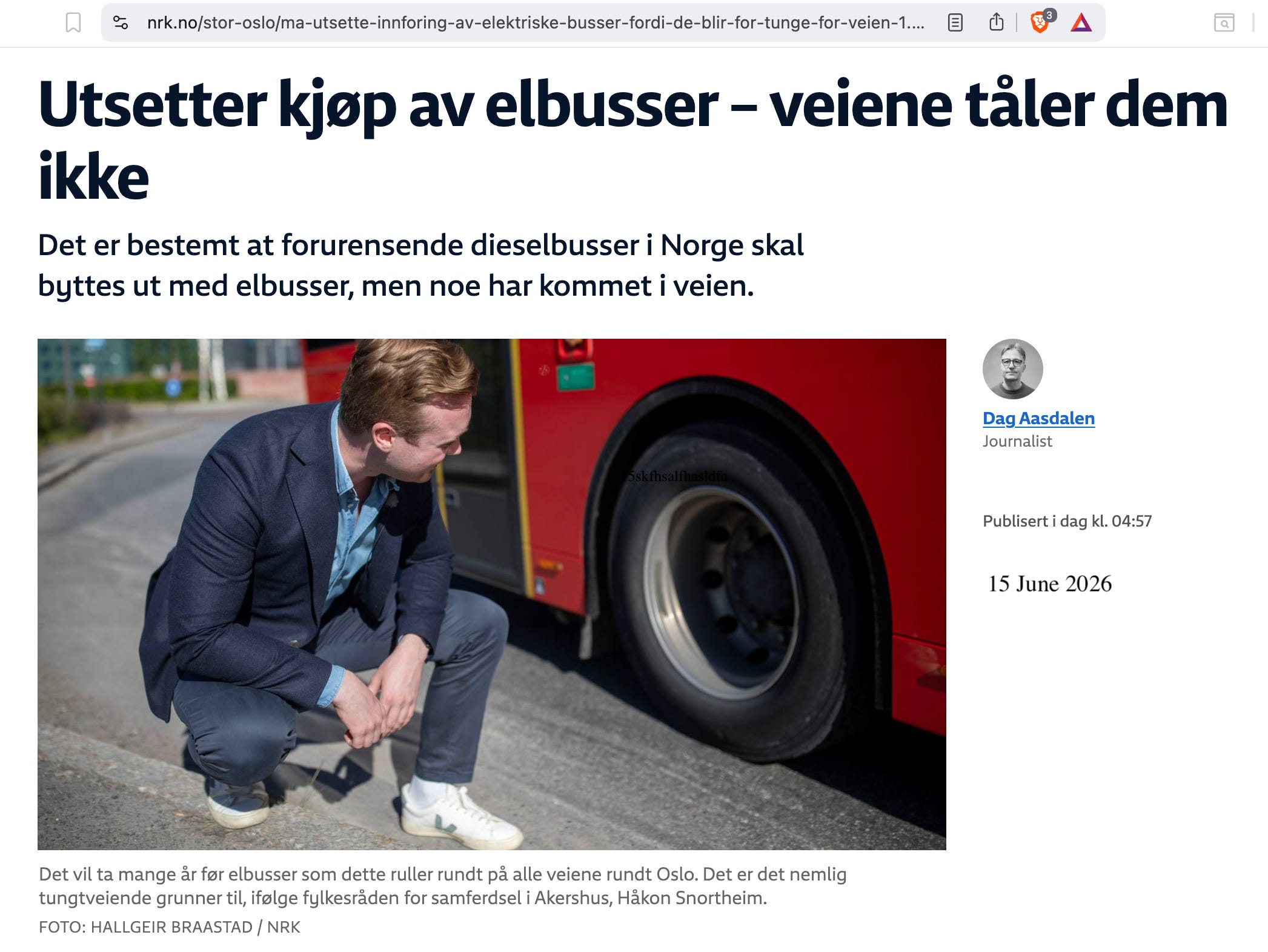
By Dag Aasdalen, NRK.no, 15 June 2026 [source; archived]
‘This is the culprit’, says Håkon Snortheim and crouches down next to the rear wheel of a red electric bus.
He is referring to the strong pressure of the wheels against the asphalt [Mr. Snortheim has thus learned that heavy stuff is baaad™].
‘We recognise that this is a bigger problem than we hoped’, says Snortheim, who is the transport councillor in Akershus country (Høyre) [that would be a state-level cabinet official whose expertise™ (ahem) derives from hopium].
Other parts of the country are also struggling [orig. sliter] with exactly the same challenge. Like Vestland [no-one could have known, you see, that physics is kinda the same in different places].
‘For example, in the new contract that we have started in Sogn [my neck-of-the-woods], there are still diesel buses running, says press spokesman for Skyss [Vestland’s public transportation company], Øyvind Strømmen.
The challenge is the same in both the east and the west of the country [replace ‘challenge’ with ‘physics’: there, I fixed that for you].
The batteries mean that electric buses weigh much more than diesel buses.
Although the state has required counties to purchase emission-free buses since 2022, it is easier said than done when electric buses become so heavy that roads and bridges will not be able to withstand the weight [for extensive background—a gov’t mandate to phase out diesel buses and replace them with electric ones (which are more expensive, hence fare increases), see this:

It’s not as if these issues™ weren’t know in ancient times of … 2022].
Too Heavy For 4 Out of 10 Roads
In Hadeland, which is located partly in the Inland and partly in Akershus county, the public transport company Ruter has now found that this applies to over 40 per cent of the roads [Ruter serves the Oslo
There, new environmentally friendly buses were supposed to replace diesel buses in 2028.
But now the public transport company will be allowed to postpone the replacement until 2031.
Also in populous areas around the capital such as Romerike and Asker, the county council is allowing for the postponement of the transition to electric buses.
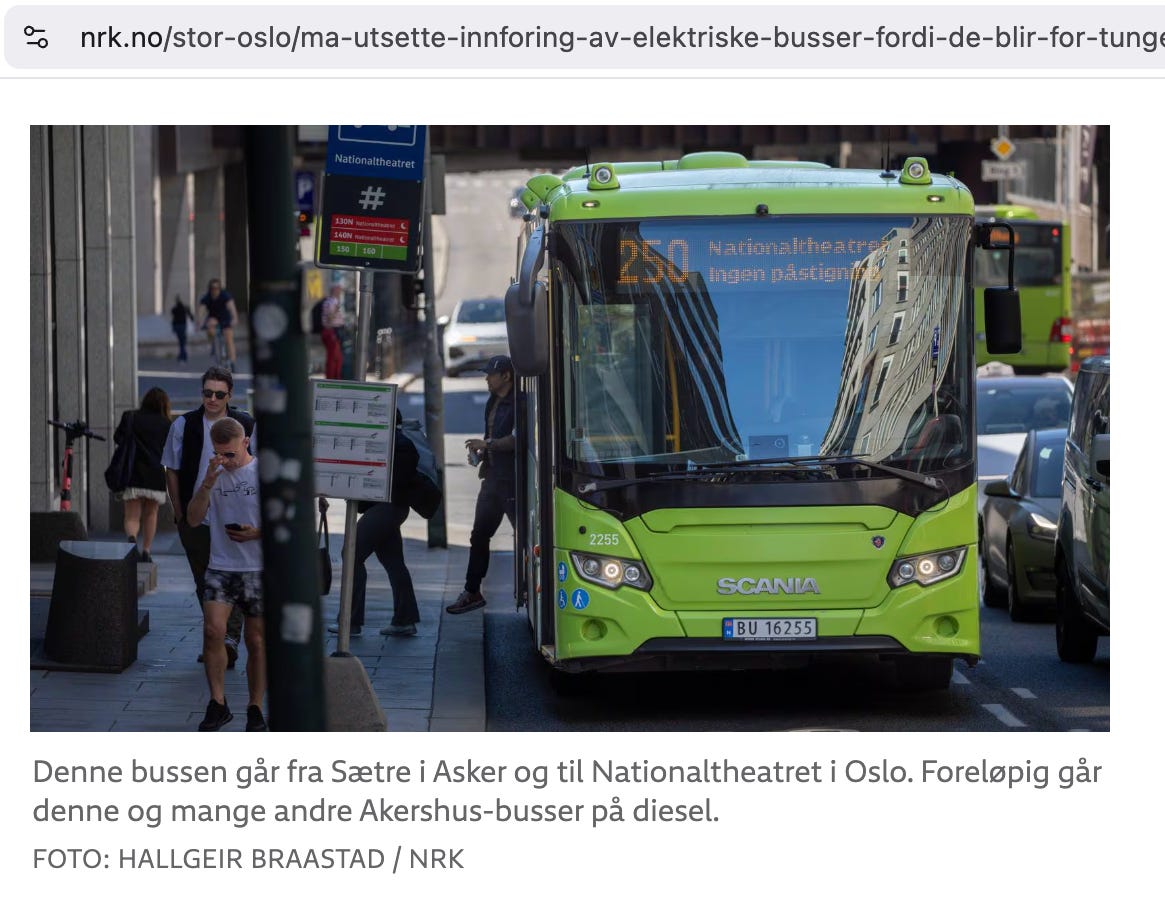
This means that diesel buses will still carry passengers.
Snortheim believes that things are going very well for passengers:
Usually, people are concerned whether the bus runs, as opposed to what kind of engine it has [no shit, Sherlock].
Divided Opinions at the Bus Stop
But among people waiting for the bus at Lillestrøm station, there are divided opinions on whether it matters that the environmentally friendly buses are delayed.
‘No’, says Luise Andresen flatly [who is of a very Nordic complexion, by the way].
She explains that she has more faith that a diesel bus will cope better in winter conditions than electric buses.
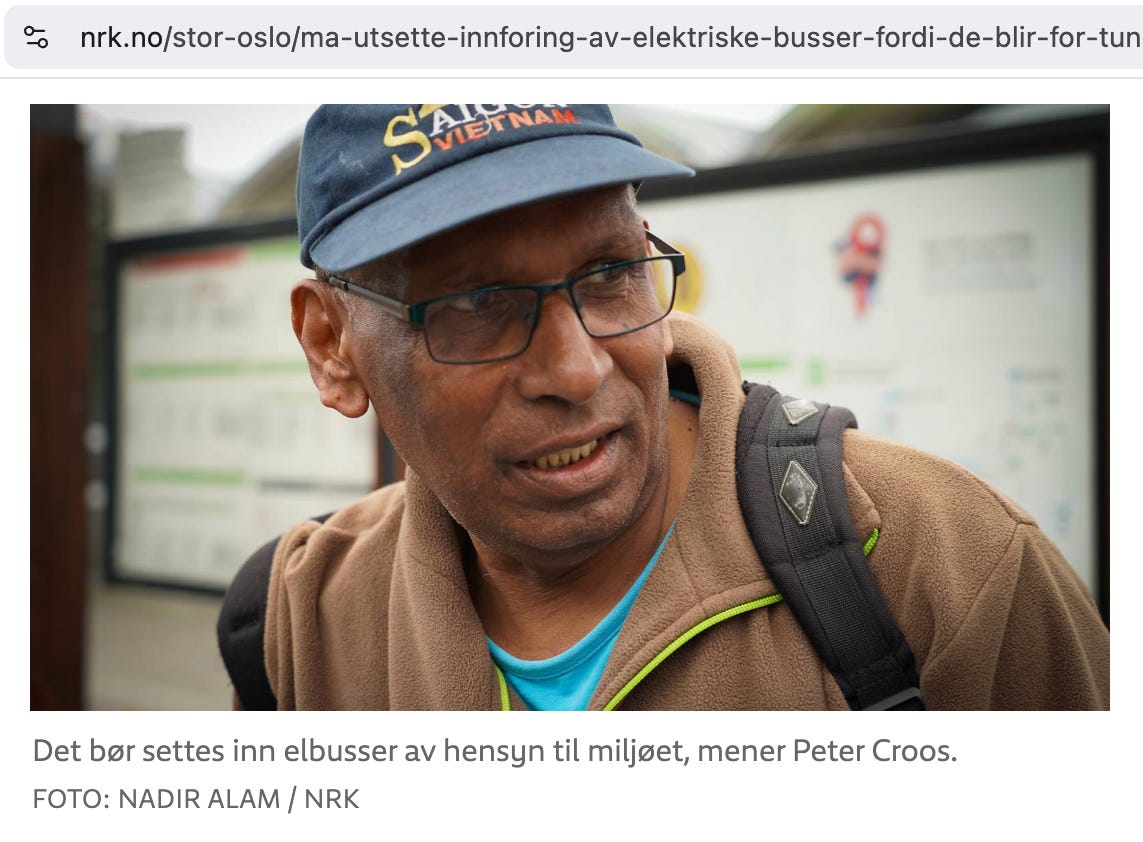
But Peter Croos does not agree:
For the sake of the environment, they should be electric buses. We should think about the next generations
Then the bus they have been waiting for arrives.
The passengers rush to board. The Akershus bus is green, but that is only on the outside [this is either a quite thoughtful pun (Ruter’s buses are typically red) or among the most stupid ways to put this (my money is on the latter)].
And it will be like this for a few more years, whether the passengers think it is okay or not.
Known Problem
The fact that some [sic; it’s, of course all of them] electric buses are heavier than what parts of the road network are designed for is a known problem for the Norwegian Public Roads Administration [orig. Statens Vegvesen]:
This is an issue we have had good and close dialogue with the county municipalities and public transport players about.
That is what department director Anette Hauge says.
But in fact, it is the counties that decide what kind of weight the roads should withstand [they built these roads and bridges before the advent of electric buses, and roads become quite a bit more expensive if they’re built to withstand heavier loads; as per US data/standards, heavy-duty roads are some 30-100% more expensive (source, but note that this paper is from 1995); note that these price differentials also hold for Norway (source)—and this is one number I’m mentioning in terms of price tag: standard/light county roads (low-medium traffic, basic design, e.g., H1 class ~9m width) clock in at 50-100m Norwegian crowns per kilometre; note further that there are maintenance expenditures that should be factored in, as well as the effective doubling of projected upkeep/maintenance requirements from 2013-2023 (source)]
‘And we contribute with professional support in these assessments where it is desirable’, adds department director Hauge.
In an imaginary case, Akershus could have raised the weight limit for its roads and made them ‘tolerate’ the weight of the electric buses.
But that would not be wise, according to Snortheim:
The buses weigh the same anyway. So even if you get an exemption, the result will be that you drive the road to pieces [the one reasonable thing this dude mentioned].
‘Postponement of the Postponement’
In Akershus county, the goal was to end diesel buses by 2028.
But when electric buses had major problems getting around on snowy roads a couple of winters ago, the deadline was postponed to 2030.
Now the environmental measure may be postponed for another year, something the Socialist Left [orig. Sosialistisk Venstre, or SV] is very unimpressed with:
‘Climate problems mean that we have to change our plans, and then asking for a postponement of the postponement is not enough’, says Tuva Todnem Lund, adding:
‘It is the county council’s job to ensure that the county council’s decision is followed up’, says Lund, who is SV’s member of the transport committee in Akershus.
The fact that the county will continue with fossil fuels for three years longer than planned will have consequences for the environment, she warns [banning plastic straws is obviously not good enough].
Must Upgrade the Roads
The liberal county council of Akershus still sees no other way than to spend more time preparing the roads to accommodate the heavy buses.
An extra NOK 150 million is set aside for road maintenance in the county’s revised budget [in case you don’t remember that one number from the above commentary, that’s enough to upgrade 1km of county road].
At the same time, the postponement of the introduction of electric buses will save them NOK 180 million. They should have been used to prepare the bus facilities for electric operation [this hasn’t been done before these buses are put into service? People, you could have upgraded another 1.2km of road with these funds].
‘These can instead be used to keep the public transport service running’, says the county councillor for transport in Akershus [meaning paying for diesel buses].
There will not be many electric buses for the residents to take, but at least there will be a bus [will the regular schedule be upheld or thinned, that’s the question, it would seem].
Bottom Lines
Morons, all of them.
Especially that young county councillor, Håkon Snortheim, who was born, believe it or not, in 1998; the following is from his Norwegian Wikipedia entry (references omitted):
Snortheim joined Unge Høyre in 2014, and has since been local leader, county secretary and county leader of Akershus Unge Høyre. Between 2020 and 2023 he worked in Geelmuyden Kiese [a PR firm], where he served as press contact for Uber, among other things. He was elected as first deputy leader of Unge Høyre in October 2020 and re-elected in 2022.
Snortheim was appointed County Councillor for Transport in the newly formed Akershus County Municipality in 2023.
I dunno if young Håkon did anything in terms of training or education; best I can do is this profile/interview at Nettavisen.no, paid for by the Conservative Party—he grew up on a farmstead, hence he’s got a lot of bondevitt, it is claimed, which translates into ‘practical wisdom of the country-folk’, but I honestly fail to see this in the above piece.
To me, he seems way outta his league and either too stupid to comprehend the issues before him or he’s just playing stoopid (he looks that way to me).
Be that as it may, but the above episode should do away with any of the remaining peeceptions about Nordic countries being run better.
It's Malmö all over again. That city where I used to live got into their heads to brush up the image of its worst area (Rosengård) by buying new modern buses, of a model that looked more like trains than buses.
They rebuilt the street grid along the bus line. New sidealks, new everything, huge undertaking, then intriduced the buses and discovered they were several tonnes too heavy for the streets.
And so they re-did the rebuilding for an extra 70 000 000:- of other people's money.
To make matters worse, a lot of the residents of Rosengård (area is basically 100% moslem) refused to pay when riding the "Orient express" as the bus was nicknamed. The drivers were threatend and assaulted and harassed.
This was solved by rebuilding the buses for an undisclosed amount, making them so the driver sits in an enclosed compartment with a seprate entry/exit, plus putting a dozen cameras in each bus (nowadays, cameras as standard for all public transport in Sweden because "we have never been safer" as a so-called comedian said, himself driving an expensive car while living in an all-White neighbourhood).
Norway seems Hel-bent on copying the stupidest, most PC, and poorest most criminal city of Sweden.
PS: Snortheim is a hilarious name. Snor = snot, mucuous. And reading it "Snort-heim" isn't much better. "Home of the snorters" - cocaine much, hm?
In "news at 6" electric batteries are heavy. In other news...the sun came up again today. This is what happens when you let women vote.