
Oslo to Mandate Green™ Construction Sites, Industry Warns of Higher Housing Prices
'City Councillor Marit Vea says they have listened to the industry and believe that the transition will be good for business.' ∽ Norwegian state broadcaster NRK, 7 Aug. 2026

Some time not too long ago, the leftie-left™ municipal gov’t of Oslo came up with more regulations and demands as the one solution™ to solve all problems:
Norwegian municipalities cannot order private developers to have emission-free construction sites. Nor can they force the state to do so, for that matter.
This is about to change.
A proposal to give municipalities the opportunity to impose such a requirement was recently submitted for consultation under the auspices of the Norwegian Environment Agency, on behalf of the Ministry of Climate and Environment.
By way of an introduction to this nonsense (and in the sense of keeping the receipts), please see this two postings:
The main pusher of these stoopid ideas™ is, of course, a career politico™ by the name of Marit Vea (but let’s not forget there are enough fellow travellers and camp followers) who, about a year ago, took to LinkedIn and declared:
One of the objections we often hear about climate measures is that ‘this will be too expensive’. I can reassure everyone that it is not emission-free technology that is making homes more expensive in today’s market [lol, rather market™]. We can thank high raw material prices [will their emissions be cut, too?] and interest rates for that [fat cat bankers are bad]. The fact is that emission-free machines are already competitive with fossil-fuelled machines in price.
And here’s what the Oslo municipal gov’t proposed:
On Thursday [9 Sept. 2025], the city council will send the regulations on mandatory electrification out for consultation.
Obos [Norway’s largest private construction company] has previously said that it will make homes several hundred thousand kroner more expensive.
But the measure is absolutely necessary, according to the city council [i.e., TINA, as in ‘there is no alternative’].
[infobox] These are the requirements
The Oslo City Council proposes to require that large construction and building sites must use emission-free or biogas-powered construction machinery.
The regulations will be sent out for consultation on 4 September and will finally be adopted by the Oslo City Council [i.e., the consultation™ is a charade].
Smaller projects such as houses under 200 square meters are exempt.
At least 30 per cent of energy use must be emissions-free by 2027.
The requirement will be tightened to 90 per cent in 2030.
Exceptions are possible in the event of technical or economic obstacles.
Expected emission reduction of 30-40,000 tons of CO2 per year by 2030 [end of the infobox].
‘When we are going to cut emissions by 95 per cent, we also have to take action on this’, says Marit Vea [no need to provide any insights, let alone data, as to what the baseline is, what the overall emissions per sector are, and how much of a cut these 30-40K tons are].

Today, we’ll revisit this burning issue™ and check in with the people of Oslo.
Translation of non-English content, emphases, and [snark] mine. Oh, if you hear a thudding noise, that’s my head banging on the desk.
How Oslo is Going to Make [Construction] Greener—[Industry] Warns of Higher Housing Prices
The bill will end up with home buyers, warns the Housing Construction Association.
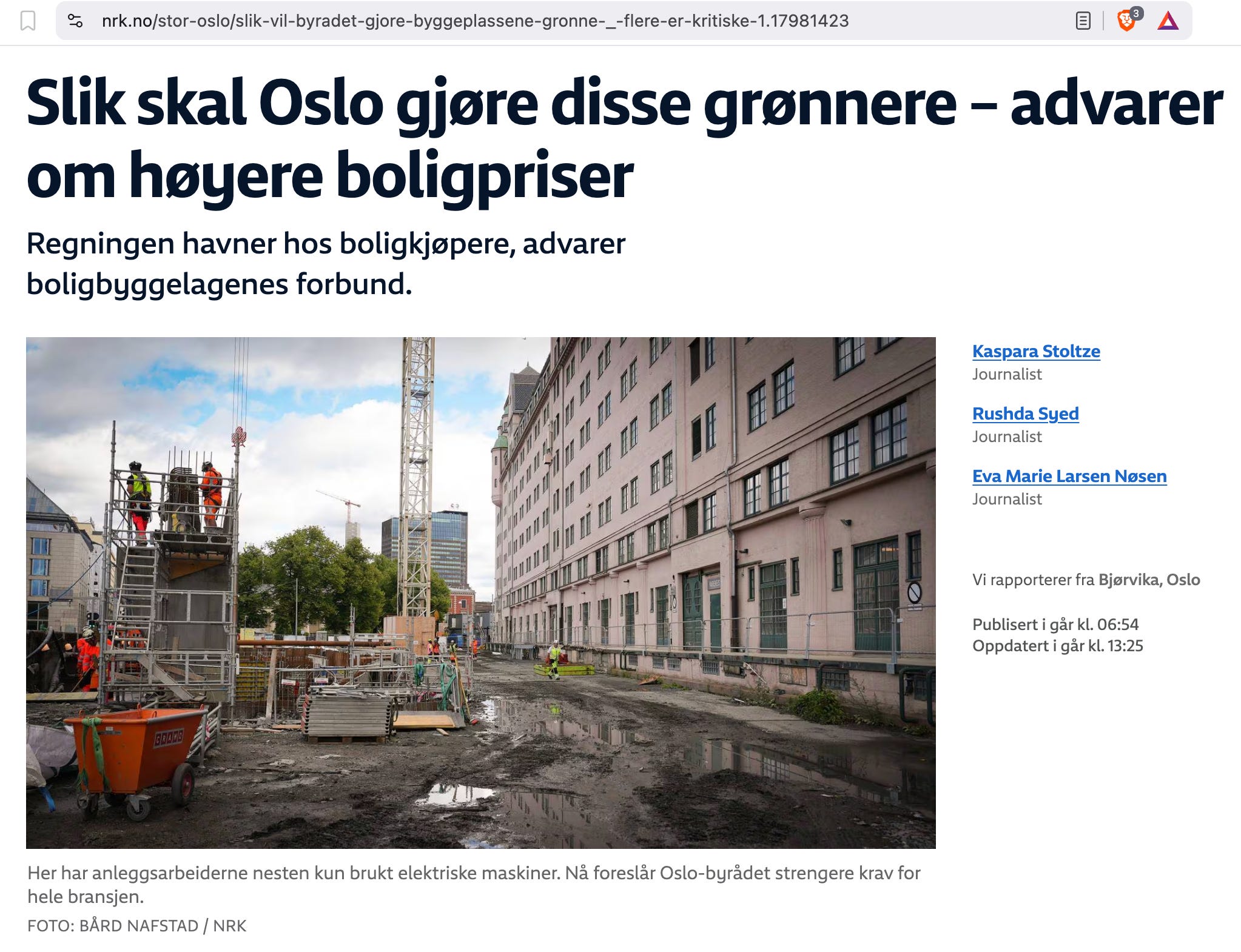
By Kaspara Stoltze, Rushda Syed, and Eva Marie Larsen Nøsen, NRK, 7 Aug. 2026 [source; archived]
A huge crater will soon be turned into offices in Bjørvika in Oslo.
It looks like most construction sites, technical and a bit grey, but the developer says that things are not what they seem.
Because almost all the machines that are humming and running are electric.
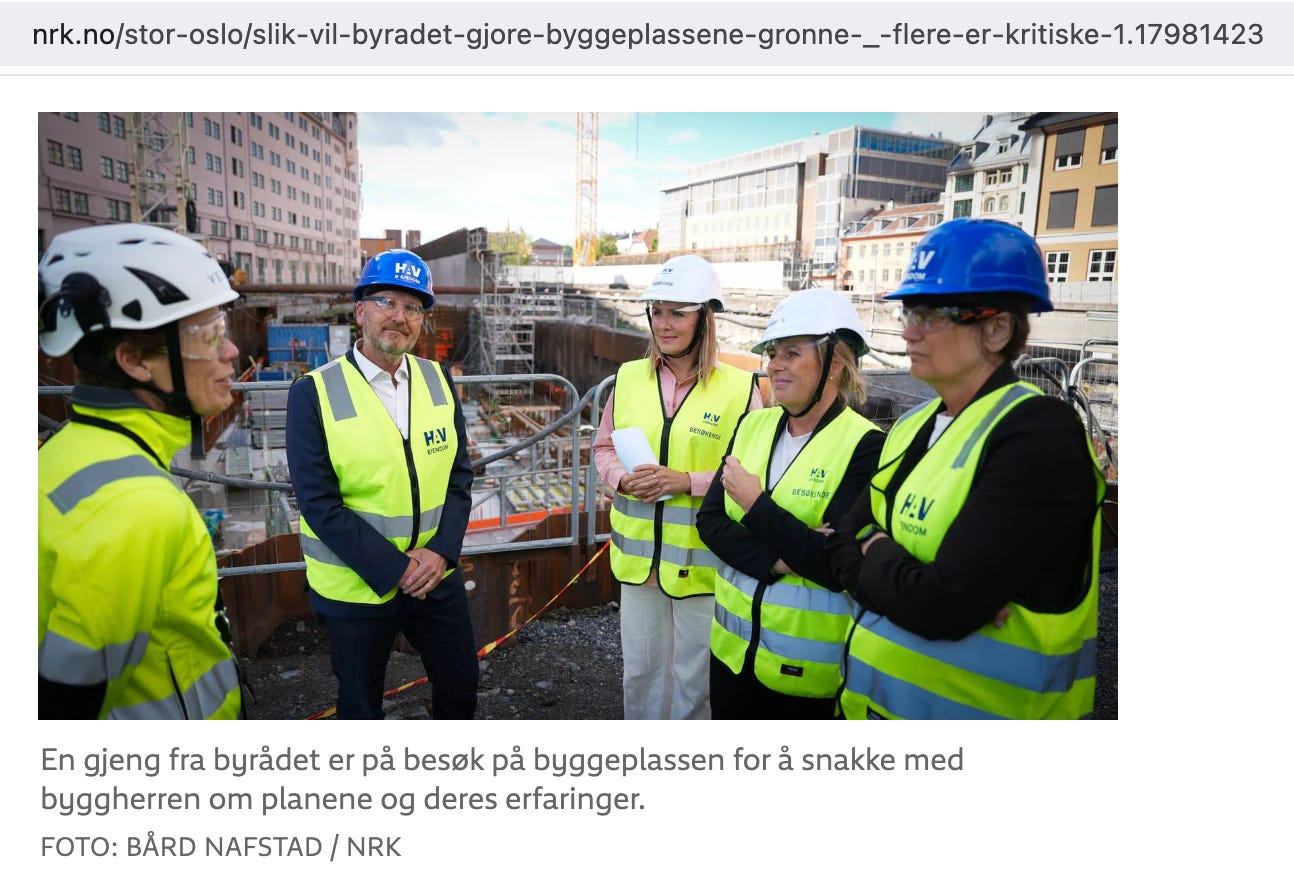
‘It is quite special in such a large project’, says one of the engineers to the politicians who have turned up in yellow vests [as if anyone needed them cosplaying politicos™ there].
But it will soon become much more common, if the city council gets its way.
Trondheim also has similar plans.
The Norwegian Housing Construction Association [orig. Norske Boligbyggelags Landsforbund, or NBBL (website), the country’s main lobby of the construction industry] believes that this will make it more expensive to build homes [I do believe that claim to be true, but the above site is for offices or the like]:
‘It is the home buyer who ends up with the bill’, says CEO Bård Folke Fredriksen.
Will Require Electrification
But these plans do not come as a shock to the industry.
The city council has electrified its own construction sites and has for some time announced that they will also forcibly electrify private construction sites [that is the above-linked piece I did last autumn; direct link to my piece].
Now the final proposal is ready:
At least 75 per cent of the energy use on larger private construction sites must be emission-free by 2032.
The escalation will take place gradually and the city council resolution provides for several exceptions.
‘If there is no technology available, we do not expect the developer to create it themselves’, explains Environment and Transport Councillor Marit Vea.
The smallest ones are also exempt from the requirements, for example those building a semi-detached house.
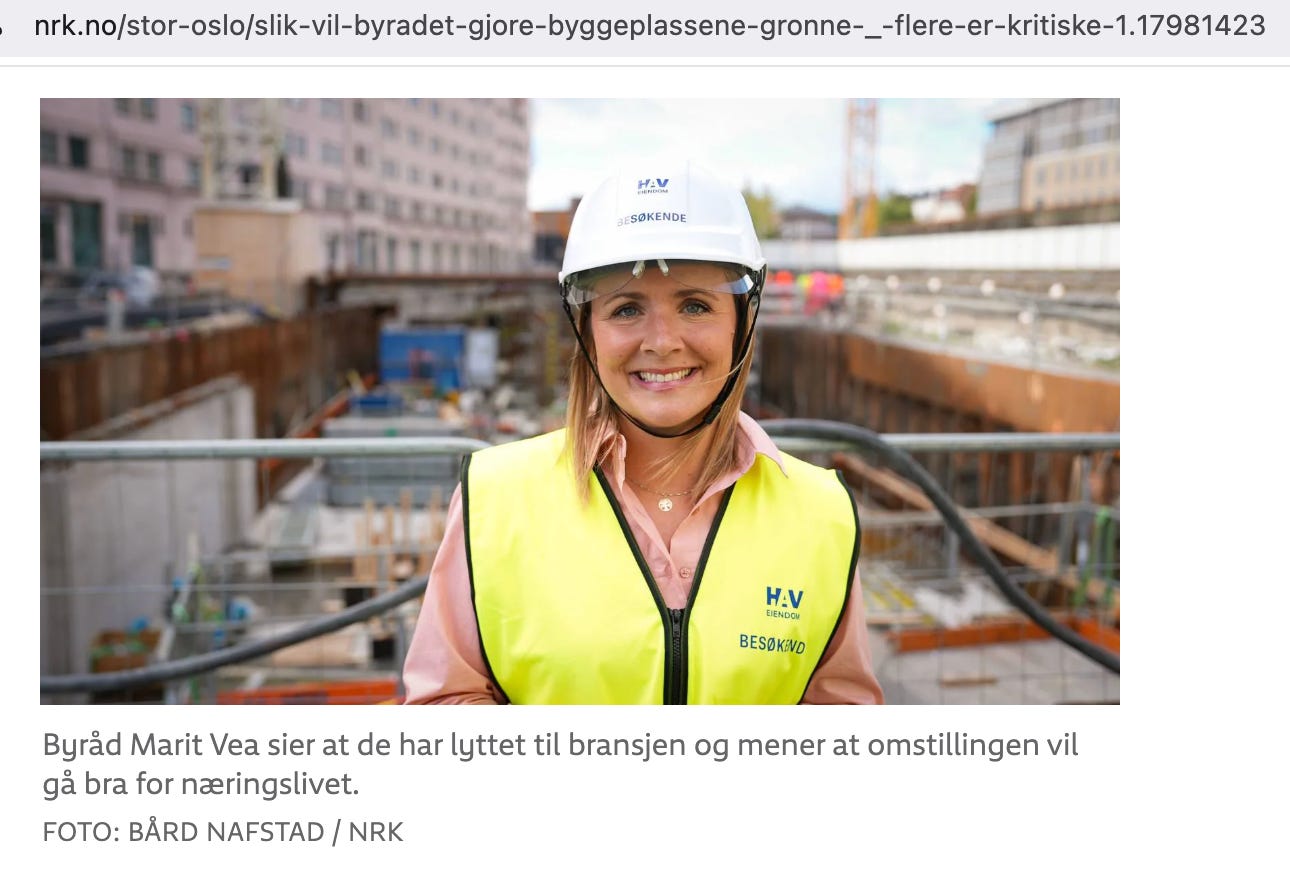
They have created the requirements to cut the city’s total emissions, notes Vea:
We have ambitious goals and will be an almost emission-free city by 2030. And this is a very important piece of the puzzle to succeed and to lead the way and show others that it is possible to cut emissions even in a city like Oslo.
No other municipality has come this far with this [huhum, I wonder why … (/sarcasm)].
Some Are More Prepared Than Others
The property developer who is building offices in Bjørvika is already well on its way.
They have given themselves stricter requirements than what the capital has today [of course they have, they’re a private business, which means they can’t rely on the welfare state (like the city gov’t), and I’ll also tell you how this ends: with escalating Green™ demands to follow as surely as day follows night, said developer made investments now and will inevitably become the monopolist in the near future].
The excavators and the large cranes—everything is electrified with the exception of a couple of large machines that are not yet available in an electrified version.
The challenge for the industry in general will be to acquire new machinery, according to Krutnes:
So we think it’s positive that they’re announcing this well in advance, so the industry has time to adjust.
But not everyone is equally prepared for the requirements.
This is according to Sverre Huse-Fagerlie, who is the sustainability manager at the Norwegian Association of Machinery Contractors [orig. Maskinentreprenørenes Forbund]:
There is a big strain on the team among the machinery contractors. Some have made a good start with the transition to green solutions. Others say that they do not have the opportunity to participate, and then they have to find work elsewhere.
The sustainability manager points out that we are talking about large investments, which will be particularly demanding for the smallest companies in the industry, notes Huse-Fagerlie:
The average contractor has around 11 employees, and a machine that costs from four to six million [Norwegian crowns; divide by 10 to arrive at current (summer 2026) US$ or euro prices] is a big risk for them to take [see, I told you what this is about: to drive small (average) companies bankrupt whose businesses will be taken over by a few very large corporations, rendering what is a quite diverse sector into a cartel].
At the same time, they are positive about the changes the city council has made in the final proposal, and feel [the key term here, and it’s totally fitting] that they have listened to their input.
Believes That the Home Buyer Must Pay
Bård Folke Fredriksen at NBBL is more skeptical and concerned.
The CEO says that it will become both more expensive and more difficult to build homes:
We already have a cost crisis in housing construction now. New costs on top of this, crown for crown, will exclude new buyers, unfortunately [so much for the DEI™ programs].
The construction cost will increase in the hundreds of thousands of crowns range with the calculations we have.
The home buyer will foot the bill
The Progress Party [orig. Fremskrittspartiet, i.e., the retarded self-styled dissident Right™] shares the concern, as deputy mayor of Oslo, Julianne Ofstad, notes:
When several large housing developers, including Obos [Norway’s largest real estate developer], warn that the requirement will make homes significantly more expensive and may lead to projects not being built, it is incredible that the Conservative Party in particular has not listened [why is that incredible? They’re also in favour of higher taxes].
The requirement will have very little climate effect, but will have major consequences for those who are already struggling to get into the housing market.
‘This is not the problem’
Economy City Councillor Anita Leirvik North says that they have talked to the industry all along.
Along the way, they found out something important [lol, that’s NRK’s wording, not mine (orig. underveis fant de ut av noe viktig)], she says:
A lot of the developers say that it’s not this regulation that’s the problem, it’s the totality of all regulation [i.e., it’s the compliance with all these mandates].
That is, all the different requirements that the municipality sets for the construction industry.
‘The city council is now announcing that we will conduct a complete review of all requirements that are directed at the industry. To ensure that we are not imposing requirements that are unnecessary or do not work’, says North [note the forms chosen: ‘now announcing’ that, at some future point in time, the ‘will conduct’ a review of regulations (red tape), and I’m sure they’ll come up with some things in a few years (my guess is after 2032 when these new regulations are in place and the red tape about, say, fossil fuel-powered machinery may be discontinued].
Bottom Lines
It’s amazing, isn’t it?
At least some sanity prevailed and there are exemptions from these demands, but at the heart of it, the insanely expensive country of Norway will become more expensive.
A bit of economics and common sense would have been good, nor merely nice to have, I’d say, though, for here’s what’s likely going to happen:
as the average construction company has 11 employees and a few machines, they’ll be under immense pressure to buy new, expensive machinery; a lot of these companies will go belly-up
their business will be picked up by the few remaining big corporations, hence we’ll end up with a cartel-like structure in the near future
To add insult to injury, the virtue-signalling about this nonsense will be insane, and we’ve already seen the absurdity of this earlier this year when NRK rah-ported™ on the problems of a Green™ upgrade in a zinc smelting plant that’s both massively violating contamination limits while also emitting more CO2 than before:

It’s highly dubious that the journos™ who write this kind of crap, as well as the normies™ who read this kind of nonsense, don’t, at some point, go, ‘wait a moment, this doesn’t make any sense’.
The mere fact that these kinds of stupid things can even exist in the real world tells you everything you may ever wanted (needed) to know about how low standards, expectations, and cognitive abilities have fallen.
Will any of this make a meaningful difference?
It’s unlikely, that is, except for the few corporate behemoths that will remain who also get some not-too-bad PR out of this nonsense, and a future sales pitch (‘we’re cleaner™ than the rest’); politicos™ also will get a service medal for ‘being seen doing something™’ or the like, as well as a spot on the boards of these developers once the politicking gig is up.
John and Jane Q. Public will continue to get shafted.
Ands thus continues the Greatest Grift of All.
It's all about to extend the fraudulant money system of God's chosen psychopaths until they own everything and the rest nothing, as Klaws Swab said: By 2030 "you will own nothing and be happy" to die.
The King James Bible is the commercial script embedded in theology. It gives rights of ownership over land and people, it satisfies borrowing, credit and usury. It confuses the teaching of the Gospel by engineering everything outside yourself to be more important than mastery of self. It aggrandises race built on religious belief and sanctions a god outside of self as superior to who you are. This birthed Johannism or inner circle Templarism into the European mind.
Livestream 9 August 2026.pages - Usury-Creed.pdf - https://thebridgelifeinthemix.info/wp-content/uploads/2026/08/Usury-Creed.pdf
Sunday livestream 9 August 2026 - https://www.youtube.com/watch?v=A05lLv40VUo
the dealers in second hand construction machinery will be delighted by the dramatic drop in prices of said machinery as a consequence of lots of smaller construction companies being forced to close shop.
the machinery will find a willing market in less developed countries, rendering the exercise of saving the earth by reduction of emissions by the decommissioning of said machines completely futile.
and in the meantime norway will of course continue to sell its fossil fuels to the rest of europe....