
MSM Muses Over 'Germany's Decline'
'Mathematically possible majorities are considered politically unacceptable, while the politically permissible majorities cannot bring about a change of direction.'

Notes (‘Night Thoughts’, if you like Heinrich Heine) from Germany, July 2026.
Translation, emphases, and [snark] mine.
The Real Reason for Germany’s Decline
Politics consists of resolving major societal conflicts, which find their symbolic expression in a change of government. But this has been impossible for decades. The consequences? Stagnation and decline.
By Frank Lübberding, Die Welt, 14 July 2026 [source; archived]
With a major reform package, the federal government wants to lead the country and itself out of the crisis. Behind this lies a technocratic understanding of politics that ignores the substance of politics. This substance consists of resolving major societal conflicts, which find their symbolic expression in a change of government. This is precisely where German politics has failed for decades: governments may change, but no real change in policy is brought about [this is quite accurate—talk about the Uniparty—but here’s the twist: the problem is that virtually all parties have policy platforms that are virtually indistinguishable at its core; personally, I have a suspicion as to why that is (increasing vassalisation pressures manifesting themselves by bureaucratic domination—our Democracy™) but let’s see what Mr. Lübberding says].
This has less to do with individuals than with a self-imposed paralysis of the party system. The mathematically possible majorities are considered politically unacceptable, while the politically permissible majorities cannot bring about a change of direction [well, that’s a superficial statement of fact that totally ignores a bunch of factoids, such as legacy media being virtually totally dominated by lefty-left sympathisers, as we’ve talked about here:

Plus there’s the subversion of politics on multiple fronts, ranging from the EU and the UN via NATO to Big Business; as to the EU, here goes:


This is but a small selection, of course, but let’s see if any of the above plays a role for Mr. Lübberding’s analüsis™].
The current polls [archived; see below] therefore reflect not only the wear and tear of a government, but a deeper defect in the German party system: majorities for a change of direction exist, but they cannot be used politically. The parties have created a system in which governments can be voted out of office without the country’s political direction actually changing. This results in an administration of stagnation. Every subsequent poll confirms this decline. Voters feel they always get the same policies, no matter who they vote for—and are literally looking for an alternative.
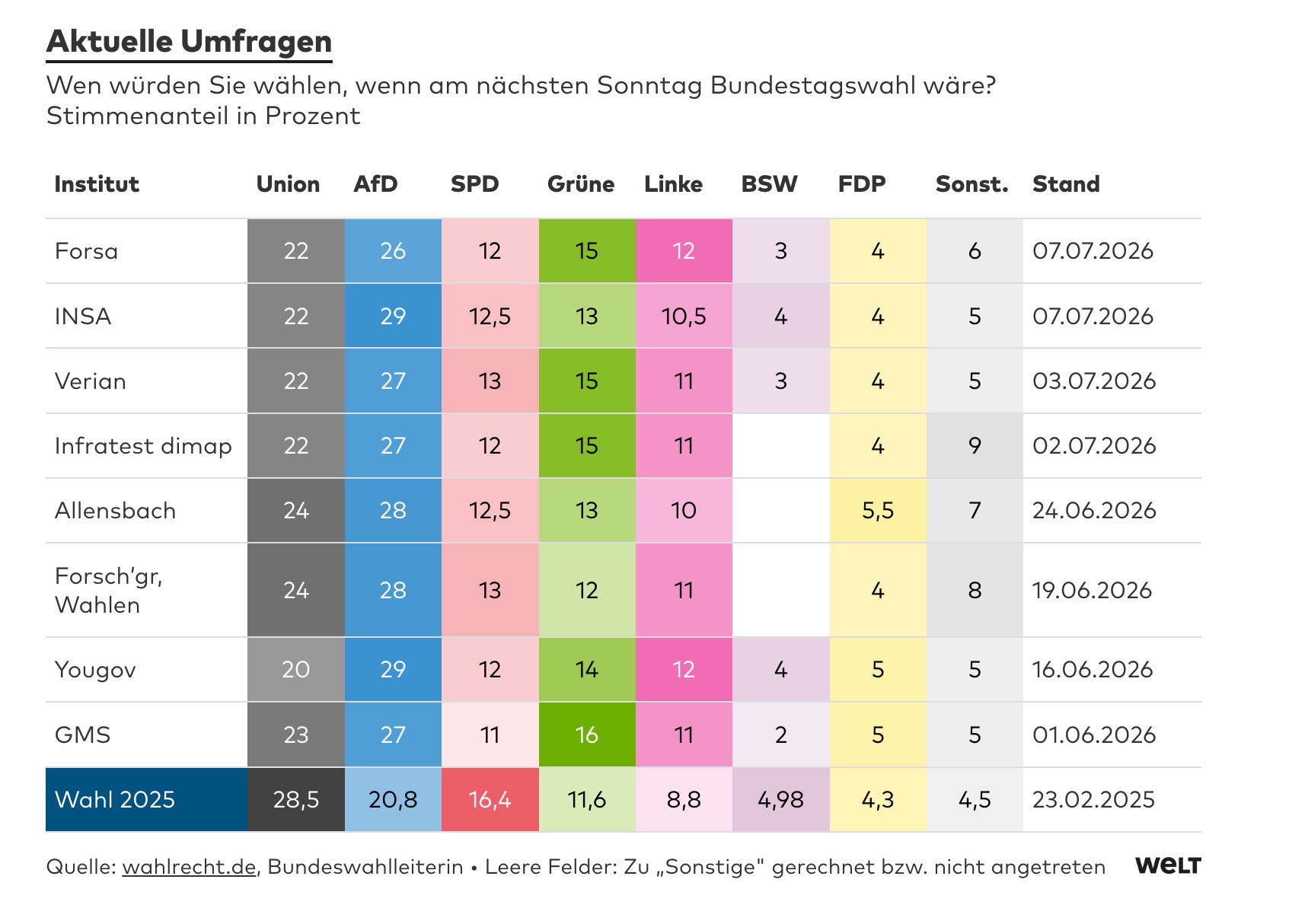
In this respect, the current polls are in line with expectations. The governing parties are losing support, the opposition is gaining trust [that’s kinda normal, you know]. However, this outlook is deceptive. Such a constellation last occurred in 1998, when Gerhard Schröder (SPD) ended Helmut Kohl’s (CDU) chancellorship. The red-green coalition replaced the black-yellow one. By 2026, it is not even clearly defined who [or what] the opposition is. Although the AfD is now by far the strongest party with almost 30 per cent of the vote, it is not considered a viable coalition partner [by whom?].
The FDP is a shadow of its former self and irrelevant for forming a government. The same applies to Sahra Wagenknecht’s BSW, which narrowly missed entering the Bundestag under scandalous circumstances. On the left, there are the Greens and the Left Party, but together they garner less support from the electorate than the AfD [note that the Greens™ are now polling better, relatively speaking, than the SPD]. Thus, two perennial governing parties [Friedrich Merz and the CDU/CSU as well as whoever is important in the SPD] are locked in a Babylonian captivity, jointly managing their own decline [plus they’re dragging the country down with them]. This decline seems baffling to both, since they claim to be centrist parties that aim to solve problems.
However, a change of government like the one in 1998 isn’t about abstractly solving problems. Rather, it involves voting out a government whose personnel no-one wants to see anymore, and seeking a change of direction [let’s see what that means for Mr. Lübberding and his ilk] that meets voters’ expectations for change. It’s about symbolism, a new style with new faces [and there we go: it means ‘symbolism, a new style’, i.e., everything but a substantial change]. This hasn’t happened in Germany since 1998 [and, if Mr. Lübberding and his ilk have their way, it won’t happen in any time soon].
When Angela Merkel finally limped into the Chancellery in 2005, the German economy was once again on a stable upward trend. The disastrous 2009 federal elections for the SPD were not the result of the controversial Agenda 2010. They were the result of a blatant breach of campaign promises made in 2005: there was to be no increase in value-added tax, as then-Chancellor candidate Angela Merkel had demanded. But that tax was raised not just by two per cent, but by a full three per cent. Even more serious for the SPD was the previously ruled-out increase in the retirement age. The SPD’s subsequent disintegration as a major political party was unstoppable [if you know that kind of recent history, imagine, in US parlance, running on ‘hope’ and ‘change’ in the middle of a financial crisis only to provide hand-outs (‘bail-outs’) to Wall Street; since I’m an equal-opportunity cynic, I’ll just note that comparable sentiments about reigning in abuses promised by Mr. Trump in 2024, incl. anti-war sentiments; note that while I have serious doubts that tax increases or the raising of the retirement age are good campaign promises, don’t look at what politicos™ say but at what they do].
Merkel represented the new Biedermeier in Germany. Incomes finally rose again and social benefits were gradually improved. While large parts of Europe struggled with the effects of the euro crisis, Germans were able to enjoy the pleasant feeling of increasing prosperity. Of course not all Germans, but the middle class, which is crucial for the election outcome, does. The middle class wants to be left alone by politicians. Angela Merkel understood this and put the country into a deep spiritual sleep. It defused major social conflicts such as the one surrounding nuclear energy by quickly adopting the previously rejected nuclear phase-out program in 2011 and even accelerating the phase-out [German politics since 1949/91 had been thoroughly de-politicised (for obvious reasons™), and to blame this malaise on Merkel is the quick’n’easy way out; note that this drastic policy shift is exactly the issue decried by Mr. Lübberding a moment ago].
‘First we had no luck, then we had ran out of it’
Angela Merkel would have lost the 2013 federal elections resoundingly if she hadn’t done that [so, voters demanded change, politicos™ re-acted, and it’s not o.k. either]. But a Federal Chancellor Sigmar Gabriel [Merkel’s main competitor from the SPD] would not have been able to implement this despite the resistance of the Union and large parts of the economy. This also applies to the handling of the major conflict over immigration that broke out in 2015 [as if that issue fell from the sky on a Monday morning]. The Union would not have hesitated to take up the widespread discontent among the population. Under these circumstances, no Chancellor would have come up with the idea of suddenly considering the German state borders obsolete.
German politics lost its corrective function in an increasingly polarised society. Instead, the Germans received a political offer that turned into an inedible mush. The Federal Minister of Economics is offering a little less climate policy, while the Federal Environment Minister is making sure that there should be a little more in less. In terms of refugee [sic] policy, the borders should now be closed a little more, i.e. instead of being wide open, they should only be open, but a little more closed than in previous years.
When it comes to economic and social policy, everyone is now putting everything on one card [it’s the last play]. By adopting the pension commission’s proposals, the attempt is being made to make a big splash, which will be accompanied by changes in tax and labor market policy. Without discussing the details of these measures here, the motive is clear: This is intended to create a spirit of optimism among the population because, after years of stagnation and decline, there is light at the end of the tunnel again.
But never before has a spirit of optimism been created in the undergrowth of politics with its countless paragraphs in the legislative process. Once again, the reduction in bureaucracy is announced, but the practice of state interventionism is not seriously changed, probably not least because it is the source of income for many party members [this is the core of the issue: gov’t and state sectors have grown by leaps and bounds, and without a reduction there, nothing can change].
‘At first we had no luck, then we had ran out of it’ [orig. Erst hatten wir kein Glück, dann kam das Pech dazu], to quote former center forward Jürgen ‘Kobra’ Wegmann. [Even] German football, once feared and admired for its efficiency, has become a symbol of decline [why might that be?]. Such a connection between football and society has little substance, because otherwise the situation in France and England could hardly be better [please re-read this sentence]. But only World Cups can connect people emotionally in the same way. This is the communicative importance of football, worldwide.
[as a related aside, here’s the Merkur noting the following:
54 per cent of the German national team players at the 2026 World Cup have a migration background. This was determined by the Media Service Integration in June 2026 based on the official DFB squad list. This percentage is significantly higher than in the general population, where around 31 per cent of people in Germany had a migration background in 2025. This is not a new phenomenon: almost half of the German squad had international roots at the 2010 World Cup [note that the parallels don’t stop here].
Diversity on the Pitch, Monotony in the Executive Suite
The high share of players with a migration background on the field contrasts sharply with the reality in the boardroom. While diversity is deeply rooted at the grassroots level—at least 20 per cent of DFB members in the approximately 24,000 to 25,000 clubs nationwide have international roots—it decreases drastically in the power structures.
According to a 2021 DeZIM study, only 4 per cent of the approximately 400 top executives in the first and second Bundesliga were Black people or People of Colour [both are, of course, Germany’s original population /sarcasm].
Any parallels of football (soccer) to society at-large are coincidental; note that Bundesliga-wide estimates of the share of non-ethnic German players don’t exist.
But do remember: Diversity is Our Strength, War is Peace, and Slavery is Freedom.]
On the political playing field, the country became unable to productively process social polarisation. This no longer happens because incompetent cooks in Berlin-Mitte [that would be Germany’s equivalent of ‘inside the beltway’ references in the US context] can only cook an inedible porridge from the recipe book called Brandmauer [meaning the exclusion of the AfD]. The left camp is hopelessly falling behind politically: the SPD, Greens and Left together only have 36 per cent approval among the electorate, according to the last INSA survey from 7 July. In Saxony-Anhalt, this camp only achieved 23 per cent approval, with the Greens at four per cent at best exceeding the figures of the desolate FDP.
The classic left-wing camp has no chance of gaining its own majority. However, it can continue to impose left-wing politics with so-called compromises on the country because the Union refuses to fulfil its function in the party system in order to politically express a change in direction that is demanded by the majority with its own majorities. As long as that doesn’t happen, the AfD’s rise will continue unchecked. The majority have simply had enough of Berlin chefs.
Bottom Lines
Beware of legacy journos™ proclaiming ‘the true cause’ of this or that.
Mr. Lübberding’s piece is particularly bad, if not appallingly so, for neither supranational or international organisations, such as the UN, the EU, and NATO, are mentioned.
That piece, then, poses as analüsis™ while, in reality, being nothing more than the functional equivalent of navel-gazing. While this stance of Mr. Lübberding—a freelance journo™ writing for all kinds of legacy media outlets—may be understood because he’s a middle-aged man who came of age before the EU was created (when even West German politics still meant something), the inability to write about the associated, or derivative, changes in governance away from participatory-representative democracy to rule by EU Commission decree is the primary problem here:
As to the burning question why an increasing share of Germans votes for the AfD, well, here’s what Germany’s enfant terrible Harald Martinstein, ironically writing in Die Welt, too, albeit back in 2023, wrote:
I know a few people who vote for the AfD or are about to do so. Surprisingly, none of them find this party particularly attractive or its personnel politically appealing. But they think what is happening in Germany right now is some kind of woke cultural revolution, directed against people like them and coupled with irrational, self-destructive climate panic. This perspective is such a horror for them that they grasp at any straw, and if the straw is the AfD.
For them, the rise of the AfD has little or nothing to do with Nazi nostalgia, which many leftists claim this as a matter of course. For them, it also has nothing to do with an infatuation with Putin.
Many turn to the AfD precisely because of anti-totalitarian motives. They have the impression that their country is developing into a historically new type of dictatorship, a country in which freedom and civil rights count for little, where privacy and dissent are no longer a matter of course, where informants are courted but Western civilisation and its way of life are demonised, and where an economically and socially downright suicidal climate and migration policy must be seen as having no alternative.
Voters are seeking protection from this, one could say desperately. But these voters no longer trust the CDU/CSU to display the courage that is needed today to defend the interests of the majority even against vocal minorities.
Read the rest of Mr. Martenstein’s much more poignant analysis here:
As I’ve written in my essay on the use of allegations of right-wing extremism back in 2022,
More often than they are not, allegations of far right-wing extremism are tantamount to a strawman argument, by which is meant that guilt by association—presumed, factual, or both—is deployed at-will to discredit any argument or individual. As such, the powers that be in politics and legacy media will (ab)use such allegations in cases where it protects and serves pre-established narratives about any given topic. In other words: accusations of (typically) far right-wing extremism are part and parcel of the political and propagandistic toolkit of those who wield political power and their fellow-travellers in Western mainstream media.
Why vote for any of these traditional right-of-centre parties when they prove to be merely one faction of a seemingly rainbow-coloured Uniparty?
So, people will vote more and more for these alleged ‘right-wing extremists’, irrespective of whether they like them, their program, or know anything about it.
Shouldn’t we, in a democracy, accept that people are voting this or that way? And, if they don’t deliver, people will vote them out of office again, right?
Yet, that’s not what the juste milieux are about: for them it’s censorship, defamation, and pushing the majority around.
As the proverb goes, ‘the pitcher goes so often to the well that it is broken at last’ (apologies for the bumpy translation from German), here’s hoping people will remember who did the breaking after the inevitable regime change.