
'Green is the New Right'
Thus Hannes Hofbauer, and he made quite a few new enemies

With the barest minimum of introduction, the below is my translation of an essay by Hannes Hofbauer (*1955), an Austrian author, essayist, and publisher. Politically, he’s an Old Labour supporter whose Cassandra-like pieces have appeared in various German-language alt-media outlets across Austria, Germany, and Switzerland. For an exemplary piece (in my translation), please see this posting from mid-November 2021.
Once ‘Covid’ hit, his critical stance regarding governmental emergency powers, the arbitrary curtailment of civil liberties, and his established objections to forced medical experimentation ‘earned’ him the epithet of ‘spreading conspiracy theories’ because his contributions ‘appeared on conspiratorial outlets’, according to the German-language Wikipedia entry bearing his name. [OT but somewhat related, upon typing this paragraph, I checked what Wikipedia has to say about me: thankfully, I don’t have an entry]
Without much further ado, here’s my translation, with emphases and [snark] added, followed by a few bottom lines.
Green is the New Right
You can see it everywhere, and it is becoming more pronounced with every passing day: the political right is green. Brown [the colour of the Nazis] is long forgotten; Christian Conservatism plagued the 1950s, and nationalism is so yesterday. Today’s right-wingers are Green.
By Hannes Hofbauer, nachdenkseiten.de, 21 April 2023 [source; archived]
The Greens combine all the necessary ingredients for this: enthusiasm for war, a culture of censorship, geopolitical and cultural missionary zeal, an affinity for the authoritarian state, and plenty of created enemy images. The descriptor of fascism is inappropriate for them because it contained the promise of a specific body politic characterised by clear demarcation from the outside world coupled with an emphasis on racial superiority. The opposite is the case with the new right. It declares itself what it stands for: cosmopolitanism and the emphasis on the superiority of its values, whose combination forms a toxic mixture that justifies, to their minds, both internal repression and external expansion.
War Enthusiasm
It was not by chance that a Green German foreign minister, in cahoots with the USA, brought Europe’s post-WW2 settlements to an end. The aggression against Serbia [technically Yugoslavia] by the NATO alliance that began on 24 March 1999, which had shortly before grown to 19 members, was the first campaign by the strongest military alliance on a sovereign state in Europe since 1945. The Red-Green coalition government in Berlin committed the German Luftwaffe to the front line. The Yugoslav disintegration process of the early 1990s had been fuelled by the Old Christian Conservatives singing the slogan of ‘national self-determination’; [by the late 1990s] now the justification for war turned towards a value-based green rationale. Summed up by the slogan ‘bombing for human rights’, this new, post-national narrative was used for the first time. Instead of supporting the Kosovo Albanians in their quest for national self-determination, the Green (and soon other) warmongers claimed to be waging war for the sake of human rights; the fact that these were seen as national rights by the Kosovo Albanians did not detract from the anti-national Green talk. In any case, the result was the same: the dismemberment of Yugoslavia, which had begun in 1991, was continued by an international force, and Kosovo was separated from Serbia. The consequences of this first major war in Europe since 1945 still determine life and politics in the Balkans today. [I’d add: (Eastern) Europe in general, as can be seen right now—in Ukraine.]
In the meantime, the enthusiasm for war has also reached the Green supporters [Hofbauer uses the derogatory term Bodensatz, which carries approx. the same connotation as ‘the Trump deplorables’, but note that Hofbauer means both the leading Greens and their unquestioning supporters to fall into this category] as Green voters stand like one man behind their warmongering foreign minister. It only took a few weeks and the military intervention of a Russia that had already been pre-identified as the enemy to win approval for the war against Russia. While the German Greens were still campaigning in the 2021 Bundestag elections that they would not support the delivery of weapons to war zones, shortly afterwards they were among the most vehement advocates of ever newer and ever more lethal weapons against Russia. Even in neutral Austria, it is the Greens, who are also in the government—here together with the Christian Conservatives [in name only]—who most loudly cultivate the image of Russia as the enemy and never miss an opportunity to advocate tougher sanctions against everything Russian. [This always reminds of the most self-identified ‘progressives’ in the US…]
The argument for taking up arms against Russia is no longer racial, as it was in grandfather’s day [WW2], with the narrative of the Slavic subhuman; the modern Green justification draws on professed values that serve as emotional justification for going to war, or more concretely: in sending others, namely the Ukrainians, to war for the time being. [These professed values] are assumed to have an identity attached to their them, which, of course, do not exist. It is difficult to define what these values are. Even terms like diversity cannot hide the vagueness of the definition of a Green-identitarian image of humanity. Exaggeratedly coined and admittedly provocatively expressed, the ideal-typical German Green—like his Austrian counterpart—advocates the use of weapons when up against a power that refuses to allow a transgender couple to adopt children. The value system culminating in this admittedly exaggerated example is post-political and universalistic in the worst sense, and it is vehemently opposed to cultural or even national differences. This derives from the conception of [hu]man being reduced to the individual, and diversity is primarily defined according to gender (self-) identification and sexual orientation, including, quite possibly, also physical frailty. Anyone who does not agree with this canon of values or even opposes will be shunned, may be ostracised, and, in the worst case, will be considered an outlaw.
Banning for a ‘Better World’
Let us recall a seemingly incidental and almost forgotten example of cancel culture: the ban on smoking in more and more public places. Admittedly, this is not an inherently Green issue, and nor does it have to be politically construed. And yet, the degree of freedom that the respective rule grants to the people living under it is measured by the way society deals with tobacco consumption. The 20th century clearly shows the ups and downs of free vs. repressive approaches to smoking. While in the left-wing upsurge of the 1920s the cigarette-smoking woman was virtually a symbol of female emancipation, in the darkest epoch of German history it was said: ‘a German woman does not smoke’. For the revolutionary 68ers, the cigarette could not be missing at any gathering; politically groundbreaking icons such as Jean-Paul Sartre or Fidel Castro took a puff on the inevitable cigar at every available opportunity—until smoking was once again discredited in the 2000s, when it, again, (re)acquired a more reactionary tinge. It was gradually banned from public spaces, this time based on (public) health arguments. The annoying advertising campaigns of the tobacco industry, still familiar to older generations, have meanwhile given way to the PR campaigns of the pharmaceutical industry.
In the course of narrowing the environmental question to so-called climate change, which must be fought by all means, a veritable cascade of bans is pouring down on the peoples of EU Europe, which admittedly—from a cancel culture point of view—should not be called that. It is mainly the Greens who demand ever more bans on everything as long as it fits the strange definitions of ‘carbon neutrality’ or ‘climate neutrality’. This includes combustion engines, oil and gas heating units, air travel, houses not insulated with up-to-date insulation materials, and much more. The infrastructural transformation thus envisaged is accompanied by an energy discourse that extols the switch from gas, oil, and coal to electricity (however it is generated and stored), including individual electric mobility and comprehensive digitalisation. This is then claimed to be a ‘green’ alternative without consideration of the energy balance or its dangers. The outcome are ever more bans and, along with them, an increasingly authoritarian state capable of enforcing such a culture of prohibition. The Covid measures have shown each and every one of us where such policies—contact bans, compulsory vaccinations, etc.—can lead, and it was the Greens who were the toughest advocates of these measures in Germany and Austria.
From Imagined Enemies to Manufactured Enemies
The creation of an enemy has always been part of the repertoire of right-wing politics. [this is the one blind spot I’d call out: talk about the pot calling the kettle black…] It is a perfect way of distinguishing [read: re-affirming] one’s own narrative, one’s own world-view from other narratives or policies and then fighting them. In the early days of the Green movement, its founders Petra Kelly and Gert Bastian explicitly spoke out against such practices. Their involvement in the peace movement in the early 1980s criticised the military build-up of their own North Atlantic alliance, which was directed both against the Soviet Union and against unpopular regimes in the Global South.
Today’s Green leadership around Annalena Baerbock and Robert Habeck represents the exact opposite of the original Green peace ambitions. Enemies are identified everywhere outside their own narrow circle of vision. Russia belongs to these enemies, and not only since the beginning of the Ukraine conflict. As early as January 2014, even before the regime change by Maidan forces in Kiev, which then led to civil war and later to Russian intervention, it was the Greens who were the first parliamentary group to advocate and implement a boycott of the Olympic Games in Sochi, Russia; at that, the CDU/CSU and Angela Merkel were still opposed to such a measure. Only Federal President Joachim Gauck, an inveterate Kremlin-hater [a Protestant pastor from former East Germany], beat the Green parliamentary group to the punch. The argument for the boycott of Russia was a law passed in Moscow that made advertising homosexuality punishable if it was accessible to young people. Twelve years earlier, the Olympic Games had been held in Salt Lake City in the US state of Utah, which has legislation on the books that any sexual act that did not serve to reproduce was punishable. Not even the Soviet Union and later Russia protested against that, nor did (West) German officials ever take offence. [do yourself a favour and look into the origins of Western disdain for Mr. Orbán’s Hungary, which has laws identical to Russia’s on the books…]
In addition to Russia as an enemy, the Greens also imagine Türkiye and China as enemies. Both countries are accused of authoritarian governance. This is true, but it should not lead to compulsive proselytising, even less so as authoritarian measures, such as the restriction of freedom of opinion and press freedom are also spreading in the EU, especially in Germany. Censorship has become a state practice as of late, as exemplified by the German ban on the Russian-funded channel RT.de in early February 2022—three weeks before the Russian army invaded Ukraine—pushed by the Greens. Wherever it is a question of eliminating positions contrary to one’s own narrowly defined canon of values, Greens are in the forefront. This was the case with the expulsion of the world-famous conductor Valerij Gergijev from the Munich Philharmonic Orchestra, countless bans on Palestinian events and commemoration days, and with bans on the appearances of historian Daniele Ganser [who holds strong anti-NATO views] or journalists like Ken Jebsen. Cancel culture has become the hallmark of modern right-wing politics, and the Greens are taking this culture of censorship to the extreme.
On the Socio-Economic Base
The New Green Right—much like the old one—is driven by capital interests. The change in the composition of leading corporations means that capital is looking for new allies in society to represent its interests and build them into the broadest possible social consensus. The creeping but steadily advancing replacement of industrialism by a cybernetic age, as described by the economic historian Andrea Komlosy in her book Zeitenwende (Turning Point), is producing new booming sectors of the economy. These include biotechnology, pharmaceuticals, and the control industry. All other sectors are also relying on more and more self-controlling production methods with new techniques such as nano, robotics, additive production processes, cognitive techniques, and artificial intelligence. Personalised product development and optimising services—not only in the medical sector—represent new processes that are replacing the mass-produced serial.
The capital accumulation process triggered by this—and, as we saw during the Corona periods, massively supported by the state—needs a new ideological base for its justification. Traditional right-wing ideas are an obstacle to this. Historian Tove Soiland has pointed out that the conventional right-wing ideologies based on racial discourses, conservative values, and anti-egalitarianism ‘have become dysfunctional for the requirements of contemporary capital accumulation’. Hence, new ideologues are what the country needs. The ideal partner for the longed-for cybernetic upswing seems to have been found in the Greens and their world-view, which is infused with [group] identity-political—or better: identitarian—values. To call it ‘left-wing’ because it has retained elements of a socio-critical culture would be wrong, because it contains all the ingredients of a right-wing practices: hatred of the enemy to the point of war enthusiasm, the will to eradicate other opinions, and the willingness to take on the corresponding responsibility, even more: the pioneering role, in the increasingly authoritarian state structure.
Bottom Lines
There isn’t much to add, but I’d perhaps add that while I, personally, do see a wide range of compatibility with Mr. Hofbauer’s Old Labour ideals, such as equality (of opportunity), fraternity, and the like, there’s something else to consider here, too.
I do know both Andrea Komlosy (U Vienna) and and Tove Soiland (U Zurich) personally, and while my respect for their work has grown in recent years, I also understand that esp. the latter looks at this entire affair from an extra-firm Marxian point of view. While I don’t share that particular world-view, I can certainly attest that Ms. Soiland’s views have evolved quite a bit since we first met back in 2010. I’d even go as far as she might be among the few Marxists who changed their views to more realistically address reality-as-is (as opposed to, say, the Green or Antifa crowd who elect to engineer reality to fit their ideological predispositions).
Moreover, I suppose that Mr. Hofbauer’s socio-economic analysis is largely in tune with the professed ambitions of Klaus Schwab, the WEF, and their corporate paymasters. No news here, but at least Mr. Hofbauer’s essay is, not unlike Ms. Soiland’s (self) critique, closer to reality-as-is than most other ‘expert’ opinion.
Finally, I do think that by foregoing quick’n’easy labelling of ‘left’ vs. ‘right’ designations, the essay is actually quite helpful in determining what, for lack of a better term, might be called ‘standard operating practices’ of the political right, both old and new. As a consequence, we are left with an arguably more realistic assessment of what constitutes the similarities of fascist endeavours of yesteryear and its present-day manifestation that, for lack of a better term, might be called ‘corporatocracy’.
Yet, what about the Greens in this charade? Well, they ‘perform’ the role of middle-management in the classic fashion of anyone engaged in that function: kowtowing to the powers-that-be while harassing and persecuting everyone and anything deemed ‘below’ their station. To me with my almost two decades of research into post-mediaeval pre-industrial European history, this is a story as old as any.
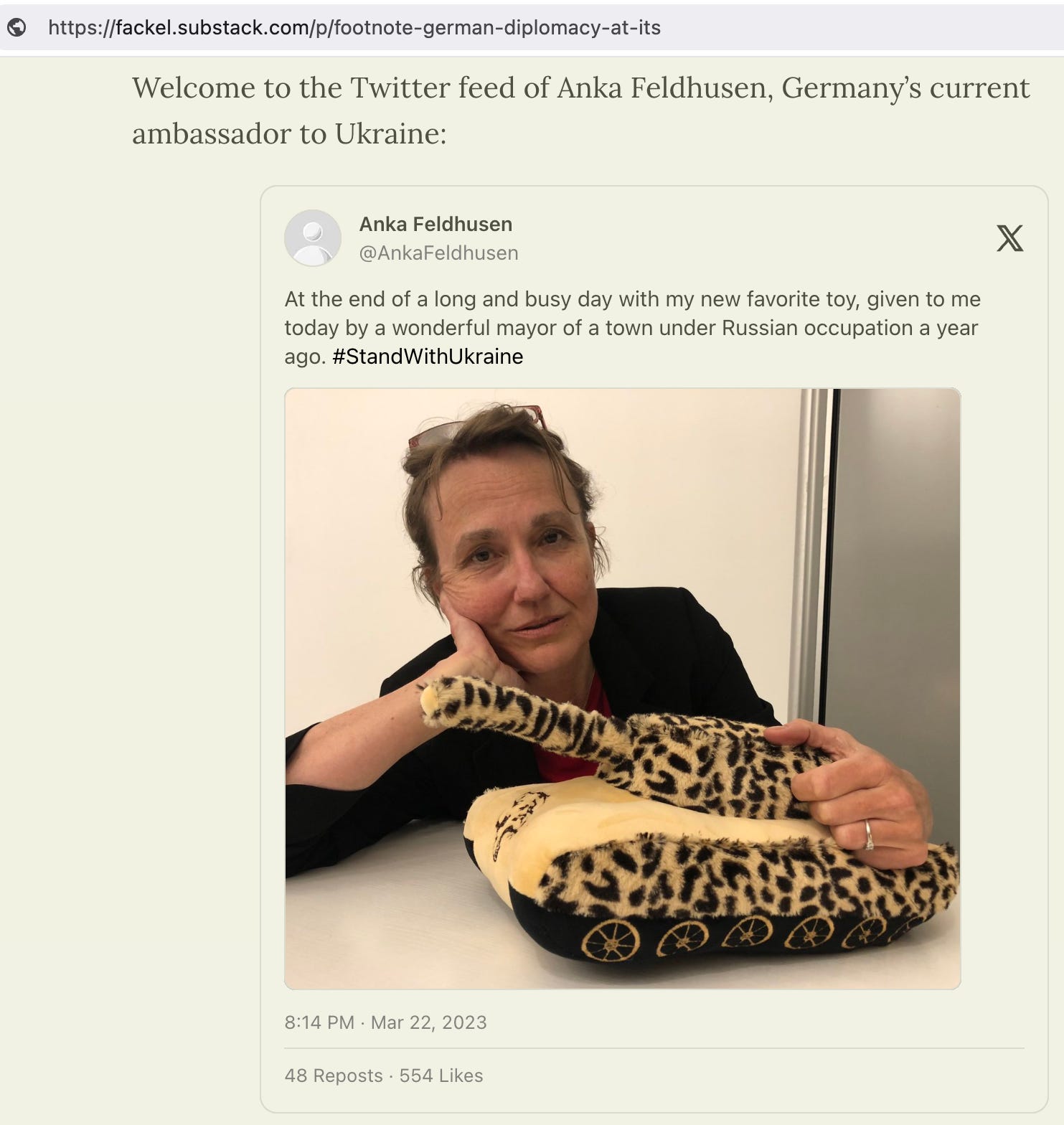
Also, consider this gem from Germany’s current ambassador to Ukraine, one Anka Feldhusen (bits and pieces of her bio):
I’ll close this post by pointing to none other than Max Horkheimer:
He has nothing useful to say about fascism who is unwilling to mention capitalism. [orig. ‘Wer aber vom Kapitalismus nicht reden will, sollte auch vom Faschismus schweigen.’ Source: ‘Die Juden und Europa’, in Studies in Philosophy and Social Science, vol. 8., The Institute of Social Research, New York 1939, p. 115].
At least some members of the Old Left are re-learning about reality-as-is. Let’s see how long until ‘the mainstream’ catches on (but I, for one, won’t hold me breath).
Also, here’s my reason (justification) for mentioning the one halfway useful quip ever uttered by Max Horkheimer (and his fellow Frankfurt School ilk):
What Horkheimer considers ‘capitalism’ is a fiction made up by Marx, Lenin, and their ilk (which, incidentally, includes the Frankfurt School) to conjure up a bogeyman.
Ever since Marx, fundamentally misunderstanding Hegel and Kant, perverted their theories into his creed of ‘scientific materialism/socialism’, a.k.a, History is claimed to progress (sic) through the dialectic, i.e. requiring (in Hegel’s terms) a thesis (the bourgeois mode of production/capitalism), which is confronted with its antithesis (socialism), both of which fight this one out and—voilà—the outcome of this kind of evolutionary fight is: communism.
That may have been a viable theory back in the 1840s, but it wasn’t around 1900, if only because politicians of all stripes—Whigs, Liberals, Conservatives, and what-not—implemented ‘progressive’ policies to stave of the proletarian revolution, with Bismarck and Teddy Roosevelt being quite the poster-children of this era.
Hence, no proletarian revolution in the ‘advanced’ economies of the West (and, as esp. US labour history shows, massive bouts of violence vs. protesting workers).
Lenin looked at this before WW1 and, upon the failed 1905 Revolution in Russia, wrote his infamous essay ‘What is to be done’, re-directing virtually the entire train of Marxist-inspired thought from the prerequisite of industrialisation for a proletarian revolution towards his ‘vanguard’ model (which is more like a conspiracy of declassé intellectuals who appear and make a revolution, like it ‘happened’ in Russia in autumn 1917).
There’s no way a proletarian rhetoric-inspired uprising alone will lead to a socialist-Marxisante revolution; this much everybody knows after the 1905 revolution in Russia, and none other than Herbert Marcuse admitted to this in his One-Dimensional Man.
A lost war, though, is a different beast, and all kinds of things may happen.
Plus there’s the whole other issue of applying the label (‘Marxist’) to Leninist scheming to make it sound as if this was anything Marx and Engels have had in mind (they didn’t, for neither of them could come up with a practical guide of how to arrive at their socialist utopia).
History, of course, doesn’t repeat itself; but what we’re able to discern are elective affinities between small, determined groups to foster revolutionary ambitions, but these require charismatic leadership and the right moment.
If said moment doesn’t arrive, left-ish factions become absorbed by ‘the system’, as happened in Germany 120 years ago.
It is worth remembering that it was on the occasion of the SPD convention in Mannheim in 1906 when the party leadership moved ‘into’ the bourgeois system by denouncing the possibility of revolutionary change. This momentous change—remember: Karl Marx and Friedrich Engels envisioned the World Revolution to emanate from Germany, which was the most thoroughly industrialised economy and society before 1914—led none other than Max Weber (1864-1920), master-analyst of Modernity and its discontents, to say the following:
I would very much liked it to take our German princes with me to the gallery at the Mannheim Party Congress and show them what the assembly was like down below. I had the impression that the Russian socialists, who were sitting there as mere spectators, threw their hands up in horror at the sight of this party, which they regarded as ‘revolutionary’ in the serious sense of the term, which they worshipped as the most powerful cultural achievement in Germany, and as the bearer of a tremendous revolutionary future for the whole world—and in which the ponderous innkeeper’s face, the petty-bourgeois physiognomy, so dominated: There was no talk of revolutionary enthusiasm, and instead a lame, phrase-like nagging, and complaining debate and wailing occurred in place of that Catilinarian energy of enthusiasm [Weber actually wrote Glaube, i.e., faith] which they were accustomed to at their own meetings. (Max Weber, ‘Diskussionsrede bei den Verhandlungen des Vereins für Sozialpolitik in Magdeburg 1907 über Verfassung und Verwaltungsorganisation der Städte’ in Max Weber: Gesammelte Aufsätze zur Soziologie und Sozialpolitik, ed. Marianne Weber, Tübingen, 1988, p. 407-12, at 407; my translation and emphases.)
Don’t tell me that these qualities (sic) aren’t everywhere in what passes for politicking. Or business, for that matter.
He's right too.
But he is right not from an angle of the new Green being a warlike ideological soup (it is but it didn't start out that way), but from a different one:
The personalities - the ambulatory psychological pathologies - making up the leadership-cadres of the post-1980s Greens are what makes them this way, and they in turn have changed their own ideology into what it is today.
The divide between pre-2000s and post-1980s is very clear.
The earlier crop was focused on personal freedom, yes, but as a collective. It didn't trust the state anymore than it trusted the capital to have a care about pollution, habitat destruction or species being made extinct, or biologists playing LEGO with genetics.
The issues were real, tangible and measurable.
The change-over started with the ozone-hole panic, blaming of all things refrigerators and hair-spray use and warning that "when all of China and Africa and India wants a refrigerator the planet will die".
I remember it well.
From then, the pathological personalities having been the ones given more and more room and power, for a host of reasons.
I was under the impression that Henry Ford and IBM industrialized the Nazi war machine in Germany.