
D is for Decision
Part three of a four-part mini-series anticipating the coming year 2026 A.D. (plus a free meme)

By way of an introduction, this year, I would like to try out something new in the next couple of days to celebrate the occasion and to extend an invitation to you to weigh in on my snark.
Hence, the next couple (four) of postings will be thematically as follows:
Observation: where do we stand at the end of 2025 in terms of geopolitics, public health (sic), and personal matters?
Orientation: with concise yet accurate information, let us try to orient in the seemingly endless chaotic mess we find ourselves in
Decision: it’s only-ever possible to make good (right) decisions if properly informed, but one still has to decide on this or that course of…
Action: don’t mull over this or that, once a decision has been made, act
Needless to say, this is a classic four-part series deriving from what’s known as the OODA loop.
Be that as it may, here’s why I’m doing this: it’s a series of thought-experiments designed to help me organise my thinking and the four essays will be short enough to (hopefully) serve you as food for thought, too.
Hence, let’s get started, shall we?
D is for Decision
I think the one and only aspect to consider is the following: if you’ve made a decision, don’t go in half-assed.
There’s nothing wrong with re-assessing one’s earlier decision, and this isn’t what I mean.
I do mean this: you cannot be partially pregnant, and neither is it possible to determine, e.g., that the modRNA poison/death juices are bad for you—and have your cat or dog take any vaccine either (terms and conditions: if necessary, a rabies shot would be the one I’m still considering for both my cat, dog, wife, kids, and/or me).
Don’t consider ‘being sassy’ or even a (self-styled) ‘dissident’ in one field and fall for whatever narrative that’s being spun elsewhere.
There’s no halfway house in these things, I’m afraid; once you’ve seen through these lies, there’s no way back.
Care for a brief example?
Let’s look at the Gulf of Tonkin incident that kicked off the major U.S. escalation in Vietnam (here’s the source = Wikipedia; emphases mine):
The Gulf of Tonkin incident (Vietnamese: Sự kiện Vịnh Bắc Bộ) refers to a naval confrontation in the Gulf of Tonkin off the coast of North Vietnam, which led to the United States engaging more directly in the Vietnam War. On 2 August 1964 there was a clash between a destroyer of the United States Navy that was collecting signals intelligence close to North Vietnamese waters, and three North Vietnamese naval vessels. On the night of 4 August, two US destroyers reported they were attacked by North Vietnamese vessels and that they were returning fire. Later investigation revealed that the 4 August attack did not happen; no North Vietnamese vessels had been present. Shortly after the events, the National Security Agency, an agency of the US Defense Department, deliberately skewed intelligence to create the impression that an attack had been carried out.[5][6][7]
And then there’s this gem, tucked away in the Wikipedia article on the Gulf of Tonkin Resolution (in the sub-section ‘drafting’):
By late May 1964, a rough draft of the resolution that was to become the Gulf of Tonkin resolution had been completed by Bundy which, if passed by Congress, would give Johnson the legal power to use force to defend any nation in Southeast Asia threatened by "Communist aggression or subversion".[21] By the beginning of June 1964, the final draft of the resolution had been completed and all that remained to do was to submit it to Congress.[31] The acting Attorney General, Nicholas Katzenbach, called resolution the "functional equivalent of a declaration of war".[31] The
You see, one could get the impression (lol, sure) that the U.S. forces in staging that second attack on themselves (sic) in early August were somehow instructed to fake this as the preparation of that ‘functional equivalent of a declaration of war’ had been completed two months earlier.
This is the proverbial case of the cart (U.S.-led aggression) before the horse (the casus belli).
Plus, we’ve yet to talk about the insane rules of engagement of U.S. and allied forces in Vietnam, which you read up on here.
Basically, once one decides to do a thing, one should, always, follow through.
And speak about it, e.g., whenever one gets the opportunity.
Doing so ain’t always easy, nor simple; doing so basically doubles one’s workload as one would still need to know, generally speaking, what the ‘normies’ take in to travel their reality™.
So, whatever you do, decide (and note that it’s literally impossible to go half-in on these matters); so you may as well become, well, like that cat.
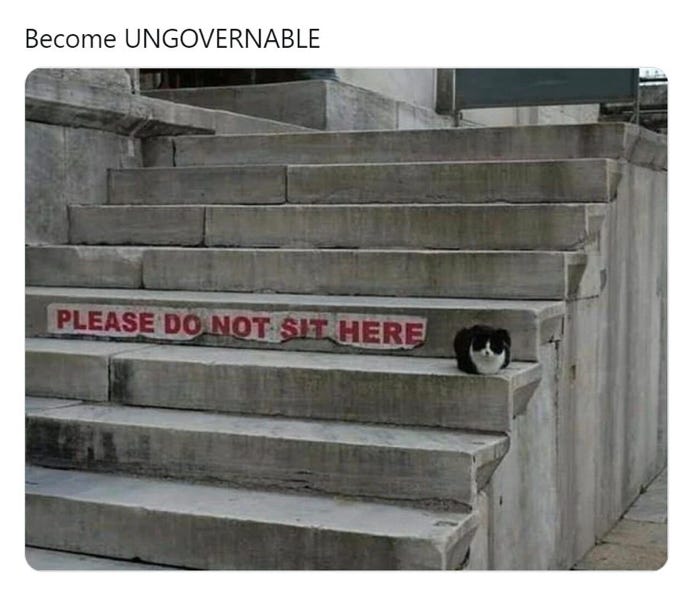
But - misunderstanding the example on purpose here - that also means understanding and sharing the understanding of what the desired goal is.
For the USA, victory in Vietnam was not the objective - continued war was.
Korea had proven that whatever had been learned in the Pacific and European theatres had been just as soon forgotten once most of the real military (the ones who'd been there in the mud so to speak) had been demobilised and replaced with deskmeat from the right mailies and with the right connections.
Imagine the shock to the system Korea was: the military that took on the Wehrmacht and the Empire of Japan losing to Korean and Chinese conscripted peasantry.
Vietnam was necessary not just for political reasons or for profiteering by the capitalists, but for the military to get real on-site job-training.
Same reason "neutral" nations such as Sweden and many others have contributed troops to UN missions: to get combat experience at all lelvels, and to Kofferdam against politicisation of the military (because politicians simply do not learn the lessons of Austria-Hungray, Tsarist Russia, and many others: titles and connections does not make you a good soldier - something Sweden learned over 500 years ago).
And that ties into decision: go all-in fully committed to the path chosen, but do not do so in such a way you cannot make a new choice.
Look at Germany's "Energie-Elände" for the perfect example of that.
My current decisions around a few “hills to die on” means I have mini-conversations with anyone and everyone locally.
Saving and using cash probably being a top one as it’s so easily relatable when handing over cash, standing in a queue, bank terminals being down etc. And it atomically plays into refusing smart tech (aka keep human interactions) and slippery slope to digital id.
For me I will continue to fight majority of “fires” personally and try to influence best I can, I have though a few chosen low hanging fruits where I will actively and vocally try to share wherever I go.