
The Science™ Blames (drum roll) Social Media Use for Plummeting Birth Rates
Experts™ and pundits™ continue to be baffled™ by continuously falling fertility rates: the Science™ with a new (partial) explanation that begs consideration

Short on time, hence no introduction other than we’ve been talking about this for the past couple of days. I found this piece interesting™ and thought you’d might, too.
Translation and emphases [as well as snarky commentary] mine.
Researcher: ‘One hypothesis is that it can be related to social media’
Birth rates are plummeting. A Finnish fertility researcher believes this may be linked to screen time and social media.
By Anders Eidesvik, NRK, 23 Sept. 2024 [source]
Over the past decade, total fertility rates (TFR) in Norway have plummeted.
Put simply, this means that Norwegian women are giving birth to fewer children on average than in the past.

Fifteen years ago, women had an average of two children. Now the same figure is down to 1.4 children per woman.
And it’s not just in Norway that this has happened. The trend is also the same in our neighbouring countries.
With the exception of the ‘baby boom’ during the pandemic [that’s the little bump in 2021], the arrows have only pointed downwards.
The biggest decline is in Finland, where the figure is down to 1.26 children per woman.

So why don’t people have children anymore?
‘I think it’s about culture’
It’s a question that’s very difficult to answer.
Politicians and researchers alike have tried several explanatory models, including economics, family policy, religion, and more [and the modRNA poison juice can’t explain the downward trend before the ‘Pandemic™’].
But despite a lot of research and investigations, the answer is still that we don’t really know.
One of those who believe we need to rethink this is Finnish fertility researcher Anna Rotkirch at Väestöliitto, the Institute for Population Research in Helsinki.
We can’t explain it with economic or socio-political reasons [good-bye social constructivism]. Nor can it be explained by religion or differences in education.
Instead, she thinks it’s about a major change in our entire culture when it comes to marriage:
Changes in relationships
Lifestyle changes
Childlessness
And she sees the changes partly in connection with the technological revolution that took place in Silicon Valley, USA between 2007 and 2010.
The iPhone was launched at the same time as social media such as Facebook really made its way into people’s lives [that’s a tricky one: the first iPhone hit stores in 2007, with social media apps coming around 2012].
Something happened in the 2010s, and one hypothesis is that it can be related to social media, although it certainly doesn’t explain everything.
According to Rotkirch, there are three major things that have changed in recent years.
1. Fewer Stable Relationships
Rotkirch points out that there has been a major change in the dating culture among young people in recent years:
We see that relationships are fewer, they don’t last as long, and they end less often for marriage and children. This is an important piece of the puzzle to answer the question.
Do dating apps play a role?
I haven’t researched dating apps myself. But we have prepared an overview of how screen time, everything you do on your screens—work, social media, dating apps and everything else—affects relationships.
She points out that screen time can have a positive effect on relationships. ‘For example, you can keep in touch with your partner, or find a partner’, adding:
But if you have a partner and spend a lot of time on screen, it affects you in two ways: you are less satisfied with the relationship and there is a greater chance of separation.
2. Lifestyle Causes Us to Have Children Later
Another major change is that people are waiting longer to have children.
Over the past ten years, the average age of first-time mothers has risen from 28.7 years to 30.2:
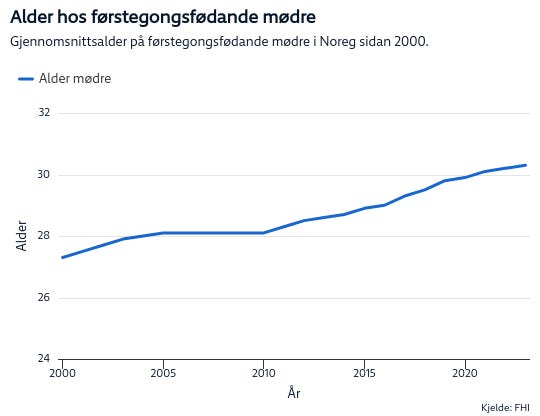
She believes that this is closely linked to the expectations that society sets:
What seems to have happened is that society encourages a lifestyle in which young people are taught to finish their education, jobs and everything else before they start thinking about children [that’s not an encouragement, it’s a set of policy positions/decisions]
This means that people simply start too late. A lot of people don’t manage to have the number of children they say they want to have.
She points out that although there has been great progress in assisted fertilisation in recent years, there is still a biological limit to when women can have children [good-bye ‘Gender Studies™’, and good riddance].
It’s a fact [sic] that if you’re a healthy woman, your chances of getting pregnant and having a healthy child when you’re 35 are only half as great as when you’re 25.
3. More Childless People
Not only are people having fewer children on average, but fewer people are having children at all:
In Finland, childlessness is at a record high. I know it’s much lower in Norway, but we have a very high childless rate. Among Finns aged 40, almost one in four women and one in three men have no children of their own.
In her opinion, childlessness is also about class [which was denied a few lines above: what is it, now?]. Rotkirch points out that those with a high income and education, as well as good health and a stable partner, are more likely to have as many children as they want.
On the other hand, those with fewer resources, lower education, lower income, and especially men, have fewer children than they would like or do not have children at all [that has likely more to do with the fact that women practice hypergamy, i.e., they seek higher-status partners, and if you don’t fall into that category as a man, you’re often stay involuntarily celibate].
Several Theories
‘It’s a very good question why the birth rate is falling. Researchers in all the Nordic countries have wondered about this’, says Statistics Norway researcher Lars Dommermuth, and elaborates:
The Nordic countries used to be seen as a textbook example of how to combine good family policy with high economic participation.
But family policy in the Nordic countries has not really changed, yet fertility has fallen since 2010.
Dommermuth and others at Statistics Norway have researched the financial crisis of 2008-2009:
We firmly believe that the financial crisis caused the fertility rate to fall at that time, but I can’t see that it can explain the persistence of the decline [well, it inched upwards until 2015 before falling again…]
He thinks Rotkirch’s hypothesis is interesting, but emphasises that more research is needed in the field [hello, grifters].
Fertility Has Been Falling for a Long Time
Global fertility has been falling for a long time.
We have gone from a world where women in 1950 had an average of five children, to today where the figure is 2.3 children per woman.

Even in India, the most populous country in the world, the figure is down to 2.3.
For a population to be stable, women need to give birth to an average of 2.1 children.
Bottom Lines
Would you look at that: social media causes fewer children, ‘the Science™’ suggests. If true, we’d better ditch it altogether.
Moreover, as long-time readers know, I’ve written about the topic of dating apps and online dating rather recently:

I think that researcher, Ms. Rotkirch, is onto something when she muses about social media use: if whatever (shoddy) data on online dating apps is any guide, there is a small number of ‘successful’ men vs. a very large, disproportionate share of ‘losers’. It is reasonable to surmise that the former will also, over time, are more likely to father children.
As to Nordic data at-all, well, the Great Financial Crisis of 2007-09 might explain the decline thereafter quite well, in particular in light of the subsequent increase until 2015.
So, we now need to figure out what’s quite likely the cause(s) of the decline since then. This doesn’t exclude the after-effects of the modRNA poison juices after 2021, but the period from 2015-19 begs consideration.
Here are my musings:
Trump Derangement Syndrome and mass-media ‘reporting™’ on ‘the Climate Crisis™’ could have scared a certain segment of the population out of the wits from 2015 onwards.
In 2017, Norway and its neighbours began to restrict mass immigration, which I consider the more likely (part-time) culprit: it’s quite well known that first-generation immigrants continue their traditions etc., and as assimilation continues, by the third generation their habits and number of children are more in line with the host society. I suppose that granular data on ethnicity and background would be a good idea to look into, but I suspect this can’t be done for reasons of political correctness.
The ‘Covid™’ shocks first led to people having more time at home, but once societies in Scandinavia returned to (the new) normal, trends continued, amplified by the modRNA poison juice. So far, the latter’s impact is still obscured by the longer-term trend. We’ll have to wait a bit more to learn if the modRNA poison juice’s impact becomes discernible in accelerating declines in birth rates.
The looming outbreak of WW3 since esp. February 2022 might also contribute in two ways: first, in a comparable vein as the Great Financial Crisis (more insecurity = less, deferred children) and, second, by the importation of Ukrainian refugees whose uprooting and shared culture (small family sizes) were compounded by their uprooting and exile. Put differently: the massive influx of Ukrainians didn’t fix the problem for obvious reasons.
That’s it for now—what are your thoughts?
The why question is interesting. The widespread metabolic problems&obesity and all sorts of pollution may play a role, too. But even more interesting is the how - how will the aging population handle the reality of diminishing resources, and at the state level, lessening of taxable citizens? Or from the warmongering perspective: fomenting war when the young generations are smaller and smaller? I cannot help thinking, that the current crop of politicians, often from the boomer generation, are too scared to even think about this reality. So all sorts of derangement syndromes are popular as cover- up for something that is quite scary to look at. The ratio of dependents&pensioners to working-age folks in 2045? State income from taxes? The current piling up of debt for those future generations that are not coming in looks like a stupid policy. Adjusting to seriously shrinking economy is serious business. What to keep and what to chuck is a difficult issue. From this perspective the immigration policies may represent a misguided attempt at a solution - ignoring entirely the costs and consequences of large scale immigration. But as nobody wants to look at the truth, another round of kicking the can down the road always turns up. All to keep boomer pensions floating (and I belong to that category myself). I'd like to have a pension, but I'd like the future generations to thrive, too.
Appreciation and blessings from Sydney Australia.