
'Partnership preferences between Syrian and Afghan refugees and the German population'
Believe it or not, if you ever wondered 'bout that, the Science™ has the answer: 'high willingness among recent male refugees…whereas whereas resident women exhibit significantly lower openness'

This is too stoopid not to bring up—hence, I’ll delimit myself to the briefest of introductions: I recently read a new paper by Stefanie Heyne and Irena Kogan, both affiliated with the U of Mannheim’s social science faculty. Note that the latter is the chair of sociology, the former’s Ph.D. (2017) supervisor, and currently employs but women.
And here’s the full reference of the paper:
Stefanie Heine and Irena Kogan, ‘Is it a match? The congruence of partnership preferences between Syrian and Afghan refugees and the German population’, Journal of Family Studies (2026), 1–25. https://doi.org/10.1080/13229400.2026.2645727.
And now for the abstract (here and in the following, emphases and [snark] mine):
This study examines partnership preferences of male refugees from Afghanistan and Syria who arrived in Germany between 2014 and 2016 and female residents of similar age. Using two comparable factorial survey experiments implemented in the first wave of the PARFORM panel and the ninth wave of the CILS4EU-DE panel, we analyse general tendencies in partnership preferences as well as partnership preferences based on education and religion. Our findings reveal a high willingness among recent male refugees to partner with resident women, whereas resident women exhibit significantly lower openness towards romantic relationships with male refugees. Comparing partnership preferences regarding the religion and education of a potential partner between male refugees and female residents who share similar characteristics reveals that homophily largely governs partner preferences on both sides, but deviations from this pattern point to alternative mechanisms, including status maximization and preservation of cultural identity. Overall, our findings indicate that beyond educational aspirations, cultural and religious distinctions can shape the expression of partner preferences, contributing to substantial asymmetry in intergroup partnership dynamics.
Two brief comments: in sociology, ‘homophiliy’ means, simply (source):
the tendency of individuals to associate and bond with similar others, as in the proverb "birds of a feather flock together".[1] The presence of homophily has been discovered in a vast array of network studies: over 100 studies have observed homophily in some form or another, and they establish that similarity is associated with connection.[2] The categories on which homophily occurs include age, gender, class, and organizational role.[3]
As to the ‘alternative mechanisms’ cited, such as ‘status maximization preservation of cultural identity’, well, the former indicates that partnering with a refugee confers something (which I’d call virtue-signalling) to the juste milieu while the latter is, esp. in light of the foregoing aspect of homophily, the obvious explanation for whatever reaction™ one sees, be it in voting preferences for ‘right-wing populist’ factions (such as the AfD in Germany, for instance).
There, I’ve ‘splained this for you in terms and a number of words that don’t require such a study™.
Let’s have a closer look at the other gems here, shall we?
Highlights from Heine and Kogan, ‘Is it a match?
Here are the paper’s two main research questions:
Our objective is to examine the extent to which the partnership preferences of male refugees align with those of the female residents. Specifically, we assess whether male refugees with particular characteristics prefer female partners residing in Germany with corresponding characteristics, and whether women with these characteristics exhibit reciprocal preferences for such men. Given the substantial cultural and socio-economic differences between these groups, the study focuses on two key characteristics: religious orientation and education.
By the way, remember the sales pitch of the ‘most educated migration ever’, said to close the gap between supply and demand in the knowledge economy of the 21st century?
While some refugees from Syria and Afghanistan possess tertiary education, many lack formal qualifications or vocational training (Brücker et al., 2020; Guichard, 2020; Spörlein et al., 2020), leading to difficulties in social integration into German society with ever-increasing shares of highly educated women in the resident population (Blossfeld et al., 2015). Consequently, differences in religious affiliation and educational attainment between male refugees and female members of the resident population may reduce the likelihood of forming partnerships between these groups.
Note, by the way, that ‘ever-increasing shares of highly educated women in the resident population’ doesn’t say a thing about productivity, employment, or status.
[the observed] demographic shift towards larger diversity in younger cohorts (Kalter & Heath, 2018; Liu & Kulu, 2025) may influence patterns of partner selection among both recent Muslim refugees and established Muslim minority groups in Germany. However, this does not necessarily imply that the latter minority groups are open to forming partnerships with newly arrived refugees from Syria or Afghanistan (Kogan et al., 2023).
So, why study religious orientation, then, if that resident diversity is, apparently, not too welcoming to the recent influx of Afghans and Syrians? Could it be, perhaps (ahem), that ethnicity plays a role here? If so, why wouldn’t one study that?
(Spoiler alert: it might be that doing so undermines the neat categories built by sociology over decades.)
Don’t be fooled by whatever inputs are used, here’s (in my view) the key aspects that give away the game here, so to speak:
One of the key factors influencing openness to exogamy is personal preferences (Kalmijn, 1998)…While the mechanisms underlying individual partnership preferences are theoretically well established (see next section), research has often struggled to disentangle preferences from other factors…scholars often overlook the two-sided nature of partner preferences…survey-based research is prone to social desirability bias when respondents answer sensitive questions…
In brief: researchers struggle to establish objective truth for several reasons, hence all of this should be taken with a bunch of salt mines.
Here, I’m skipping over the methods section, mainly because there’s a lot of verbiage (e.g., ‘we synthesize existing theoretical approaches on the role of preferences in partnership homogamy and outline potential scenarios for the interplay of partnership preferences by education and religion between male refugees and female residents. Confronting these scenarios with empirical data, the study examines whether both groups strategically utilize education and religious orientation in the partner market. It further assesses how similarities and differences in preferences for these attributes and groups’ characteristics are reflected in overall patterns of preference alignment.’) that essentially boils down to two factoids:
First, as regards sociological theories discussed, note that the key sentence looks to me to be this one:
In ethnically and racially diverse societies, a different form of status exchange [relative to the synthesising literature review performed in the preceding paragraphs] can occur (Davis, 1941; Merton, 1941).
Basically, this was known in 1941, and there’s nothing new to add here, apparently, except for a new dataset.
Second, the findings are, well, similarly deep™, e.g.,
in the context of religious affiliation, individuals are expected to prefer partners who practice the same religion rather than those of a different faith…
The mechanism of exchange for the refugee group aligns with the theoretical framework outlined by Merton (1941) and Davis (1941).
Oh, look, it’s the same bunch of references: what a surprise™.
Sources and data input include the CILS4EU-DE panel, ‘a survey of nationally representative samples of ninth-graders aged 14–15 in Germany, Sweden, the Netherlands and England, in which children with migration background were oversampled’. The date used comes from its 6th iteration (2022), i.e., ‘respondents were mostly 26–28 years old’, with participation rates standing at 87.1%, ‘resulting in 4,196 men and women participating in three modes (web, postal, and telephone) (Soiné et al., 2024)’.
And then there’s this:
The PARFORM survey was designed to study Partnership Formation in the Context of Recent Refugee Migration, with its first wave being conducted throughout 2022 and 2023 in CAPI and CAWI modes. A sample for PARFORM was drawn from 67 municipalities with a high share of Afghan and Syrian refugees in 14 out of 16 German federal states. Addresses were obtained via municipal registers between 2021 and 2023 and the Central Register of Foreigners (Ausländerzentralregister (AZR), provided by the Research Data Centre of the Federal Office for Migration and Refugees (Forschungsdatenzentrum des Bundesamts für Migration und Flüchtlinge (BAMF)) 2023: Sample from the inventory of the AZR from date 31.07.2023 (BAMF-Forschungsdatenzentrum, 2021)).
Basically, two datasets were correlated by using Factorial survey experiment (FSE), which ‘combines features of experiments and surveys’:
Compared to classic survey questions, FSEs offer the possibility to single out how specific factors influence people’s judgments by systematically manipulating the specific factors and randomly assigning the specific factors to respondents of a survey. An additional advantage of FSEs is that they are less susceptible to social desirability bias, as respondents evaluate hypothetical scenarios with simultaneous variation across multiple dimensions…
Here’s the exemplary set of questions resulting from these FSE-guided aspects:
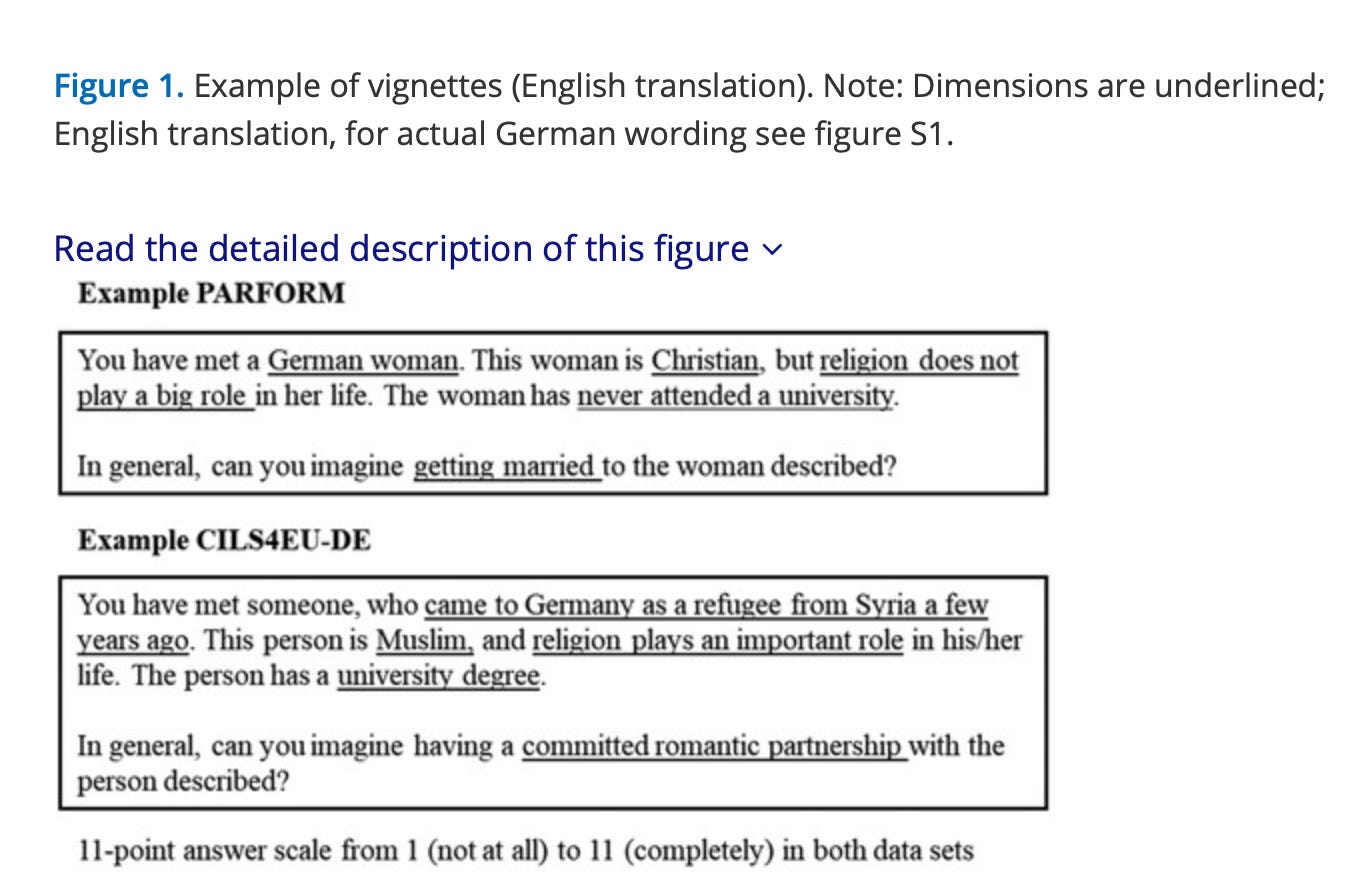
The issues resulting from such an apples-and-oranges comparison are actually spelled out, thus showing the massive in-built biases in the underlying data:
While information on the religious affiliation (Christian vs. Muslim), the level of religiosity (important vs. not important) and education (educational degree vs. no educational degree) of the described person is identical in both FSEs, the information on the origin of the potential partner differs between the two surveys…
Operationalization of the origin of a partner differs somewhat between refugee men and resident women, which may indicate that respondents draw somewhat different boundaries regarding a hypothetical partner’s citizenship, ancestry or migration generational status. Furthermore, while in the CILS4EU-DE survey, the description of this partner was formulated in gender-neutral language (‘you have met someone’), the PARFORM vignettes always described the partner as a woman (‘you have met a woman’) to make it easier to understand for respondents with lower skills of the German language. This difference may have also eased participation among resident women with a homosexual orientation, as the vignette in their case did not presuppose the partner’s gender [excellent point: how many of these women were in the sample? What about homosexuality as a ‘confounder’, generally speaking?]…male refugees with homosexual orientation were instructed by the personal interviewer to respond to the vignette as if the hypothetical partner were male [I’m sure that a) there were sooper many of these and b) that such direct intervention on part of the survey-performers didn’t muddy the waters…]
And here’s the breakdown of the data input:
For our analyses, we used only information of those respondents that evaluated at least one vignette (n = 2880 in PARFORM) and – for the CILS4EU-survey – included only those respondents that identify themselves as being female (n = 2215 in CILS4EU-DE). Furthermore, we excluded respondents with missing information on religious orientation and highest educational degree (60 respondents in CILS4EU-DE, 183 respondents in PARFORM). We then constructed two distinct analytical samples that differ with respect to the inclusion of specific vignettes [we’re at the point where the input is re-organised by the authors]. The first analytical sample (called ‘all vignettes’ in the following) contains 15,896 vignette evaluations by 2,697 male respondents from the PARFORM data and 8,615 vignette evaluations from 2,155 female respondents from the CILS4EU-DE data. The second analytical sample (‘matching vignettes’) contains only the evaluations of vignettes that relate to the respective group of particular interest in this study. For male refugees (PARFORM) these are vignettes that describe the origin of the partner as either being a German woman or a woman that is neither German nor co-national, but lives in Germany. For female members of the resident population (CILS4EU-DE) these are vignettes that describe the partner as being either a Syrian or an Afghan refugee. This data set contains 7,938 vignette evaluations for male respondents and 4,307 vignette evaluations by female respondents.
There’s a significant over-representation of male refugees vs. female locals, something that screams non-representativeness in general and, given these comparatively low numbers—4,307 women out of perhaps 60m or so Germans (sure, adjust for age bracket and sex)—vs. close to 8K men out of a refugee population of (as given by the authors) 1.4m (similar adjustments required) means that the sample is also under-powered to staggering degrees.
There’s also a section on religious orientation and educational attainment, which is totally in line with expectations (refugees are more religious and less educated).
The give-away in writing, however, is here:
In all the following analyses, we employ linear regression analyses. Since each respondent evaluated several vignettes, the observations are not independent. To account for this, we calculated robust standard errors clustered by respondents. Additionally, we control the survey mode (CAPI vs. CAWI in PARFORM; PAPI vs. CAWI in CILS4EU-DE) and the order in which the vignettes were presented. Since the experimental design and the randomization of vignettes reduces the risk of confounding and omitted variable bias, we do not control any respondent’s characteristics in our analyses. It is important to note that all subsequent results are based on models [!!!] that include the full set of vignette dimensions. In presenting the findings, however, we focus only on those vignette dimensions relevant to our theoretical expectations [that one gives away the game]. The results of the full models are reported in the supplementary material.
And here are the findings:
We observe a high level of openness among male Afghan and Syrian refugees towards partnering with members of the female resident population. By contrast, openness among resident women of a similar age towards partnering with a refugee is comparatively low. In light of the pronounced socio-economic and cultural differences between the two populations described above, these findings are not that surprising.
Boy, am I glad we now know that for sure (given the literature from the early 1940s, I suppose the paper can be added to the X+1 category of such findings).
I’m similarly skipping over the particulars of their detailed enquiries into whether religion of education is more important, which yielded the following results:
The preference for university-educated partners among respondents with lower education points to the status maximization…Among resident women, this pattern may also reflect an exchange mechanism, whereby less educated women seek partnerships with more highly educated individuals, consistent with Hypothesis 3b.
I’m unsure if they still teach hypergamy (marrying/mating upwards) as a concept in sociology, but that’s kinda like the foundational notion taught over a century ago, which also ‘splains that kind of behaviour. (Note the wording ‘consistent with [our] hypothesis’.)
Sigh.
Results and Surprises (not)
Our results indicate a high level of openness among male refugees towards partnering with female members of the resident population, but a comparatively low level of openness among the latter towards partnering with recently arrived male refugees. This implies [sic] a substantial incongruence in partnership preferences among the two groups. Given the stark difference in individual characteristics among male refugees and resident women, this is not surprising [doh]. A closer examination of these potential partners’ characteristics reveals pronounced homophily patterns [i.e., finding a mate that’s alike] as well as several noteworthy deviations from the homophily matching mechanism.
And these ‘several noteworthy deviations’ are important, too:
We found a general disapproval of a religious partner – regardless of their specific religious affiliation – among non-religious male refugees and non-religious women in the resident population. Interestingly, in the absence of a religiously unaffiliated partner option, individuals without religious affiliation tended to prefer a Christian over a Muslim partner.
I’m coming out strongly in terms of this shows considerable biases, of course, but this can be explained, I’d argue, by pointing to tradition and heritage, right? The below section follows the above paragraph directly:
Both, male and female religious Christians showed an approval of a Christian partner, which is particularly strong if this partner is religious. Religious Muslim men and women displayed a stronger preference for a Muslim over a Christian partner, but they differed in how they evaluated the importance of this partner’s religiosity. While all these findings are in line with matching based on homophily, the following result aligns rather with a different mechanism. Our findings show that while religious Muslim refugees show a preference for a religious partner of the aligning affiliation, this is not the case among religious Muslim female members of the resident population [translation: female Moslems don’t prefer religious nutjobs]. The lack of preference for religious Muslim refugees among female Muslims in Germany could align with the status maximization scenario [of course; it could also have to do with, you know, news reports about stone age Afghan men, eh?]. At the same time, this could also be a sign that religious Muslim women from the resident population in Germany differentiate between Germany-based or their ethnic group-specific Islam and the one brought in by refugees from Syria and Afghanistan [q.e.d.]. This pattern might reflect a broader cultural distinction, where established Muslim communities perceive newly arrived religious practices as unfamiliar or even incompatible with their own interpretations of Islam [could it be, say, that these recent refugees bringing with them their Wahabi-inspired creed is the reason here or, alternatively, as Heine & Kogan posit, this is why]. Additionally, it could indicate a social boundary meant to maintain a sense of stability and continuity within their own communities, resisting external influences that might challenge their established norms and values.
And here’s the final verdict from the paper:
Our results show that…there is a significant mismatch between the two groups. The strong openness of male refugees toward women from the resident population – beyond what matching based on homophily would predict – appears to be driven in large part by their absolute preference for highly educated partners [that’s surely the case for an illiterate refugee from, say, rural Afghanistan]…the reluctance of resident women to accept partnerships with refugees is largely explained by their rejection of the ‘imported’ religious Islam [we definitely needed the Science™ ‘splaining this to us]. It is possible that resident women perceive the religious practices of newly arrived refugees as different from their own, reinforcing a social distance that limits intergroup partnerships. Moreover, this reluctance might not only reflect religious differences but also concerns about gender norms or perceived lifestyle incompatibilities [yeah, sure, why not throw reality in there, too, for a change].
Limitations include different surveys and gender biases, which are ‘not expected to be substantial’, while the entire paper—which is in the peer-reviewed literature, no less—concludes with this note:
Finally, it is important to note that we cannot directly test the underlying mechanisms driving partner preferences. Instead, we rely on theoretical frameworks to derive hypotheses that describe patterns potentially covered through several mechanisms. This means that our interpretations should be seen as indicative rather than definitive, highlighting the need for further research to test the underlying mechanisms driving partner preferences.
So, basically, theory and hypotheses trump reality, which is also so much more complicated that it can, at this point, not be tested.
Please fork over more money for ‘future research’ into this truly mind-boggling matter.
Bottom Lines
Apologies for having wasted your time; I hope you got something (snark, perhaps?) out of reading it.
This is the gold standard (peer-reviewed) social science, folks, this is as good as it gets.
I have no idea how much money this paper cost, but I know one thing: I could have told them for free and used up way less time to do so.
People like to look for partners that look and, yes, feel, more or less alike. There’s nothing that requires further elaboration here, with perhaps the general notion that women tend to be more o.k.-ish to partner with stronger conquerors, as per, say, the Italic-Roman legend of (drum roll; source)
The rape of the Sabine women (Latin: Sabinae raptae, Classical pronunciation: [saˈbiːnae̯ ˈraptae̯]; lit. ‘the kidnapped Sabine women’), also known as the abduction of the Sabine women or the kidnapping of the Sabine women, was an incident in the early history of Rome in which the men of Rome committed bride kidnappings or mass abduction for the purpose of marriage, of women from other cities in the region. It has been a frequent subject of painters and sculptors, particularly since the Renaissance.
The word “rape” (cognate with rapto in Portuguese, rapto in Spanish, ratto, in Italian, meaning “bride kidnap”) is the conventional translation of the Latin word raptio used in the ancient accounts of the incident. The Latin word means “taking”, “abduction” or “kidnapping”, but when used with women as its object, sexual assault[2] is usually implied.
One could also look at other examples, ranging from the Mongol conquests of China and the Arab world to British governors of India taking local wives to the many women in occupied Germany or Japan who ‘got friendly’ with the conquerors.
What’s in this for the women, you might ask? Well, a protector of sorts, and the potential to further one’s bloodline (that someone from one’s own tribe didn’t manage).
So, is life fair, one might ask; it’s quite likely not, and while the massive immigration into Western countries has changed our societies drastically in a very short period of time, let’s not forget that this is happening as there are fewer and fewer ‘indigenous’ men who are worth the trouble.
While this shouldn’t downplay the real tragedies and crimes connected to, say, rape and grooming gangs, domestic violence, and other forms of problems in society, there may also be a quantum of truth in the notion that women might choose recent immigrants for biological and social (ideological) reasons.
Too bad we cannot have an open discussion about these things, eh?
Did the authors, at any point in the paper, research if the men had a permanent residence permit (which would be granted after marriage to a German woman)?
First they used my tax money to feed the incoming men. Now they are using my tax money to investigate why German women won't marry these men. In the future they will use my tax money to subsidize marriages between German women and foreign men.
The real problem that they are missing is that the new male arrivals are, in fact, lower status than native male population however deficient the native males may be as a group. The Syrian and Afghan men are trying to marry up. That doesn’t work for men. Basic Biology and Basic Social Behavior. Wonder if I can get paid by this worthless PhD factory.