
NATO’s Eastern Flank: Deutsche Bahn and the Bundeswehr’s War Preparation
While passenger rail transport sucks in Germany, we're told to rest assured that the cargo subsidiary will deliver the goods in case of open fighting vs. Russia! Russia! Russia!

In spring 2024, I brought the so-called Operationsplan Deutschland to your attention, which was decried loudly by feminist icon Alice Schwarzer, among others, in the following ways (words):
Germany is actively preparing for war, even [sic] within our country. On behalf of the Ministry of the Interior, Lieutenant General André Bodemann has spent the past twelve months working together with 150 experts to draw up an ‘Operation Plan Germany’…
According to the general, this is not only a task for the state as a whole, but also for society as a whole. Keyword: ‘Operation Plan Germany’. The General is already ‘looking forward to the great task’ and is pleased that he has met with approval everywhere so far.
Read the rest here:

Last time we checked in with Deutsche Bahn, it was in spring of this year:
What does Deutsche Bahn need most urgently? Diesel locomotives and flat wagons! Well, if we were living in normal times, it would probably need both least of all. In fact, almost half of the German rail network is still not electrified…
‘Due to the low capacities, it is almost impossible to quickly deploy a large number of tanks from and through Germany towards NATO’s eastern flank…
In the likely event that the power grid is attacked, Deutsche Bahn will need many more diesel locomotives than it does today.’
If you’re up to that kind of nonsense, please find out (much) ‘more’ here:
Today, we’ll follow-up on this issue as the Tagesanzeiger recently spoke about the great strides the Bundeswehr, Deutsche Bahn (I know), and everybody else concerned made since April 2024.
Translation, emphases, and [snark] mine.
Transport Infrastructure on NATO’s Eastern Flank: Deutsche Bahn and the Bundeswehr’s War Preparations
In confidential working groups, the Bundeswehr and Germany’s railway subsidiaries DB Cargo and DB InfraGO are preparing for a possible attack.
By Jens Tartler, Der Tagesanzeiger, 27 Aug. 2025 [source; archived]
Deutsche Bahn and its subsidiary DB Cargo are often mocked [and rightly so]. But after Russian dictator Vladimir Putin’s attack on Ukraine in 2022, the freight transport company was able to demonstrate its untapped potential. Because coal-fired power plants in Germany had to be ramped up, DB Cargo brought 1,000 coal wagons out of the so-called standstill reserve within six weeks [I’m unsure about that connection, but I think it’s the Nord Stream attack implications for total morons; also, consider the achievement: 1,000 carloads in six weeks is an awe-inspiring rate of 166 railroad cars a week—not too shabby for a company with 26K (2019) employees, 2600+ locomotives (‘traction units’), and well over 82K railroad cars (sayeth Wikipedia)].
The railway company admits that DB Cargo has far too many wagons [speaking of railroad cards…]. ‘But it has resources like no other railway in Europe.’ [Ah, DB Cargo has been made great already] Therefore, the German government must under no circumstances ‘wipe out’ the company [because—no-one knows when we’ll all are supposed to march east once more].
Because DB Cargo is not only helping to mitigate the consequences of the Russian war of aggression, but is also NATO’s most important logistics provider in Europe [which is also why DB Cargo has that many railroad cars], experts from the railway subsidiary, the infrastructure operator DB InfraGO, and the German Armed Forces are collaborating in working groups. Similar groups also exist for the energy industry and IT security [but that’s not to be talked about as publicly as the railroad stuff, mainly because people tend to like choo-choo trains and stuff (unless they have to travel with the Deutsche Bahn, or DB for short].
Train Carrying 18 tanks weighs 1,000 Tons
‘Defense is a task for society as a whole’ [orig. Verteidigung ist eine gesamtgesellschaftliche Aufgabe], railway circles declare: ‘When the German government was looking for partners, DB was an obvious choice.’ [lol, this is way too stupid: continental Europe, for reasons that are easily explainable (outside Britain and the US, too little capital was freely available for such projects) and clearly understood (there’s no discussion about the role of gov’t (they had it built, and since the ‘Civil War’ in the US (1861-65) and the 1866 war between Prussia vs. Austria, railroads were essential in every major war since), went for state-owned/managed railroad companies from the 1830s onwards (in some cases with bouts of privatisation in-between), and since it’s only states that may wage war, it’s a matter of course that gov’ts take recourse to—railroads…].
Officially, a spokesperson for the state-owned company stated in response to an inquiry
Deutsche Bahn is a partner for the Operationsplan Germany, to meet the new European challenges, including in the area of military logistics, together with the German Armed Forces and NATO members. This partnership is already supported by an efficient transport network.
Then comes the postscript: ‘We ask for your understanding that, for obvious reasons, we are unable to provide details of military logistics and contract content.’ [doh]
The network’s capabilities were demonstrated, for example, when the Bundeswehr brigade was deployed to Lithuania. The majority of the logistical task was completed within six weeks [for comparisons, in WW2, a coup d’état in Yugoslavia (27 March 1941) was followed by a German invasion that began on 6 April and involved 337K soldiers, 875 tanks, and 990 aircraft; by contrast, the Armoured Brigade cited here, Panzerbrigade 45, or the Litauenbrigade, consists of 4,800 military personnel that will be ready by 2027 (sayeth Wikipedia), but let’s note that the operation has began in 2024]
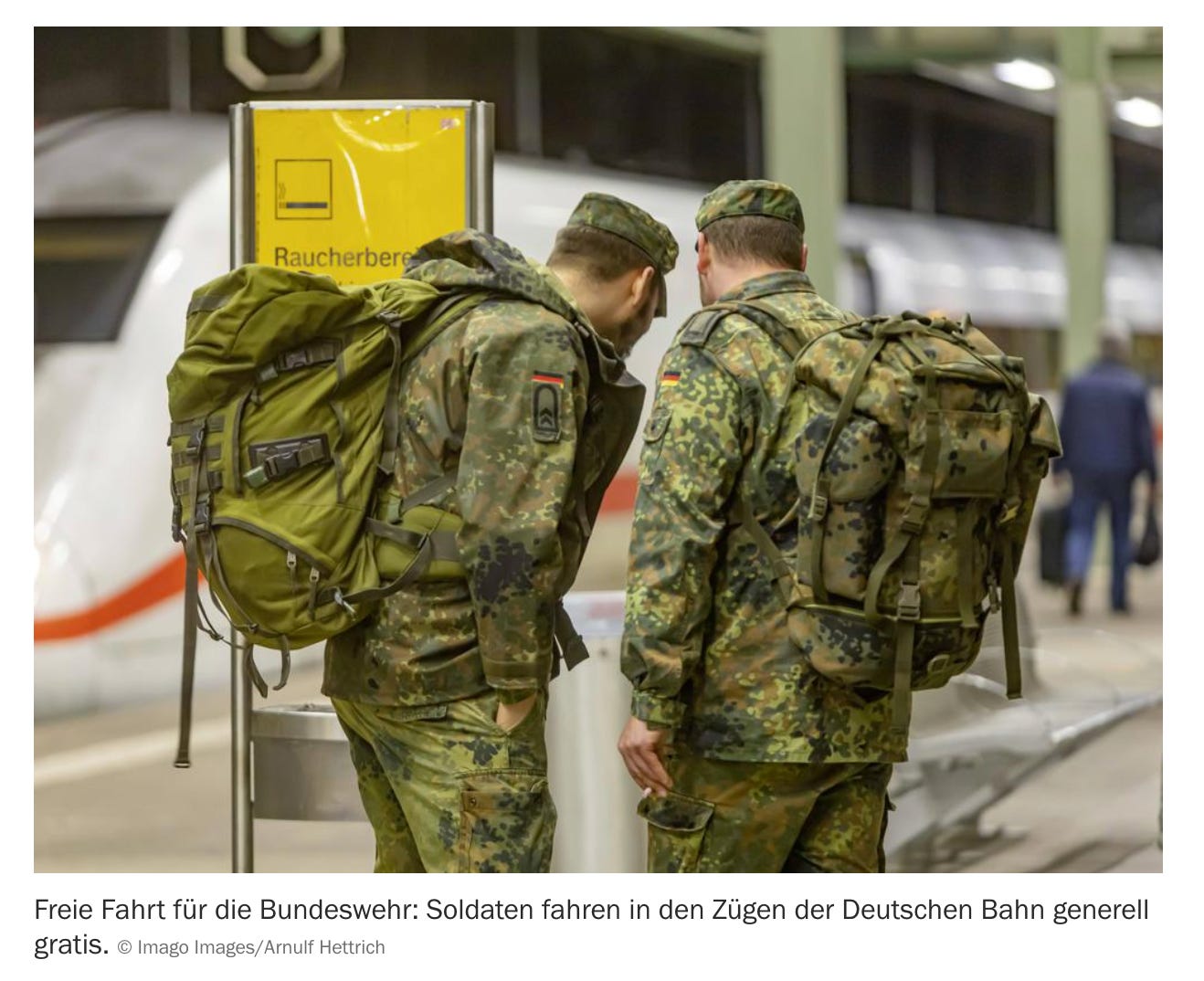
Free travel for the Bundeswehr: soldiers generally don’t pay train fares.
A single Leopard 2 battle tank weighs 84 tons. Sigrid Nikutta, head of DB Cargo, said at the Munich Security Conference in February that a single train could transport 18 tanks or 60 ammunition containers. According to Nikutta, such a train weighs 1,000 tons [aren’t you amazed what kind of weight these cute choo-choo trains can pull? Also, good luck east of Germany, for Soviet tanks were generally lighter than Western ones, which also means that railroad bridges typically can’t carry these trainloads].
If NATO’s external borders were threatened, up to 800,000 soldiers from the allies, along with their weapons, vehicles, and supplies, would have to be relocated as quickly as possible across Germany to their respective operational areas within 180 days, where they would be accommodated and cared for [we’ll talk more about the accommodation aspect tomorrow, for the time being, let’s just express the planners’ hopium that ze Rooskies will also adhere to these time-tables (‘cause if they don’t, well, all the well-paid contractors doing™ the planning may throw up their hands decrying that ze Rooskies are baddies and weren’t playing along)].
Standard-Gauge Tracks to Lviv
To help Ukraine in its current war against the aggressor Russia, military equipment is being transported by NATO partners from the Baltic Sea ports to a logistics hub south of Krakow and then on to the attacked country. During the war, Ukraine managed to lay tracks with almost the same standard gauge as the rest of the world [this is widely misleading: in the former Eastern Bloc, a wider gauge is used, which is the second most-used gauge]. A wider gauge is used in the countries of the former Soviet Union [I do wonder who paid for this and who carried out that work; also, while we’re not talking about a lot of mileage here, this is an important logistical aspect, and for further particulars, please see the footnote1].
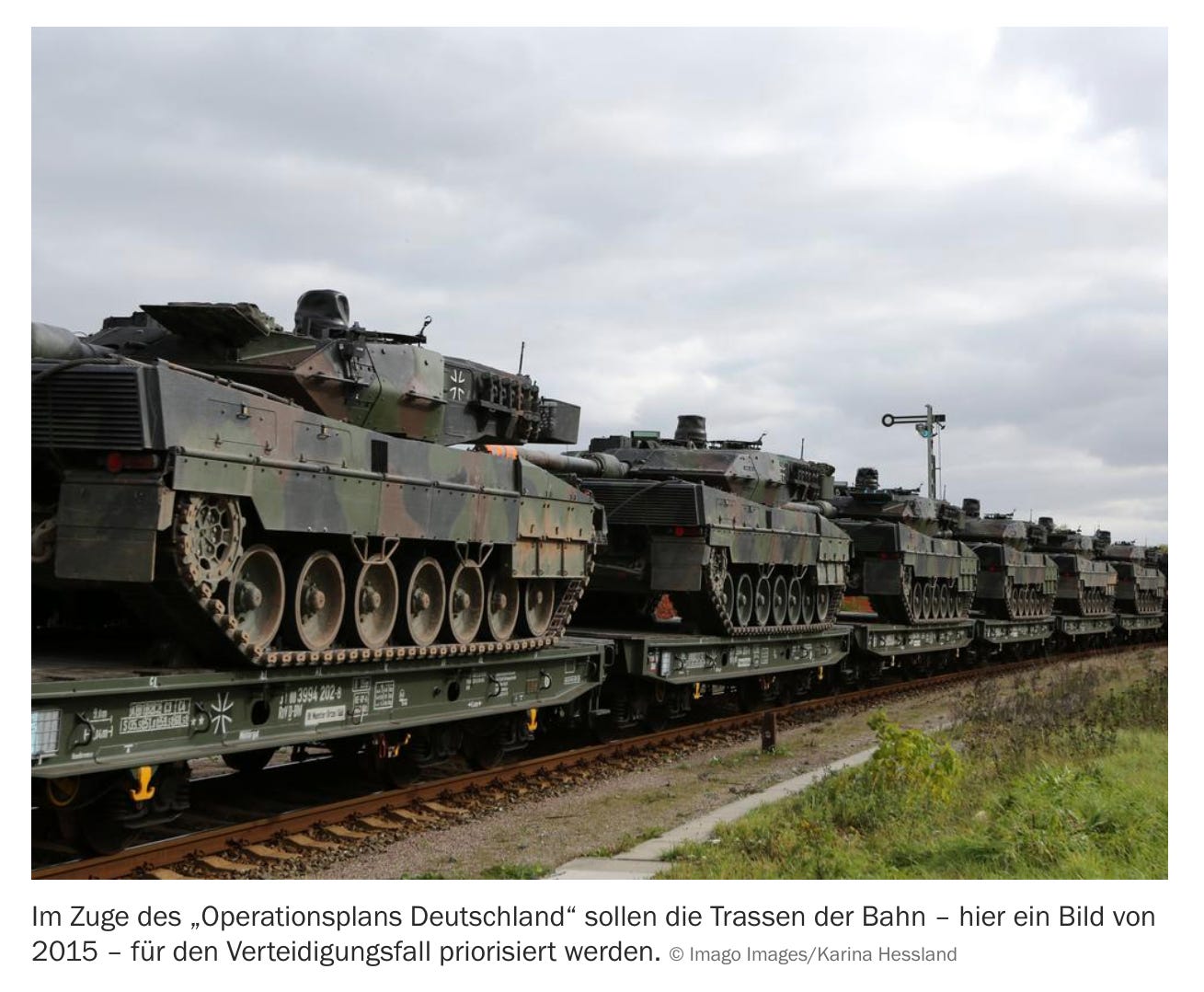
Like other members of the defence [sic] alliance, Germany has a NATO rail network. Routes have been classified, and bridges have been examined for their load-bearing capacity—an important consideration for a train carrying multiple Leopard 2s. However, the railway company points out that there are much greater problems with motorway bridges in this regard [these, too, are very tricky to overcome, and for edification, I direct your attention to this account by the Modern War Institute at West Point, parts of which I’ll cite for you in this footnote2 (go ahead, you won’t regret it)].
As part of the Operationsplan Germany, rail routes are to be prioritised for defence purposes. In this case, passenger trains such as the ICE would, of course, also be stopped because military logistics takes priority.
The railway company states:
We are already doing a great deal. But now the Bundeswehr must define how we strengthen NATO’s eastern flank. What do we still need? Where do we need to upgrade something?
[ahem, do check out Rail Baltica, the EU’s largest infrastructure project—here’s a primer from their website:
Until World War II, the Baltic states were linked to Europe by a standard 1435 mm gauge railway. Since the mid-20th century, however, they have operated on the Russian 1520 mm gauge, aligning rail traffic primarily along an East-West axis. Today, most freight still comes from CIS countries, moving on 1520 mm infrastructure. This hinders integration with the EU rail network via Poland due to technical and logistical barriers.
Rail Baltica, part of two major EU transport corridors, will connect Estonia, Latvia, and Lithuania to the standard-gauge European network—bridging the gap and fully integrating the region into the EU rail system.’
And let’s check in on the construction update (via Wikipedia):
As of 2025, the completion of the single-track railway from Tallinn to the Lithuania-Poland border as part of phase 1 is scheduled for 2030, with the rest of the network’s schedule dependent on funding.[7][8]
That’s the one single-track railway that will win the war.]
In Germany, the development of a basic military railway network is almost complete, according to the Federal Ministry of Transport. The basic military road network already exists. It includes roads suitable for military deployments.
In the fight for budgetary resources, politicians at state and local levels are now trying to qualify their favourite road and rail [pet] projects for these basic networks. This could undermine the military logic behind them, warns Paula Piechotta, Green Party budget expert in the Bundestag [she’s a 36 year-old woman whose background is medicine and who, according to her Wikipedia profile, ‘works 2 days a month as a radiologist at the MedVZ of Leipzig University Hospital.[1][2]’ That amount of education and experience, as well as her political focus being health policy (sayeth Wikipedia[4]) renders her a ‘budget expert’ for the Greens, by the way]
Helicopters and Infrared Cameras for Surveillance
Since all political leaders agree that Germany is already engaged in a hybrid war with Russia [for we’ve always been at war with Eurasia], critical infrastructure is also being protected against acts of sabotage and espionage. This is where the federal and state interior ministries and their police forces come into play. They are using helicopters and infrared cameras for surveillance, for example.
In October 2022, six months after Putin's invasion of Ukraine, the German government also established a joint Critical Infrastructure Coordination Staff at the state secretary level. The then-Federal Minister of the Interior, Nancy Faeser (SPD), referred to the acts of sabotage on the Baltic Sea pipelines and the railway infrastructure and emphasised:
Since the beginning of the criminal Russian war of aggression against Ukraine, we have also seen a changed security situation in Germany and Europe.
A spokesperson for the Federal Ministry of the Interior recently said in response to an inquiry:
In principle, the operators themselves are primarily responsible for protecting critical infrastructure.
At the same time, it is a national task in which the federal government, states, and municipalities work closely together with the operators.
Bottom Lines
As stupefyingly maddening this kind of coverage is, we gotta keep tabs on ze Germans returning to the role they played since the 1860s: central Europe’s potential power-house with world-power ambitions. Background here:

Needless to say, coverage like the one presented above is hare-brainedly stupid, only works on those who are too lazy to understand logistics, and don’t give a flying f*** about the real world: a single-track line from Poland to Talinn available by 2030?
C’mon, man, WTF?
When my grandfather (1922-88) first deployed to the Soviet Union in summer 1942, it took him several days to reach the end of the railroad: his train left Vienna on 30 July, to arrive at Orel on 4 August 1942. And Germany’s efficiency in running trains was a tad better back then, I’d argue.
This is all too maddening and, frankly, insulting to the intellect of anyone who’s able to add 1+1 and come up with the axiomatic answer 2. That, of course, appears to exclude German and NATO planners, as well as the experts™ and journos™ who write about that nonsense.
So, I’ll repeat the wrap-up of mine that accompanies the top-linked piece by Alice Schwarzer:
What the German generals are doing is—despicable at-best. Cheering on the US troops marching east, giving them ‘free hugs’, and ‘offering coffee’ while they are assured, by the German ‘leadership’ (sic) that this is all that’s required.
This is delusional, and, I’d argue worse than the Covid shenanigans, as whatever happens ‘at the front’ will not stay there.
So, this is where we are (kudos to Poland Balls):
These are the connections (source; emphases indicates the Ukrainian terminus):
Przemyśl–Mostys’ka (Poland/Ukraine)
Przemyśl–Chyriv and Stryj–Starjava railway lines, reopened by 2023 as a result of the Ukrainian War. From 1963 to 1995, this connection provided standard-gauge privileged through traffic on the Przemyśl–Zagórz route.
Halmeu (Romania)–Vynohradiv (Ukraine)–Batjowo–Záhony (Hungary) railway line
Tereswa–Valea Vișeului railway line (section of the Sighetu Marmației–Ivano-Frankivsk railway line), 60 km, Romania
Note that the first three are between 5-15km deep in Ukraine, with ‘only’ Ivano-Frankivsk being some 75km (north) to 100km (east) of the Romanian and Polish borders, respectively.
This isn’t a small feat, but it’s not going to change the big picture, that is, unless ze Rooskies advance so far across the Dnjepr that whatever remains of Ukraine will be mainly in its north-west (note I’m not advocating/hoping for such an outcome, I’m merely pointing out the obvious here).
And I shall quote without much further ado:
Unlike the Russian Federation, NATO forces do not enjoy the same unrestricted freedom of movement for military forces across friendly territory. Currently, the Baltic states operate Russian-gauge railroad tracks, while other European NATO members utilize a standard European gauge (a single [!!!] line from Poland to the Lithuanian city of Kaunas is the sole exception). This incompatibility means that trains carrying military equipment and supplies from larger NATO bases in Germany or Poland would have to transfer their cargo to Russian-gauge trains or proceed via ground convoys to their destinations. Not only are both options time-consuming, they require trained personnel and significant military resources (e.g., heavy equipment transporter systems, military police and security elements), as well as proficiency and familiarity in conducting such operations.
Baltic rail infrastructure significantly lags behind other European nation-states. A north-south axis across the three countries is currently nonexistent. Plans to correct this are already in motion in the form of Rail Baltica, the largest EU infrastructure investment project in the Baltic states. Ultimately connecting the capitals of Estonia, Latvia, and Lithuania via European-gauge track (along with an additional connection to Helsinki via Tallinn), Rail Baltica would allow for a standardized and uninterrupted rail link to the rest of NATO, with freight service up to 120 kilometers per hour. Though broad commitments by the EU and Baltic states have been made, the project is not expected to be completed until 2025.
Crazy stuff on all aspects. Since all this war mongering is ostensibly happening because the Russian Bear intends to invade Europe, Russians would have do the inverse when it comes to different railroad gages. Where is the evidence that Russia is building trains capable of traversing the narrower Euro gauge?
Of course, none of this has to do with any reality and more to do with “East India” imperial strategy. German government works for the Empire. How else to explain their incapacity to correctly assign the blame for the destruction of the North Stream pipeline? They do (or not do) everything based on the imperial directives.
WWI was the war to cripple Germany. WWII was the war to have Germany and Russia exhaust themselves. WWIII is to stop the Euro-Asian integration, weaken Russia and take over her vast natural riches, and to fully integrate China into the New World Order (the wet dream of the Money Empire).
In order for this to happen Germany must perform its farcical role with the level of incompetence which reflects its fundamental vassal reality.
Delusions and madness… Thanks for the Polandball link I’ve not come across that, made me laugh :) and now more to watch.