
Green™ Lockdowns in Bergen, Norway
Citing 'air quality issues', Bergen municipality is 'recommending' all public employees to 'work from home': the WHO's wet dream of One Health™ coming true before our eyes

Since we started this week by talking about climate activism masquerading as the Science™, I may very well share something that happened over the weekend that’s very much related to this.
As this post’s title indicates, the Bergen metro area is pioneering a form of ‘soft’ climate lockdown these days due to ‘air quality problems’ as detailed below.
Since we’re quite deep into ‘totally smug, virtue-signalling BS-peddling’ territory with this measure, it strikes me as a brilliant idea to direct your attention to the celebration of ‘EV adoption saving lives’ from the ancient era of (drum roll) late 2025:

And without much further ado, here’s this week’s runner-up for the category of ‘news in stupid virtue-signalling’; all non-English content comes to you in my translation, with emphases and [snark] added.
Act 1: A Message from Above
Late on Saturday evening, the following message arrived in my inbox:
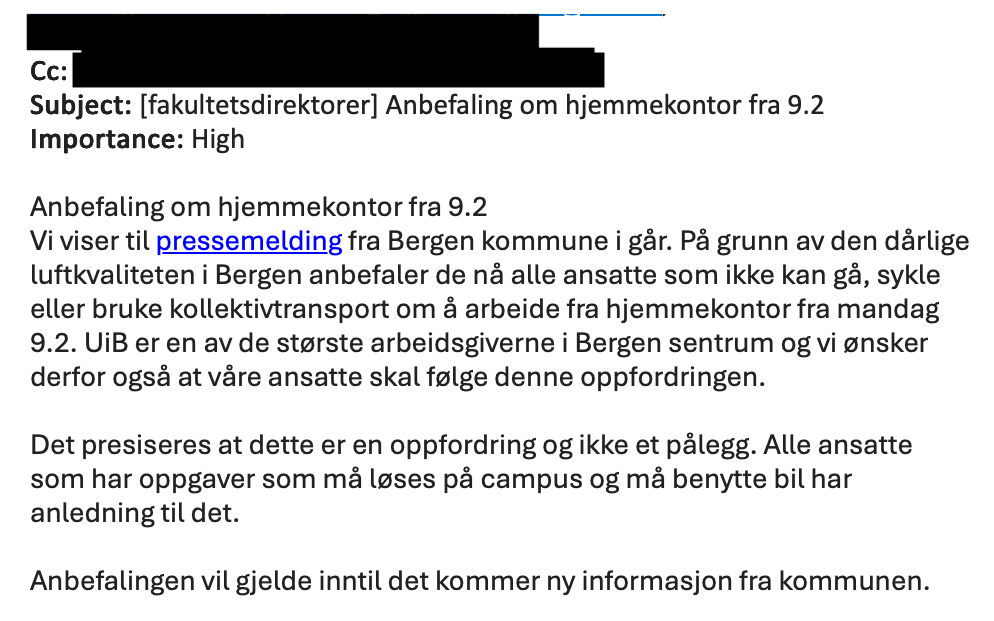
Subject: Recommendation for home office from 9.2. [anyone who understands anything about Norwegian official-speak knows that an anbefaling is treated as if it was an order; most Norwegian Covid mandates were ‘recommendations’]
We refer to the press release from Bergen Municipality yesterday. Due to the poor air quality in Bergen, they now recommend all employees who cannot walk, bike, or use public transport to work from home from Monday 9.2. UiB [the University of Bergen] is one of the largest employers in the centre of Bergen and we therefore also want our employees to follow this request [see what I meant about the ‘recommendation’? They aren’t ‘too polite’ to say out loud what they want, they simply clothe it in less-than-too-unfriendly lingo]
It is clarified that this is a request and not an order. All employees who have tasks that must be solved on campus and must use a car [sic; also: lol and morons] have the opportunity to do so.
The recommendation will apply until new information is received from the municipality.
There’s but one thing I’ll add right now—and that’s the very nature of this kind of politicking: where I come from, if someone ‘recommends’ something to me, I’m making up my mind (mostly, I do so and decide otherwise, much like, say, advertisements ‘recommending’ this or ‘suggesting’ that); when I came to Norway in summer of 2020, almost all Covid-related nonsense was similarly ‘recommended’, to which my default reaction is, thank you, but no, thanks.
But the present context is, of course, way wilder than the above-related email suggests; it is to the press release by the municipality of Bergen that we turn next.
Act 2: ‘I’m From the Gov’t, and I’m Here to Help’
As indicated in the above email, and much like during the Covid shitshow, we’re also deep inside the gov’t by press release phase, which means, above all, that something is announced with all the accoutrements of ‘the greater good’ or ‘the common weal’—which means, in reality, that it’s an edict or diktat that must not be questioned, and which cannot be questioned as it’s not emanating from, say, the city council or any other representative assembly. Note, further, that those who invite media and the public to such press briefings may also determine if questions are permitted or not (and in this context, a press release is all that was done, plus some reporting™ in legacy media).
Here’s the press release (archived), written by one Håvard Prestegården, with its main points highlighted; speaking of important aspects, I merely note that it was first published on 5 Feb. 2026 and updated on 6 Feb. 2026—which means that it took the University of Bergen another three days before they reacted™—on a Saturday evening (at 7:28 p.m., no less).
This is What the Municipality is Doing to Improve Air Quality
Sweeping the roads is among the measures to address the pollution. ‘We are monitoring the situation very closely and are continuously considering more measures’, says Eivind Nævdal-Bolstad, City Councillor for Urban Development.
In recent weeks, there has been occasional high air pollution in parts of Bergen Municipality, especially along the city’s access roads. It is mainly the particulate matter that poses a health risk, especially for vulnerable groups. Bergen Municipality is continuously implementing the measures that the city council has adopted in the local air quality action report.
Removing Dust From the Roads
‘Much of the particulate matter comes from road traffic. One of the most important things now is to ensure that the roads are swept and salted properly’, says Eivind Nævdal-Bolstad, City Councillor for Urban Development [remember—this is from the top-linked piece: ‘analyses show that a higher share of electric vehicles neither increases nor reduces particulate matter levels’—that in the ancient era of late 2025, we knew that EV adoption, Norway’s big gov’t solution™ to climate change™].
This week, Bergen Municipality has spread calcium chloride [Wikipedia; it’s a fancy way of saying ‘we’re using salt to de-ice the roads’] to bind road dust on municipal, priority roads. The county council has followed routines for sweeping its roads, as well as sprinkling them with magnesium chloride [Wikipedia; same here, it’s a regular way of road maintenance in winter]. Both types of salt keep the road surface moist and bind dust particles.
Danmarks plass [‘more than 60K vehicles…per day’, as per Wikipedia; it’s one of the main offramps/intersections in downtown Bergen] is currently the area with the highest measured pollution. The Norwegian Public Roads Administration’s contractors are out every day to sweep and remove dust from the E39 between Fjøsanger and Nygårdstangen. They will continue to do so. They will take similar measures at adjacent tunnels in the same area.
Have Daily Meetings
The Urban Development Council has taken the initiative for a regular morning meeting with representatives from, among others, the municipal chief physician and environmental health protection [‘no-one is safe unless we’re all safe’].
‘The purpose is to inform about measures that have been implemented, and to discuss which measures may be relevant if the situation worsens’, says Nævdal-Bolstad [no talk about anything reeking of, say, city councils or assemblies deliberating in public—these pesky voters and representatives might disturb the peace].
Many are concerned about whether the municipality will adopt more intrusive measures to limit car traffic, such as higher tolls [Bergens Tidende wrote about a ‘five-fold increase’ of tolls (see also below)] So far, this is not the case.
‘But the situation can of course change, and I believe that the people of Bergen will understand if we have to limit traffic for the sake of people’s health’, says the city councillor on Thursday afternoon [5 Feb. 2026].
Pay Attention and Follow Health Advice
Air pollution is caused by the weather phenomenon of inversion. Bergen is surrounded by mountains, and when the winter weather becomes cold and dry with little wind, polluted air can remain stagnant in the city.
‘We can’t do anything about the weather, but there is still a lot that Bergen residents can do, both for their own health and to limit pollution’, says Nævdal-Bolstad.
On days with high pollution, the city councillor encourages people to travel by public transport, follow the fire department’s advice on proper wood burning, work from home if possible, and follow the available health advice [worked like a charm during the Covid shitshow; also—isn’t there a vaccine™ to help us out on this one?]:
‘Bergen Municipality is constantly monitoring the situation and assessing the need for new measures on an ongoing basis. We will also continue to keep Bergen residents updated both through our own information channels and through the media’, assures [sic] the city development councillor.
In other words, they’re gonna make you sit around chewing toenails until they’ll update you on this or that measure to ‘keep you safe’.
As during the Covid shitshow, the main thing to remember is—don’t be afraid.
Act 3: Legacy Media on the Crisis™
And to see what is being made out of this situation, we now turn to legacy media, specifically, Bergens Tidende, the city’s main daily paper. The below piece is somewhat truncated here because part of it is merely a reprinting of the above press briefing from the city gov’t.
City Council Recommends Home Office for Employees in Bergen Municipality
If the air quality does not improve, higher tolls and lower speed limits may become relevant.
By Simen Sundfjord Otterlei, Bergens Tidende, 6 Feb. 2026 [source; archived]
On Friday evening, Bergen Municipality wrote in a press release that the city council recommends home office for employees in the municipality from Monday [I removed some of this write-up].
‘We hope other employers and companies consider doing the same’, [Urban Development Councilor Eivind Nævdal-Bolstad] adds.
The municipality has over 20,000 employees. The city council emphasises that the call only applies to those who have a job that makes home office possible.
‘Considering all measures’
There has been high air pollution in Bergen for several weeks. The city council has recently been asked in political meetings what measures are being considered.
People in risk groups and children are particularly vulnerable. The city council has not yet made any recommendations to schools and kindergartens to keep children indoors [but otherwise healthy adults who commute to their offices should ‘work from home’? Make it make sense, fellers…]. However, several kindergartens have implemented measures, such as reducing outdoor time and avoiding letting children sleep outside.
On Friday, the municipality held meetings with the county municipality and the Norwegian Road Administration, they write in the press release [see above]. Nævdal-Bolstad:
We are now in a situation where we are considering all available measures.
There May Be Increased Tolls
This weekend, road sweeping will be increased.
If there is no improvement next week, more measures may be relevant, says the city councillor. He lists the following examples:
Temporarily reduced speed limits
Increased tolls [this is certainly going to go over excessively well with the already highly-taxed city-dwellers; they’re considering quintupling these tolls levied at literally all thoroughfares]
Cheaper public transport
[if in doubt, increase taxes, that’s the mantra—but there’s no obvious man-made solution other than (drum roll)]
‘Needs Wind or Precipitation’
The meteorologist has discouraging news to report when it comes to air quality.
‘The same weather we have now will continue next week as well’, says Haldis Berge, meteorologist on duty at the Weather Service in Western Norway, adding:
There is little wind and it stays dry. If we had more wind, the air layers would have mixed. And with precipitation there would have been wet roads that would have stopped the suspended dust [I’m sure her education™ was very well worth it].
But that is not how it is going to be.
The long-term forecast has some snow symbols appearing next weekend. But Berge is far from guaranteeing that it will happen:
‘It is very uncertain [ah, that pesky future stuff, isn’t it unfair?]. It is far from certain that there will be any precipitation’, says the meteorologist.
Bottom Lines (Intermission)
So, there you have it: if there’s some adverse weather, your gov’t will try to limit your access to the outdoors and will, in all likelihood, increase taxes to nudge™ people into compliance.
Speaking of compliance, note the specific Nordic love for anticipatory obedience—‘this is a request and not an order’ and ‘we therefore also want our employees to follow this request’, as the university leadership put it—or, as I would put it in my mother tongue (German), Kadavergehorsam.
They aren’t ‘too polite’ to say out loud what they want, they simply clothe it in less-than-too-unfriendly lingo and hope no-one puts up a middle finger.
Yet, it was the same with the pandemic™ measures, as the gov’t’s ‘lessons learned’ from the Covid (Blue Ribbon) Committee put it:
the population has a high level of trust in each other and in authorities. We believe that this high level of trust has in particular contributed to popular support for infection control measures, and to the high levels of vaccine uptake.
Or home office nonsense while the kids are supposedly unaffected; see the below-linked content (also for that above quote):

So, basically, this is the continuation of the Pandemic™ shitshow, brought about by the same clowns.
Tune in tomorrow when we’ll explore the Science™ underwriting these green™ de facto lockdowns; this much I’ll share in advance—it’s kinda like we’ve seen this shitshow before…
Covid ended all trust of Gov’t for me, not that I had a lot. I worked for the G for many years, so knew how unreliable and stupid the leadership was. Sometimes it was truly amazing to behold.
I notice a complete lack of any kind of reference to what particles in what amounts per volume of air.
My thinking is, this follows the same stupidity as the EU's and Sweden's rules for Radon in drinking water: from wells the maximum recommended is 100Bq/L and at 1 000Bq/L the water is deemed unusable for drinking. However, for bottled water, 1 000Bq/L is under the limit.
Make it make sense.
Ever since Tjernobyl we've had a Radon-scare going on with people buying exxpensive de-Radon treatments for their houses out of sheer fear. Me, I've said since then:
"So, open a couple of windows and air out the basement a couple of times per week, problem solved"
To the great horror of others. Apparently, a normal draft isn't enough to move the air. It must be the special fan used by the special man in the special suit. Same with water. The lake water here is so clean there are sweet-water snails living in it: they were almost extinct in the 1980s due to pollution from car exhausts (leaded petrol creating sulphur trioxide which became sulphuric acid when it came into contact with moisture/water).
Which brings me to Bergen. Bergen in the 1980s did not have these problems. Perchance it might be profitable to delve into regulations on air quality from back then, when there was actual poison being emitted at face-height from traffic?