
Germany's Energy Transition: a High-Risk System Apart from Reality
'Since 2020, the number of so-called redispatch measures to stabilise the power grid has almost tripled. Without these interventions, power outages would occur.' ∽ Prof. Timo Leukefeld

Time to follow-up on Germany’s (and Europe’s) energy woes, which are deepening as winter drags on. It’s mid-February 2026, and there’s still chatter about going to war against Russia: with what kind of fuel, by the way?

None of this is actually news in the sense of that term, but, alas, since nobody remembers anything that happened before Monday morning, here goes.

The author of today’s featured translation is this:
Professor Timo Leukefeld, Dipl.-Ing. [engineed], is a lecturer and author, and he also works as a speaker and thought leader at the Zukunftsinstitut [trans. Future Institute]. He developed the first affordable and truly energy-independent house in Europe and advises home builders. In Freiberg, Saxony, he built two energy-independent houses where he lives and works.
Check out his gov’t profile; Zukunftsinstitut; personal website.
All non-English content comes in my translation, with emphases and [snark] added.
We Built a Lot, But Little Was Delivered
Germany is considered a pioneer of the energy transition, but the reality is different: we built a high-risk system replete with symbolic politics
By Timo Leukefeld, Focus Online, 12 Feb. 2026 [source; archived]
Germany prides itself on being a pioneer of the energy transition [everyone knows that pride comes before the fall]. At conferences, in well-sounding declarations of intent, and according to public discourse, the country is considered a world champion of renewable energies. The reality, however, is sobering and expensive. And it is more dangerous for the economy, housing construction, and energy supply than many decision-makers want to admit. The figures are available. They tell a story that has little to do with the political narrative.
The Great Myth: 22% is Not a Breakthrough!
Let’s look at the foundation, Germany’s total energy consumption—electricity, heating, and transportation combined: the share of renewable energies in total final energy consumption was around 22 per cent in 2024. According to preliminary analyses, this figure improved little or not at all in 2025. This is not a matter of opinion, but statistics. And at 22 per cent, we remain [well] below the EU average. Countries like Spain, Portugal, Greece, or even Bulgaria are ahead of Germany [that must be a quite hard admission to make; note that the paragraph reproduced below is this one; note further that it’s a bit odd that a bar—between the EU total and Sweden—seems to be missing from that graph (see below)]
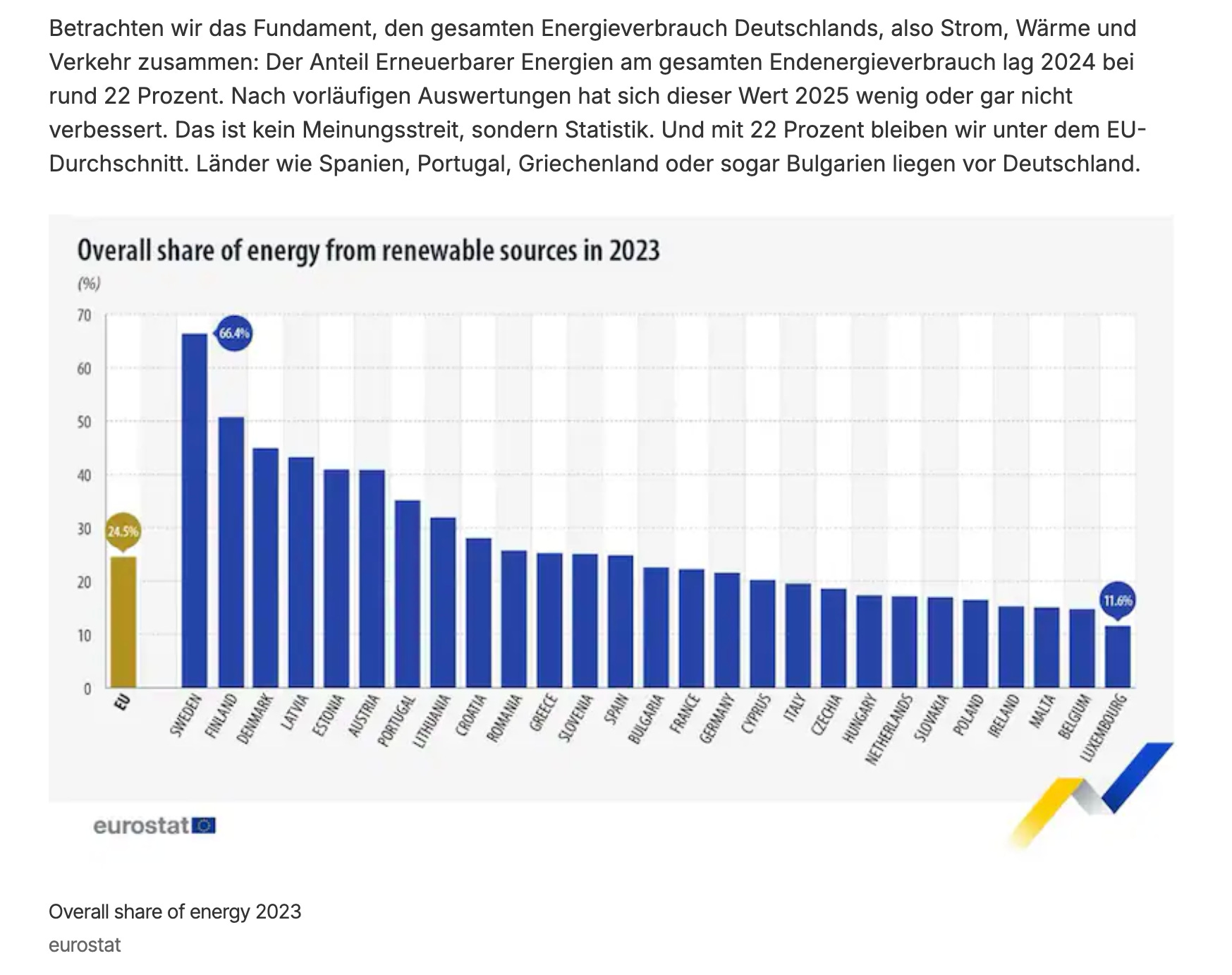
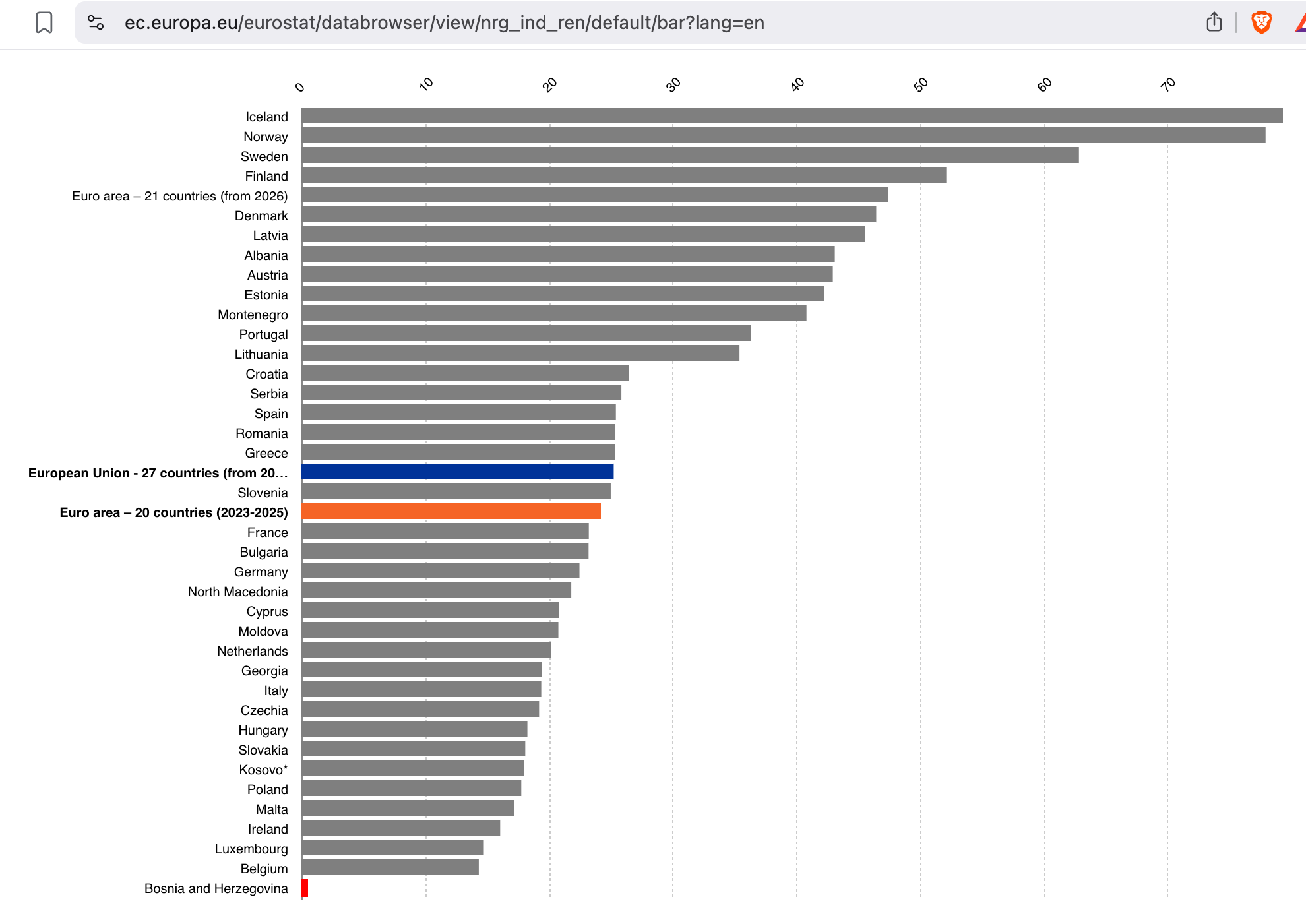
[note that I was unable to locate that graph, yet the one I found similarly shows the ‘Share of energy from renewable sources’ from Eurostat (online data code: nrg_ind_ren; DOI:10.2908/nrg_ind_ren; last update: 03/02/2026): and now we also know the ‘missing’ bar would have to be either Iceland or Norway, both countries that far exceed Germany’s accomplishments (which, to me, explains why that bar was likely omitted)]
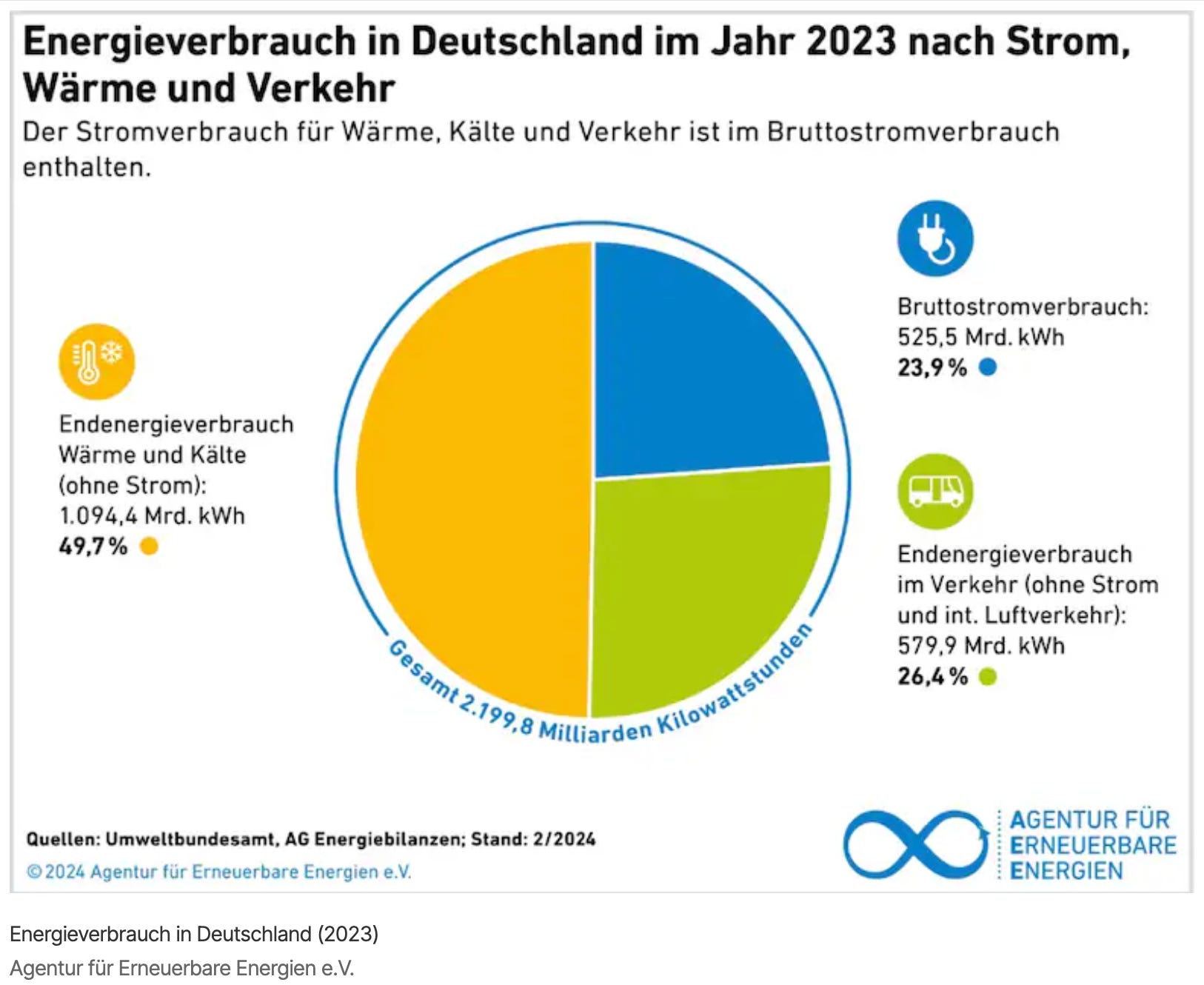
The distribution is even more problematic: around 50 per cent of Germany’s final energy consumption is for heating, about 25 per cent for transportation, and only 25 per cent for electricity. This is precisely where the greatest political and media focus lies. According to the Fraunhofer Institute for Solar Energy Systems (ISE), renewables covered around 55.9 per cent of the electricity sector’s small share in 2025. Sounds impressive.
However, in percentage terms, this is the same as in 2024. In the heating sector, the share of renewables has stagnated at 18 per cent for three years, and in transportation, it’s even declining at less than 7 per cent. Thus, all three consumption sectors are experiencing stagnation or regression. The energy transition is therefore not a holistic project. It’s an electricity project with a lopsided profile.
[title of the below graph: ‘energy consumption in Germany in 2023: blue= electricity (Strom), yellow = heating (Wärme), green = transportation or traffic (Verkehr);]
Capacity of 50 Nuclear Power Plants Built, 3% Electricity Delivered
Between 2020 and 2025, around 64 to 72 gigawatts of new wind and solar power capacity were installed in Germany. In terms of pure installed capacity, this corresponds to roughly 45 to 50 former German nuclear power plants. The result: the share of renewables in total final energy consumption rose by about three percentage points during the same period.
Three percent. That’s not a transformation. That’s an economic declaration of bankruptcy [to say nothing about its intellectual and media camp followers: wishful thinking doesn’t make up for reality]. Installed capacity is growing rapidly, but real energy yields are stagnating. Offshore wind farms are competing for wind power and delivering less than predicted. Solar energy is primarily produced in the summer, when electricity demand is generally lower than in the winter. Politicians have clearly been confusing capacity with output for some time now; megawatts are celebrated, kilowatt-hours ignored [rsvp to the banquet of consequences].
The Grid Survives Only With Emergency Repairs
The electricity grid is the silent crisis point of this energy transition. Since 2020, the number of so-called redispatch measures to stabilise the power grid has almost tripled. Without these interventions, power outages would occur [what will go wrong before too long…?].
Twenty-five years ago, there were three to six interventions per year [that’s the baseline]; in 2020, there were nearly 6,798 interventions [i.e., a massive increase by a factor between 1,000-2,000%]; in 2022, this number had already risen to 12,633; and in 2024, to around 17,297. Finally, in 2025, 19,318 emergency interventions were recorded. That’s an average of 53 interventions per day to prevent a blackout [now that’s an impressive amount of short-term fixing of shit, but given the complexity of the system, it’s a matter of time before something goes wrong and cannot be fixed quicklly]. The costs for this grid congestion management increased from €608 million in the third quarter of 2024 to around €667 million in the third quarter of 2025.
The mechanism of these interventions [‘redispatch’ measures] is absurd. In the north, wind power is curtailed because transmission capacities are limited. In the south, fossil fuel-based, fast-response gas-fired power plants are ramped up, or electricity is imported. Germany is shutting down renewable energy plants and paying compensation while simultaneously buying expensive electricity from abroad. The grid has reached its physical limit. Without daily interventions, it would be unstable, resulting in power outages. A modern industrialised nation should not be operated this way.
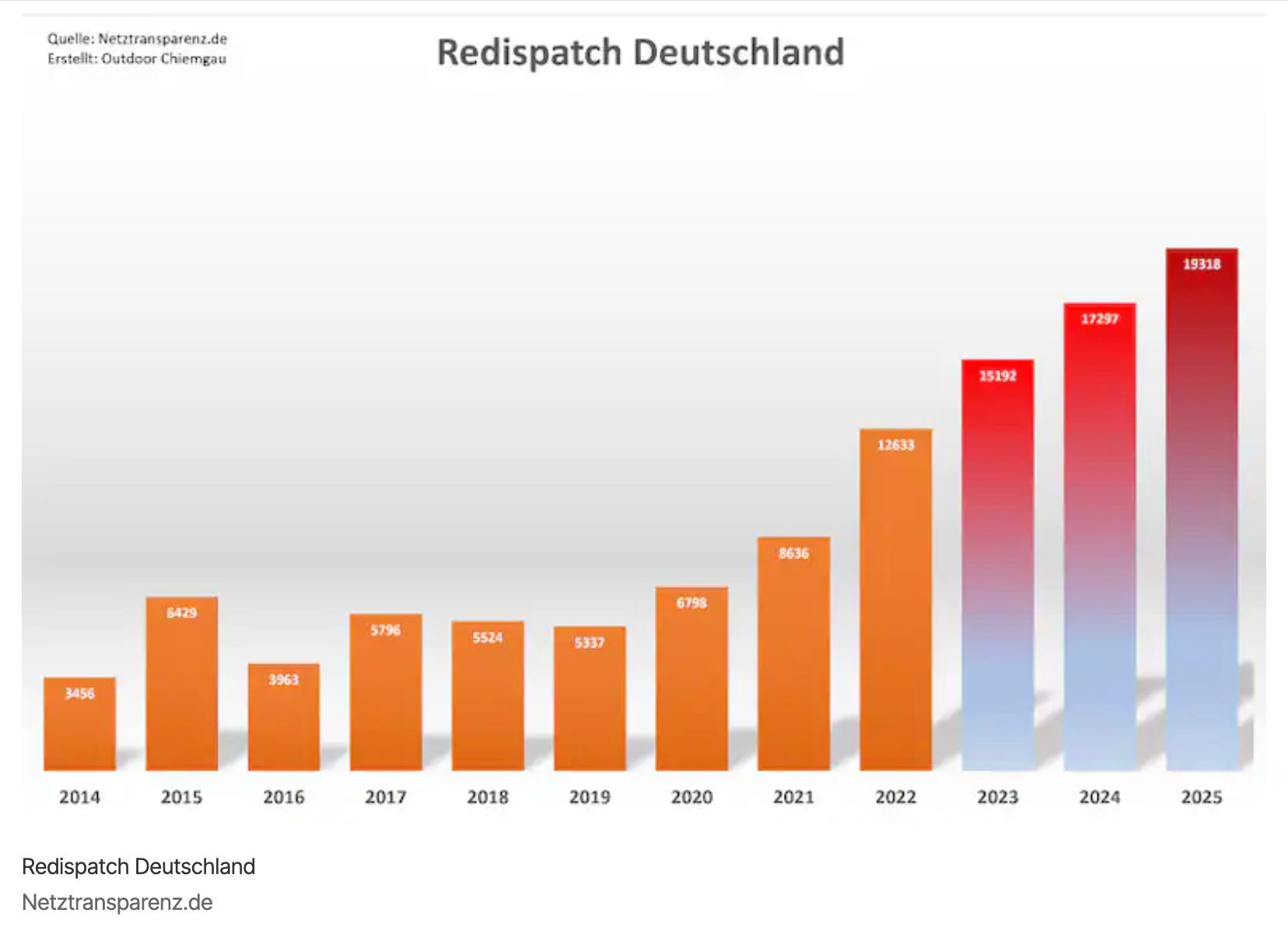
[and if you thought that kind of ‘redispatch’ shit was bad, guess who controls electricity prices (spoiler alert: it ain’t Mr. Market]
Electricity prices have long been politically controlled. For 2026, the federal government plans subsidies of around €31 billion for the EEG account [that would be the earmarked funds for the Erneuerbare-Energien-Gesetz, Germany’s Renewable Energy Sources Act (Wikipedia)], grid fees, electricity tax, electricity compensation, and industrial electricity prices. This corresponds to about six per cent of the total federal budget [re-read this: six per cent of Germany’s federal budget are earmarked for electricity subsidies, which is a only about half the share of US gov’t expenditures on defence™ (which, in the current fiscal year, stands around 12% of GDP, provided one included atomic energy outlays that are accounted via the DOE)].
Without these subsidies, electricity prices for industry and households would be virtually unaffordable. At the same time, fossil fuels are subsidised with around €15 billion, a declining amount. The real price driver is not the fossil fuel component, but rather the system costs of a poorly integrated expansion of renewable energies. Germany is therefore paying twice: once for the expansion and a second time for repairing the side effects [all I can think of about this situation is (drum roll):
[and now back to the piece]
From Export World Champion to Importing Nation
Until 2023, Germany was a regular electricity exporter. In 2017, the export surplus was around 60 terawatt-hours. Since the shutdown of its nuclear power plants, Germany has become a net importer. In 2024, around 28 terawatt-hours were imported, and in 2025, still 22 terawatt-hours. Cost: more than two billion euros annually. Mind you, this is happening at a time when the output of installed renewable energy sources is at a record high. This hardly constitutes security of supply.
Although electricity imports decreased last year and exports increased, the cost of purchasing electricity rose compared to 2024. The reason for this surprising cost increase lies in the higher price increase for imported electricity. While the price of exported electricity rose by 14.1 per cent from 2024 to 2025, the price of imported electricity increased by 17.4 per cent.
Costs No-One is Honestly Quantifying
What has the energy transition cost so far? No one knows for sure. However, what it will cost in the future is alarmingly clear. Studies commissioned by the Chambers of Industry and Commerce estimate the energy transition alone will cost five trillion euros by 2045. If all other sectors are included—buildings, industry, agriculture, waste management, and defence—these costs are likely to be many times higher.
At the same time, according to Der Spiegel magazine, 4.2 million people in Germany already struggle to pay their energy bills. They live in energy poverty. Experience shows that social acceptance [of policies] collapses at around six million. The energy transition is therefore highly fragile from a social perspective.
The Inconvenient Truth
The energy transition isn’t failing because of wind and sun. It’s failing because of system design, ideology, and political complacency. Germany is building power generation facilities without sufficient energy storage. Power generation facilities without adequately developed grids. Power generation facilities without a sufficiently developed market logic and without comprehensive, flexible price signals. Annual balance sheets replace real-time capability. Average values replace security of supply.
A genuine, sustainable energy transition doesn’t need symbolic politics, but rather intelligent, expanded grids, flexible electricity consumers, energy storage, sector coupling, and an honest cost-benefit analysis. There’s no question: transforming our energy system is necessary. But not at any price and not blindly.
Those who don’t change course now risk not only economic competitiveness, but the stability of an entire industrial base. And that would be the most expensive failed investment in post-war German history.
Bottom Lines
Stark words of warning, issued in legacy media: I consider this too little, too late.
States can go to war with empty coffers and treasuries; we know that from history (Germany in 1939 was pretty much bankrupt).
But back then, Germany had an industrial base (sure, import issues remained high), and energy in the form of coal and oil; hence, it was possible to wage war.
Fast-forward to now, what might save Europe may be the lunatic incompetence of its leaders™ who are both fanatic ideologues and without much, if any, clues about how the world works.
Sadly, this doesn’t guarantee that something doesn’t go catastrophically wrong in-between.
Stay frosty.
You can have an energy-sector devoted to making good standards of living and solid industry possible.
Or you can have an energy-sector devoted to making money.
The EU, and all its members, have tied their peoples' lives and futures to the neoliberal capitalist anchor of the second choice.
The UK says “hold my beer”.