
German MSM Muses Over Record-Low Birth Rates
Die Welt noticed low birth rates since, well, the Covid shots ± 9 months, plus the data-mongers also reveal that mass immigration doesn't stave off demographic collapse

It’s the dog days of mid-summer, and we all know it’s that time of year when official number-crunchers (gov’t statistics offices) release their main reports concerning the previous year’s data.
With over a year delay relative to Norway, legacy media in Germany notices that something is oddly wrong:

This is part one of a two-part enquiry into the statistics yearbooks of Germany (this posting) and Austria (tomorrow) about some, well, let’s call them oddities™ that the number-crunchers couldn’t avoid not noticing (mainly, I suspect, because the data aren’t political, while the reporting™, of course, is).
Translation, emphases, and [snark] mine.
Birth Rate Continues to Fall: Lowest Among Women of German Citizenship
The already low birth rates in Germany continue to fall. Among the individual federal states, Lower Saxony is the best performer, Berlin the worst [kinda the silver lining here, if you’d ask me: if you’ve been to Babylon Berlin, you know]. Foreign women are also having fewer children.
Via Die Welt, 18 July 2025 [source; archived]
The birth rate in Germany fell to 1.35 children per woman last year. It was therefore two per cent lower than in 2023 with 1.38 children, as the Federal Statistical Office announced in Wiesbaden on Thursday.
This means that the decline has slowed significantly. A total of 677,117 children were born in Germany last year [the lowest-ever recorded number since WW2 occurred in 2011 with 663K births, according to Statista.de]. This means that the number of births fell by 15,872 or two per cent compared to the previous year [2023], when 692,989 newborns were counted.
According to statistics, Lower Saxony had the highest total fertility rate with 1.42 children per woman [approx. in the Norwegian ballpark], while Berlin had the lowest with 1.21 children. In 2024, the birth rate of women with German citizenship [orig. deutsche Staatsangehörigkeit] was as low as it had been in 30 years: 1.23 children per woman [same as in Norway, by the way, or elsewhere in those countries that attacked Sars-CoV-2 most aggressively with tons of poison/death juices:

Incidentally, these data are staggering, esp. since they prove, I’d argue beyond the shadow of a doubt, that 'Westernisation’ or ‘Modernisation’, widely understood, is a key driver here, and of these public health™ is but one front; others incl. staggeringly high cost-of-living, piss-poor career/earnings prospects, feminism, and, of course, Western decadence (lifestyles).]
The birth rate for women with German citizenship was 1.23 children—a similarly low figure was last recorded almost 30 years ago in 1996, when a woman had an average of 1.22 children. However, the annual decline has also slowed here, the Federal Statistics Office explained.
The total fertility rate of women with foreign nationality was 1.84 children, two per cent lower than in the previous year. According to the data, foreign women have been giving birth to continuously fewer children since 2017 [see what I mean? Among the most absurd aspects of the (im)migration debate™ since 2015 has been the expectation, widely shared among our juste milieux, that third-worlders may change their mores and attitudes literally overnight; it would appear that wasn’t too far off, but that it would take a tad longer to ‘trickle down’ (pun intended, gotta pull one’s punches consciously)].
According to the statistics office, the total fertility rate indicates how many children a woman would have in the course of her life if her fertility behaviour was the same as that of all women aged between 15 and 49 in the respective year [oh, would you look at that wording: it’s ‘only’ women who can have children; I suppose the Trans™ inquisition will soon storm the Statistics Office for being, well, at least somewhat tethered to reality].
Statista.de in Their Own Words
I so hate second-hand reporting™, which I only read to make available to you, dear readers; here’s Press Release No. 259 from the Federal Statistics Office (Statistisches Bundesamt), dated 17 July 2025.
Doing so essentially reveals the copy-and-paste job™ some unnamed journo™ over at Die Welt did when composing™ the above article™: it’s virtually verbatim taken from that press release. With a few major exceptions, which is why I’m inserting this section here.
First, while the 30-year-low of fertility rates has one particular, very Germany-only background: so-called Re-Unification of 1989/90:
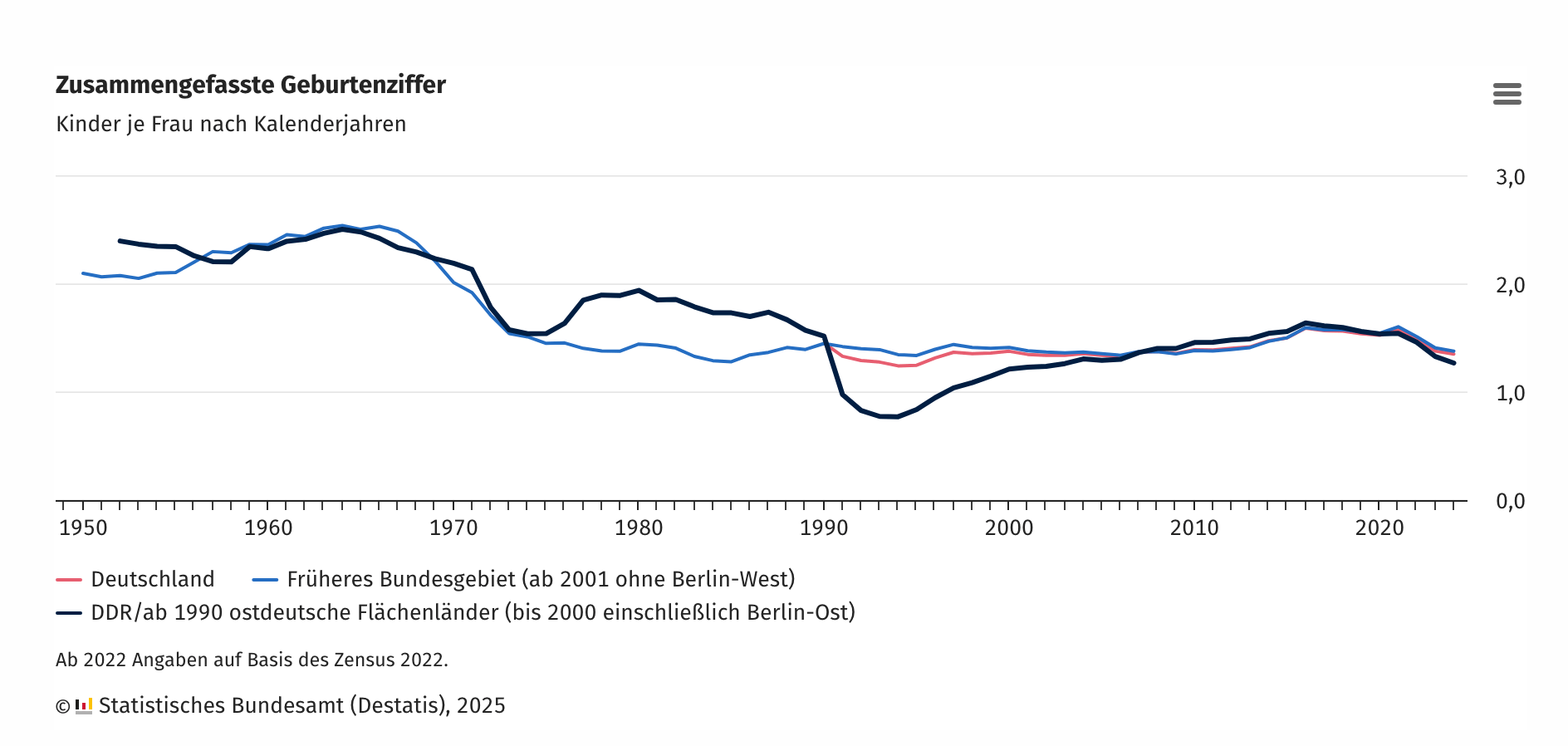
The thin red line = all-Germany; thin blue line = old West Germany [note the consistently lower birth rates during the 1970s and 1980s relative to the] black line = former East Germany, whose birth rates collapsed as a consequence of the fall of communism.
And here is more about the distinctions between ethnic Germans and (vs.) foreign residents:
Fertility rate of German women fell to the level of 1996
The total fertility rate of women with German citizenship fell to 1.23 children per woman in 2024. A similarly low fertility rate was last measured among German women almost 30 years ago in 1996 (1.22 children per woman) [what a problematic comparison: there were way fewer resident foreigners back then, and then there’s the entire, above-related German-only collapse of birth rates in former East Germany—thou shalt not compare apples and oranges]. The decline in the fertility rate compared to the previous year was particularly noticeable at -8% in 2022 and -7% in 2023. In 2024, however, it only fell by 3%.
Oh, would you look at that: that little factoid about the -8% and -7% fertility declines in 2022 and 2023, respectively, is omitted from Die Welt’s reporting™. Did anything happen in, say 2021, that might have contributed to these declines? Before one would think about that, though, hence it must be omitted from legacy media reporting™. Personal opinion here, but—change my mind.
Yet, to their credit, the number-crunchers of the Federal Statistics Office are actually doing their job, hence the subsequent two paragraphs that shed way more light on these trajectories than whatever nonsense legacy media reports™:
Women born in 1975 gave birth to an average of 1.58 children
The so-called final number of children [orig. endgültige Kinderzahl] can currently be determined for women born up to 1975. Women born in 1975 who reached the end of their childbearing years in 2024 at the age of 49 according to the statistical definition gave birth to an average of 1.58 children. The final number of children had previously fallen continuously among women born in the 1960s and had reached its historic minimum of 1.49 children per woman in 1968 [oh, look, more context: German women are now giving birth way less often than 1968]. Women born in the 1970s give birth to more children on average. Especially women over the age of 30 born between 1970 and 1980 had or are having children significantly more often than women born in older cohorts.
While the comparison to the Old Federal Republic to post-unification™ data is very problematic (for various reasons, incl. different territorial extent, the above-mentioned absorption of the former GDR, etc.), the German number-crunchers also point to the following comparative angle:
In many other European countries, fertility rates are also continuing to fall
Comparable international data on the development of the total fertility rate in 2024 is not yet available [untrue; here’s Norwegian data, dated 17 March 2025]. However, data from the European statistics authority Eurostat up to 2023 show that the fertility rates in most European Union (EU) countries have continued to fall compared to 2022 [would you look at that!!!]. This results in an average of 1.38 children per woman for all 27 EU states in 2023, a significantly lower figure than ten years earlier with 1.51 children per woman in 2013 [oh, look, Statista.de just confirmed that mass immigration is not a solution to low, and sinking, birth rates, which may actually be the much bigger bomb shell in this report]. Germany was at the European average in 2023. The highest fertility rate was in Bulgaria with 1.81 children per woman. The lowest fertility rates were recorded for Malta with 1.06 and Spain with 1.12 children per woman.
Bottom Lines
Isn’t it, you know, kinda weird that legacy media reports™ the way it does, i.e., without mentioning the two major revelations by the Federal Statistics Office?
Let’s recap, beginning with the implicit bombshell: across the collective West, birth rates have been falling for decades, yet something™ massively accelerated this trajectory starting in late 2021 and depressing birth rates by 7-8% or more in 2022 and 2023, respectively. It’s amazing how legacy media is able to report™ on these data without it ever occurring to these journos™ to consider, you know, the poison/death juices and the rest of the Covid Mania.
For the record, German legacy media appears to be entering the reporting™ stage roughly 2.5 years after, e.g., Norwegian legacy media began noticing™ (that’s the top-linked piece) that something was, indeed, a tad rotten:
At this point in time, it might take only another couple years before German authorities will convene a Blue Ribbon Committee on birth rates:

Apart from hormonal birth control (since 1967) and shitty economic prospects for future parents, there is a third aspect:
In a crucial review paper entitled ‘Environmental factors in declining human fertility’, Nature Reviews Endocrinology volume 18, pages 139–157 (2022), which was published in mid-December 2021—that means that none of the Covid poison/death juice-related issues is included in this discussion by ‘the Science™’ (yet)—we may find tentative answers:
A crucial question is whether this decline can be explained by economic and behavioural factors alone, as suggested by demographic reports, or to what degree biological factors are also involved…
We hypothesize that declines in fertility rates might be linked to exposures to chemicals originating from fossil fuels causing human reproductive problems and cancer; early gestation might be a sensitive period.
May main criticism here is—the omission of staggeringly higher radio frequency (RF) exposure, i.e., cells phones and wireless internet since the late 1990s.
Read ‘more’ about these reflections™ here:

Be that as it may, we note, that none of the above is kinda anathema in Northern Europe; it is beginning to come to Germany, perhaps in the coming years.
With officials thinking™ and doing™ like they do, though, there’s little hope things change to be expected in the near-term.
If anything, those who know, well, they will become ever-more weary of official communiqués and legacy media reporting™.
The majority, though, who refuse to put one plus one together, well, they will eventually prove Charles Darwin’s theory of evolution correct (and, yes, lest you ask, the same applies for mental illness masquerading as LBGBTQ+ or whatever: those who fail to reproduce are, in evolutionary terms, dead-enders or failures).
And therein we may find, after much more weirdness, insanity, and carnage, a silver lining for the future of mankind.
Birth rates have been dropping for decades. The current drop is due to a combination of common causes behind the historical trend and the COVID jabs which constitutes a special cause. It is worth keeping in mind that young people currently trying to have children were, for the most part, sexually developed by the time death juice came about. I suspect the worst is yet to come with the generations who got jabbed prior to developing reproductive organs. I fear the fertility drop is likely to be precipitous.
Not a "decline" but a full on collapse. What about the Commonwealth nations pre and post?