
On EU Sanctions, Levied 'Beyond the Rule of Law'
‘People need to know what to expect.’ ∽ A spokesperson for the German MFA

Time to follow-up on a particularly egregious example of the EU Commission picking winners and losers—this time, once again, among journos™. As in earlier instances of rampant militarism in the run-up to the drift towards open warfare, those who are critical are deemed a ‘threat’.
Needless to say, with the below account is now appearing, let alone in a reputabe™ legacy media outlet such as the Süddeutsche, I’m pursuing two aims here:
a simple case of record-keeping of at least some receipts, and
don’t forget that the very same institution™, the EU Commission, also pays for court rah-portin™ by (drum roll) legacy media journos™
‘Facts count, the truth counts’, said Ursula von der Leyen in her speech to the EU Parliament at the beginning of last week, when the vote of no confidence against her was tabled. She was always prepared to engage in discussions—but only if they were based on ‘facts’ and ‘arguments’.
Thus Franz Becchi of the Berliner Zeitung quoted EU Commission president Ursula von der Leyen about a year ago; read the rest here:

For today, we’ll look at ‘facts, facts, facts’ and see how close they are to da truth™, as related by the story of a German citizen who dared to criticise the powers-that-be and now finds himself ‘sanctioned’ by the EU Commission.
Translation, emphases, and [snark] mine.
The Choice of Weapons
The EU has sanctioned German citizen Hüseyin Doğru for ‘disinformation’ and spreading Russian ‘narratives’. He now lives on 506 euros a month. Europe is fighting back against Moscow’s information war, but what does this mean for freedom of expression?
By Ronen Steinke and Hubert Wetzel, Süddeutsche Zeitung, 23 June 2026 [source; archived]
Doğru orders a Turkish tea, and while he’s at the register, he gazes at the display case of pastries. He can no longer afford to go to a café every day, even though the tea here only costs two euros.
The sun is shining, we are in Berlin-Wedding, a few homeless people are standing in a square behind a church [when did this became normal™?]. There are many people here who don’t work. But a person sentenced to unemployment by the state—that’s not so common [note that a) the EU isn’t a state and b) that we’re talking about the thought-crimes of Mr. Doğru here]
That person is Hüseyin Doğru, 43 years old, a German citizen [of obviously non-German origins]. He is forbidden from engaging in any paid work, as decreed by the European Union, according to EU Regulation 269/2014 [none of these materials are linked in the original piece], which was last tightened in December. ‘Although: I would be allowed to work’, says Doğru, ‘but no one is allowed to pay me for it.’ [fun factoids incl. Mr. Doğru is not listed in Annex 1, and our two intrepid journos™ can’t even cite a single article or title of said Regulation, let alone provide the information that we’re talking about a regulation that’s been ‘updated’ and ‘expanded’ significantly since its original adoption in 2014; he was added to the ever-expanding list of sanctioned individuals via Council Implementing Regulation (EU) 2025/965 of 20 May 2025 where he bears the number 20].
He sits down; outside the window stands an abandoned building, formerly a department store. The German Armed Forces are considering whether to establish a conscription centre there [I’m unsure if this is irony or not]. For Doğru, who describes himself as a political leftist, this is a sign of the ugly new times, as he puts it: ‘Social cutbacks and preparations for war.’ His own story, he says, is an example of this [huhum, let’s explore this, shall we?].
Until recently, Doğru wrote for a media agency financed by Russia, then for his own online publication. He wrote articles about what he sees as ‘imperialist’ German foreign policy. About the ‘genocide’ against the Palestinians, which he claims is also being perpetrated with German weapons [note that the scare quotes are there in the original]. Now he has to get by on 506 euros a month. This is the amount he is still allowed to withdraw from his bank account to ‘satisfy basic needs’. This is stated in letters from the Bundesbank (German Federal Bank) that the Süddeutsche Zeitung was able to review. The rest of his savings are frozen [now, let that sink in: the EU Commission issues a decree, which is laundered through what in EU-speak is labelled a ‘competent national authority’—and, interestingly, in Germany, this is done via the Foreign Trade departments of the gov’t (but it involves institutions that are in no way, shape, or form responsible to the citizen™ or the Bundestag), specifically, the Bundesbank, the Bundesamt für Wirtschaft und Ausfuhrkontrolle (Federal Office for Economic Affairs and Export Control), and the Zentralstelle für Sanktionsdurchsetzung (Central Office for Sanctions Implementation)].
Even if a friend or family member wanted to lend him some money, that would now be a criminal offence. It would be considered circumvention of EU sanctions. ‘Provision of economic resources’, Section 18 of the Foreign Trade and Payments Act [orig. Außenwirtschaftsgesetz]. Minimum sentence: three months in prison [but individuals, if found guilty by a court of law™, can get up to five years for violating these provisions].
German security authorities and the European Union consider Hüseyin Doğru a political manipulator, a skilled disinformation agent who has accepted money from Russia for years. The accusation: Moscow deliberately uses people like him
to weaken social cohesion in Germany and Europe [orig. um den gesellschaftlichen Zusammenhalt in Deutschland und Europa zu schwächen] by manipulating debates and artificially inflaming them with misinformation, by sowing distrust in facts, media, and democratic structures, and by discrediting state structures or portraying them as incapable of action.
That’s how a spokesperson for the German Foreign Ministry summarised it last summer [the SZ doesn’t link to anything that permits me to check the statement for its accuracy, which isn’t me annotating or footnoting anything, but the entire sanctions régime in Germany is based on the Foreign Trade and Payments Act, Außenwirtschaftsgesetz, whose art. 4 bears the title ‘Restrictions and Obligations to Protect Public Safety and Foreign Interests’ and specifically notes, among other things, the interests of both Germany (1) and the EU (4a); please see the footnote for details1].
The EU finally wants to defend itself against
an invisible war being waged by Russia
An information war that, in the opinion of many [who, exactly, would these ‘many’ be?], Europe has done little to counter for far too long. This is also due to the fact that the media attacks from Moscow have become increasingly sophisticated, increasingly elaborate, and increasingly covert. Hüseyin Doğru is one of the first to have sanctioned the EU for ‘disinformation’, with an official act on 20 May 2025—and with a consistency and severity intended to deter others [as you read on, please let that sink in; moreover, here are the grounds as given in Council Implementing Regulation (EU) 2025/965 of 20 May 2025:
Hüseyin Doğru is the founder and representative of AFA Medya A.Ş. which is a media company based in Istanbul. AFA Medya A.Ş. operates “RED”, which comprises a number of media platforms, and which has close financial and organisational connections with Russian state propaganda entities and actors, and shares deep structural ties, including interlinkages between, and rotation of, individual personnel with Russian state media organisations.
RED has used its media platforms – often publishing under “redstreamnet” or “thered.stream” – to systematically spread false information on politically controversial subjects with the intent of creating ethnic, political and religious discord amongst its predominantly German target audience, including by disseminating the narratives of radical Islamic terrorist groups such as Hamas [setting aside the alleged ties to Hamas (not a fan of), the key word here, it seems, is ‘intent’: good look proving this in a normal court of law, but since we’re talking the EU, there’s no such thing as a regular enquiry or a court, let alone judicial review].
During a violent occupation of a German university by anti-Israel rioters, RED personnel coordinated with the occupiers to disseminate images of their vandalism – which included the use of Hamas symbols – through their online channels, thus providing them with an exclusive media platform, facilitating the violent nature of the protest [this is apparently the crime here: there are no references, footnotes, police reports, or court records noted—all it took for the EU to issue a decree is, it would seem, some more or less vague insinuations; this paragraph likely refers to an ‘anti-deportation protest’ at Berlin’s Humboldt University (as per the Deutsche Welle’s rah-portin™), which involved ‘Police said that the two Irish, one Polish and one US citizen had been involved in “violent” protests on October 17, 2024’—all fine and well, but where’s the rub? As per the World Socialist Website’s rah-portin™ from late May 2025, here’s the issue at-hand, it would seem: ‘The EU accuses Red Media of “systematically disseminating false information on politically controversial topics and specifically supporting narratives that are seen as destabilising for the EU.” This essentially refers to the fact that Red Media reported on pro-Palestinian protests in Germany, interviewed Greta Thunberg and reported live from the occupied Humboldt University while pro-Palestinian activists occupied its premises. This is a thorn in the side of German government politicians.’ The EU Council Implementing Regulation (EU) 2025/965 merely alleges something deriving from a) an accusation (not even a police report) and b) ‘a thorn in the side’ of German gov’t politicos™, which tells you all there is to know (but the SZ won’t tell you)].
Through AFA Medya, Hüseyin Doğru thus supports actions by the Government of the Russian Federation [no comment] which undermine or threaten stability and security in the Union and in one or several of its Member States, including by indirectly supporting and facilitating violent demonstrations and engaging in coordinated information manipulation [note that if the preamble (supports Russia! Russia! Russia!) comes before the ‘thorn in the side’ of German gov’t politicos™, there’s something quite rotten—plus there’s the alleged crime™ of ‘indirectly supporting and facilitating violent demonstrations’, you know what this is: a contrived piece of shit].
A spokesperson for the Foreign Office said in February that he was pleased the case was becoming more widely known. This way, others who were also spreading propaganda for Russia would learn what they faced: ‘People need to know what to expect.’
The EU finally wants to defend itself against
this invisible war that Russia is waging
This case is a novelty. The Europeans only started imposing EU sanctions on individuals who supported the Russian regime not with weapons or billions in oil, but with words, social media posts, and videos in 2024. Since then, they have put around eighty people on their sanctions list for spreading Russian ‘narratives’ most of them Russian. Three of them are German. And only one of them, Doğru, lives in Germany with his wife and three children. From the EU’s perspective: as an enemy within.
Hüseyin Doğru himself portrays himself as a ‘dissident’ whose only crime is to have criticized EU and NATO policies. For some like-minded people, he is a kind of martyr for freedom of expression, for the [lefty-left] politician Sahra Wagenknecht, for example: the EU sanctions against him are ‘totalitarian madness’, she recently said to the Berliner Zeitung: ‘This is how dictatorships deal with opposition members.’
A few days ago, a professor of European law at the University of Erlangen-Nuremberg, Bernhard Wegener, also raised doubts on the specialist portal Verfassungsblog [a blog ‘on matters constitutional matters’; no link is provided, but I’m guessing we’re talking about Prof. Wegener’s piece on the Swiss former intel officer Jacques Baud who’s under similar EU sanctions] Such sanctions ‘increase the reach and effectiveness of the propaganda that they seek to combat, and at the same time discredit the Union’. This means the EU:
Instead of trusting in the power of the constitutionally guaranteed freedom of expression, the overly fearful Union is making itself legally vulnerable … In their severity, their comprehensiveness and their procedural assault, these measures are clearly beyond any proportionality. [perhaps someone should have told the good professor that there’s no police complaint, prosecutor’s enquiry, or court ruling, too?]
The lawyer Wegener is not a friend of Putin, on the contrary, ‘I am a Putin hater’, he says on the phone. Nevertheless, he finds it doubtful how the EU is taking action against the media here:
These are opinions that I don’t share, but that one should be able to express. And that I want to hear. Especially in times of war, it is important to allow counter-speech [since when are ‘we’ at-war?].
It’s a fundamental question of the rule of law.
Can you fight fake news without restricting freedom of expression? Who actually decides what this is, fake news, ‘disinformation’?
After all, the EU’s accusation against Doğru is not that he broke any laws [q.e.d.]. The EU’s accusation is that he is a political opponent. In a democracy that is an important difference [fun factoid: the EU isn’t a democracy].
In order to evaluate the EU’s actions, you need to know Hüseyin Doğru’s story. The first meeting with him takes place in a pastry shop. Two more follow. E-mails and documents are exchanged for weeks. There are conversations with officials, access to EU investigation documents, letters from banks saying that Doğru can only spend his 506 euros a month on his own ‘basic needs’ and nothing else. If, for example, he were to use it to pay for insurance for his family members, this amount could be reduced immediately [in case you’re worried that, say, central bank digital currency will be a form of social control, it seems that CDBCs aren’t that relevant to make this happen (what CBDCs do is scaling up these coercion/control possibilities, but I suppose it’s nothing that’s not possible already); my gut feeling is that CBDCs are desired to keep up the façade of the rule of law and absolve whoever is involved in these shenanigans from any liability, specifically third parties, such as financial institutions taking orders from gov’t].
Doğru requests that he and his lawyer Alexander Gorski be allowed to proofread all of his quotes that are published in this text before publication. That is his condition for the talks.
His story begins in 2017. At that time, the Russian state’s propaganda apparatus was in full swing in Berlin. The Russian state broadcaster Russia Today fuelled the discourse of right-wing populists with a television program and online articles. When a 13-year-old girl from a Russian-German family briefly disappeared, Russia Today reported on an alleged kidnapping and rape by ‘southerners’ [orig. Südländer], which the German police allegedly covered up. When the German authorities exposed this as a lie, Russia Today called it ‘anti-Russian propaganda’.
Gaza war, ‘reason of state’, police violence:
Doğru’s team was surfing a wave of indignation
What was new in 2017 was that Russia Today also wanted to launch a politically left-wing outfit in Germany. This is where Hüseyin Doğru came into play. ‘I was grateful for the opportunity to do journalism’, he says, and that he was promised that he would be able to work freely, without any restrictions on content. Doğru says that before that he worked as a social worker with refugees in his hometown of Frankfurt am Main. During the Gezi protests in Turkey, where his parents are from, he filmed videos that he uploaded to YouTube.
His wife, Briton Lizzie Phelan, had previously worked for Russia Today [Ms. Phelan’s Wikipedia entry contains this gem: ‘The Guardian said her Libyan reporting was "controversial".[8]’]. Now the two of them built a team in Berlin that was supposed to denounce German racism and German police violence. Redfish was the name of their media start-up, financed 100 per cent by Ruptly, a media agency that was in turn a 100 per cent subsidiary of the Russian state-owned company TV Novosti.
The Tagesspiegel once sent a reporter who described the chic offices in Moabit, young and hip [I think reference is made to this piece, but i don’t know]. But everything was financed with money from Moscow, as part of a network of companies that also included Russia Today [hard to say, if it’s the afore-mentioned piece, it specifically notes ‘who finances this outlet remains in unknown’].
Hüseyin Doğru takes a new tablet out of his backpack. He says he never saw himself as a Russian propagandist:
As long as no one interferes in my editorial work, I have no problem with whether the money comes from Russia or Germany or any other government.
After all, ARD and ZDF [both German state broadcasters, like the BBC] also work with ‘state money’, which isn’t much different, he says.
When pushed, he quickly turns his argument around: ‘journalism’ and ‘propaganda’—these things can never be clearly separated, he says. It is always a question of perspective. ‘We just made left-wing propaganda, you could say. We’re just left-wingers.’ [I think this is what he may think, but I doubt that’s the underlying reason for his persecution].
Hüseyin Doğru’s team was riding a wave of outrage. Their reports often talked about the Gaza war, German ‘reasons of state’ [meaning: support of Israel], occupied universities, and violence against police. From October 2023, the accounts on Facebook and Instagram grew to several hundred thousand followers. In October 2024, Doğru posted a picture of a pro-Palestine demonstration on Telegram. The text, in English: ‘While the German police use dogs against pro-Palestine protests, hardline neo-Nazis are allowed to march freely through the city on the same day, with only a handful of police officers.’
This article can be found in the confidential [sic] EU dossier used to justify the sanctioning of Doğru in 2025, as ‘Exhibit 5’, exhibit number five, file number WK 6041/2025 INIT. The EU writes: This is disinformation. Here, Hüseyin Doğru used ‘deliberately cropped images to create an impression of the German police as anti-Palestinian and friendly to right-wing extremists’.
When asked, the Berlin police said the report wasn’t entirely false. The only thing missing is the context [q.e.d.]. The Gaza demonstrations that day had many thousands of participants and coincided with a visit by then American President Joe Biden. On the other hand, there were only about a hundred right-wing extremists walking through Berlin-Marzahn. Logically, there were fewer police there.
The EU has collected more such evidence, almost all of it screenshots from social media [this is perhaps the stupidest use of resources here]. For example, this one from November 2024: Doğru wrote that Germany had decided to ‘strip citizenship’ of critics of Israel. This is a scandal, a further ‘escalation’ of racism against ‘Palestinian voices’. This article, written in English, went viral on social media.
This is also classified as ‘disinformation’ in the EU dossier against him. However, this report is not entirely false. In November 2025, a German who had just been naturalised was actually denaturalised. The reason: he had cheered on the terrorist Hamas on Instagram. The immigration authorities found that there was a lack of commitment to Israel’s right to exist [which is problematic, sure, but for reasons other than those pertaining to naturalisation, eh?].
German security authorities see good reasons
why Doğru is not as naive as he pretends
If you leaf through the dossier with which the EU justifies its sanctions against Hüseyin Doğru, you will actually look in vain for clear false reports; instead you will read pointed, sometimes tendentious articles. On 24 February 2025, the third anniversary of Russia’s invasion of Ukraine, Doğru posted:
For three years, the US and Russia have been waging a proxy war in Ukraine. As Trump moves toward a deal to end the fighting and secure access to Ukrainian raw materials, EU leaders vow to stay involved.
The expression ‘proxy war’ is a judgment that is clearly protected by freedom of the press according to Article 5 of the Basic Law. The view that a ‘proxy war’ is being fought between NATO and Russia in Ukraine is also shared by many people in German parliaments. Politicians from the AfD, of course, but also politicians from the Sahra Wagenknecht alliance or the Left Party. Also some members of the SPD [virtually all dissident™ players from the Anglosphere also call that spade a spade].
The difference is that the German security authorities see good reasons that Doğru is not as naive as he claims to be [once more, good luck proving that kind of ‘intent’ in a court; I don’t think prosecutors would even get that far with the kind of evidence™ mentioned above]. Since 2022 at the latest, as they see it, Doğru has not just been a passive recipient of Russian money. Since then, at the latest, he has also actively started to conceal and cover up [what Mr. Doğru has done, however, is not explained].
In 2022, after the Russian attack on Ukraine, the EU decided for the first time to take tough action against Russian propaganda media. The television production company TV Novosti was de facto thrown out of Berlin [not de jure in the best Germany of all times?], as were all the smaller media companies around it—Russia Today, Ruptly and others that glossed over or even encouraged the murder and massacre by Russian troops in Ukraine [I’m unsure how media companies ‘even encouraged’ this, esp. if one considers the pro-war cheering by US corporate media, c. 2002/03, for instance; I’m not saying these things are the same, but these allegations clearly deserve some nuance …]
But Doğru, who wrote primarily about the Middle East, continued. While some of the other German employees of Russian media were now looking for new jobs, such as the former Russia Today employee Florian Warweg, who moved to the blog NachDenkSeiten and later to the Ostdeutsche Allgemeine Zeitung, Doğru left almost everything as it was. He simply continued to run his Redfish Telegram channel under the slightly different name, Red Media [which is, of course, mean™, I suppose].
Doğru claims that he has stopped accepting money from Russia from 2022.
German intelligence officials don’t believe him. Doğru moved his company headquarters to Istanbul in 2022, out of the sights of European authorities. There, he established a shell company while remaining in Berlin with his team. He chose the company name AFA Medya. AFA stands for ‘Antifascist Action’, he says now. The address listed in the Turkish commercial register, as discovered by the Tagesspiegel newspaper, belongs to a company specialising in ‘virtual offices’.
German security authorities speak of an ‘attribution procedure’ they initiated, meaning an investigation into the flow of funds. With an allegedly clear result. The trail led to Moscow, says a German official. Doğru denies this. He says he has earned his money entirely independently since 2022, through donations and advertising. He refuses to provide any evidence [but there is nothing, apparently, in these ‘attributions’ that would hold up in court either: ‘an allegedly clear result’ is all there appears to be; personally, I’m agnostic about all of this, but I suppose that if the German officials had evidence, they’d show it].
Doğru’s lawyer says he filed an appeal immediately after the sanctions were announced last May. Addressed to the Federal Office for Economic Affairs and Export Control, which enforces EU sanctions in Germany, but also to the European Commission. No one there was willing to show him the evidence linking him to Moscow; it was all classified [q.e.d.].
This is how political sanctions work: the case of Hüseyin Doğru was decided behind closed doors last May [2025] by the foreign ministers of the 27 EU member states or their representatives [this is a huge issue in and of itself: this was likely done via foreign office staffers accredited as extraordinary ambassadors, which is even further removed from any popular or parliamentary oversight, let alone responsibility]. As with all sanctions, a unanimous vote was required. The rest is the work of officials: the sanctions decision is published in the official gazette, and the person affected is informed by letter. Not too early, so that he doesn’t have time to hide any potential assets [I tend to agree with Ms. Wagenknecht on her characterisation of ‘this is how dictatorships’ do such things].
The term ‘disinformation’ used by the EU is surprisingly vague, says a judge
It is the European governments themselves that have collectively authorised themselves to intervene so deeply in the fundamental rights of their own citizens, without the say of the EU Parliament [which is not a legislature as it cannot initiate legislation]—and who also reserve the right to maintain such sanctions until they change their minds or until the European Court of Justice intervenes [but, hey, Russia! Russia! Russia! is a most evil dictatorship].
Hüseyin Doğru turned to the European Court of Justice last July [that would be 2025] and wanted to have the sanctions reviewed by independent judges. It works, but it takes time. He still doesn’t have a court date. His case will be the first of its kind.
Shortly after his sanctioning, on 25 June 2025, he posted a dramatically illustrated historical story on his private account at X under the heading, ‘How former Nazis filled NATO’s early ranks’ [can’t seem to find this piece via search engines…]. This Doğru article can also be found in the EU dossier against him, as ‘Exhibit 3’. However, it is true that Hitler’s generals also helped build the Bundeswehr and the Alliance [q.e.d.; pro tip: look for ‘Organisation Gehlen’].
And this is how the entire ambivalence of this case becomes apparent. There is a European Union that does not want to stand by defenselessly and watch as a criminal Moscow regime helps control the media discourse in this country. But also a European Union that must not jeopardise its own constitutional values, not least the freedom of the press, which applies and must apply especially to critical statements.
A former European judge recently criticised the term ‘disinformation’ that the EU authorities used in the case of Hüseyin Doğru as surprisingly vague. The lawyer Ninon Colneric was at the European Court of Justice from 2000 to 2006, sent from Germany by the then red-green government. In a 66-page report on Doğru’s case, which she prepared on behalf of Alliance MEP Sahra Wagenknecht, she writes: It is also unclear whether ‘the disinformation in question really contributes to Russia’s destabilising activities’ [couldn’t find that report, but here’s a pertinent press release]. The actions of the EU authorities against this German probably violate his fundamental right to freedom of expression and information according to Article 11 of the European Charter of Fundamental Rights [we’ll have to await the EU Court of Justice’s ruling, I suppose, before we will know™ for sure …].
It is also strange that the EU writes on the official sanctions list that Hüseyin Doğru is Turkish. In reality he is German. Born in Frankfurt, he has lived in Germany all his life, as the child of Turkish-Kurdish immigrants, even though he was only naturalised in 2021. Doğru says that this mistake by the authorities annoys him and that he considers it downright racist [don’t underestimate the incompetence factor].
At a final meeting in early June, after much hesitation, he showed his naturalisation certificate, which was issued in Berlin on 10 November 2021. And the expatriation certificate from Türkiye, dated 18 October 2021. It seems at least sloppy that the authorities are still calling him a non-EU citizen five years later.
His case is once again generating a lot of likes in pro-Russian media
When asked, the spokeswoman for the EU Commission in Brussels said that the EU sanctions list only ever contains sparse information about individuals; that’s normal. ‘The goal is not to list all information about the individual.’ [but it should be, you know, accurate lest we must infer that other stuff in the Official Journal of the EU might also be … done in a sloppy way, eh?].
Doğru was recently invited to the European Parliament, where MEP Ruth Firmenich from the ‘Bündnis Sahra Wagenknecht’ wanted to speak with him. But it wasn’t clear to Doğru whether he would be allowed to return to Germany afterward. EU Regulation 269/2014 also prohibits him from ‘entering and transiting’ the EU. He says, ‘That’s unbelievable, I’m a German citizen.’ But he says he’d rather not find out [anyone who still doesn’t want to discuss how the Covid shitshow contributed to this?].
In the meantime, one thing is clear: his case is generating more clicks, likes, and outrage. A while ago, he told his story to Johnny Miller, a Briton who runs the Moscow Report video program from Moscow, a Putin-friendly [sic] ‘alternative media outlet’ [note that one mustn’t be a ‘friend of Putin’ to decry what is done to allegedly ‘stand with Ukraine’].
Doğru sat in front of a mint-green wall and said in English that the EU sanctions against him reminded him of the Hitler era [a stoopid comment, if there ever was one]. Back then, he said, there was a ‘Editor’s Law’ in Germany; all journalists had to write as the dictator pleased. An absurd comparison [at least that is true—or is it?]. But his interlocutor, who lives in Moscow, nodded eagerly. The interview is now circulating worldwide. Even the Iranian propaganda channel Press TV has included it in its programming [I haven’t watched it].
Bottom Lines
A long and stupid piece, which I’m presenting here to keep some receipts.
There is ample information™ from the EU about their sanctions régime, e.g.,
My personal favourite™, however, is the this website ‘splainin™
What are sanctions (restrictive measures)
Although they are called ‘sanctions’, EU restrictive measures are not punitive. They are intended to bring about a change in bad or harmful policies or activities by targeting the non-EU countries, including organisations and individuals, responsible.
Note that the scare quotes are there in the original:
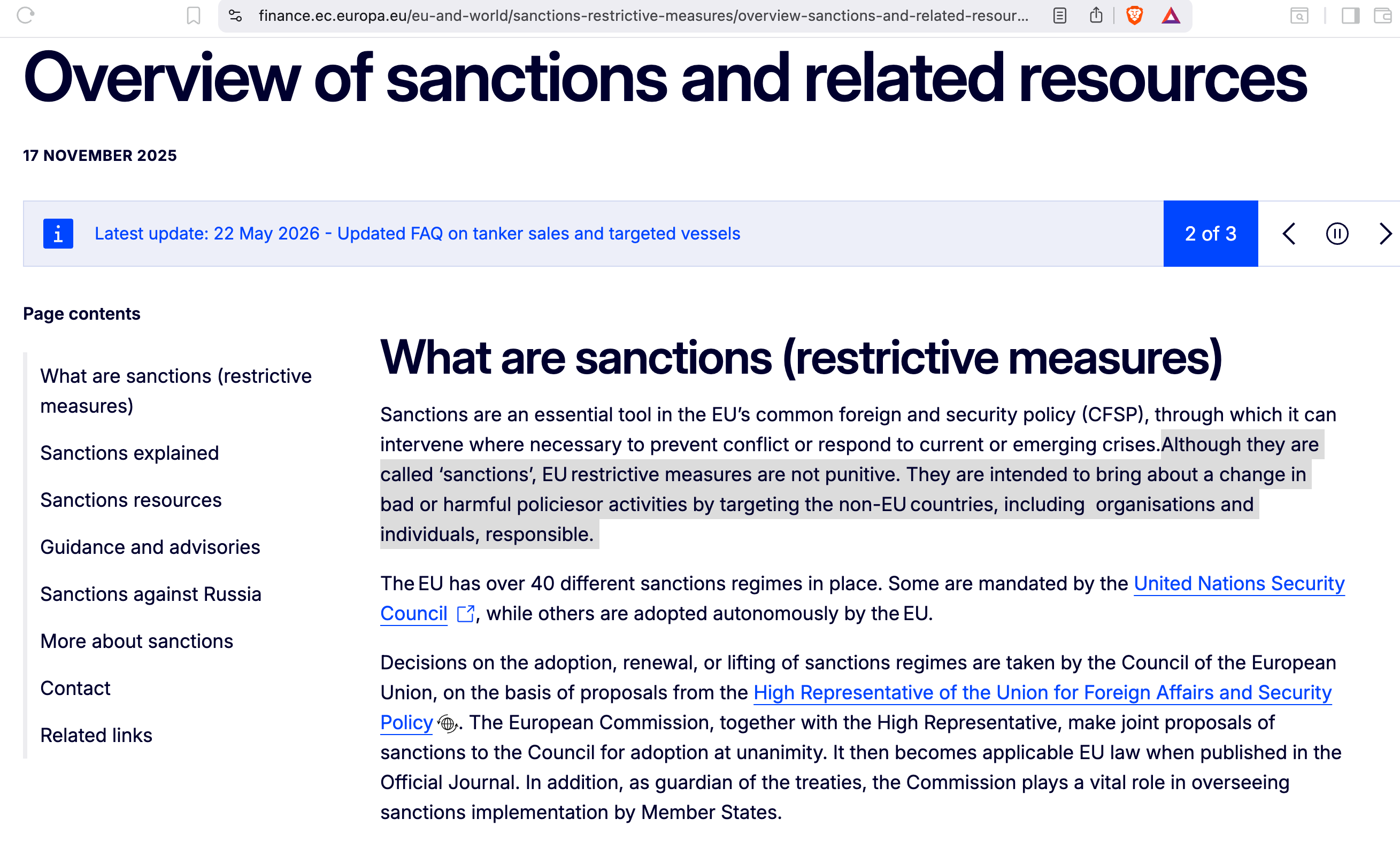
At this point, I suppose that the main issue here is the we’re targeting ‘non-EU countries, including organisations and individuals’ part, which may derail the sanctions against Mr. Doğru. Or it may not, for all it takes is another decree by the EU Commission; there, fixed that for you.
Do check out Mr. Doğru’s version:

I’ll leave you with two more paragraphs from the World Socialist Website as linked above (muahahaha) and a nugget of ancient wisdom:
Inclusion of Red Media in the EU’s sanctions list means the banning of the platform without even an objective hearing of evidence, let alone a court decision. At the behest of the German government, the EU institutions are de facto cancelling the freedom of the press. Anyone who disseminates unfavourable opinions or does not report along official lines is to be sanctioned. The EU institutions is creating a precedent for censoring unpopular media beyond the rule of law.
The as yet unproven accusation that Red Media is financed by Russia is completely irrelevant. Not only because numerous German media products are financed from other countries. Above all, freedom of the press includes not only the freedom of opinion of the publishers, but also the freedom of the population to listen to the different sides of a conflict and form their own opinion. However, in view of the preparations for war against Russia, any position that does not follow the official war narrative is declared ‘enemy propaganda’ and banned.
As to the Romans, they knew:
Quod licet Iovi, non licet bovi is a Latin phrase. Its literal meaning is ‘what is permissible for Jupiter is not permissible for a cow’.
And here’s the pertinent text:
Section 4 Restrictions and Obligations to Protect Public Safety and Foreign Interests
(1) In foreign trade transactions, legal transactions and actions can be restricted or obligations to act can be ordered in order
to guarantee the essential security interests of the Federal Republic of Germany,
to prevent disturbances to the peaceful coexistence of nations,
to prevent significant disturbances to the foreign relations of the Federal Republic of Germany,
to guarantee public order or security in the Federal Republic of Germany or another Member State of the European Union,
4a. to safeguard public order or security with regard to projects or programmes of Union interest within the meaning of Article 8 of Regulation (EU) 2019/452 of the European Parliament and of the Council of 19 March 2019 establishing a framework for screening foreign direct investments in the Union (OJ L 79 I, 21.3.2019, p. 1) or
to counteract a threat to the supply of essential goods and services in the country or parts thereof and thereby, in accordance with Article 36 of the Treaty on the Functioning of the European Union, to protect the health and lives of people.
(2) Furthermore, in foreign trade, legal transactions and actions may be restricted or obligations to act may be imposed by statutory instrument in order to:
implement decisions of the Council of the European Union on economic sanctions in the area of the Common Foreign and Security Policy;
implement obligations of the Member States of the European Union provided for in directly applicable legal acts of the European Union for the implementation of economic sanctions in the area of the Common Foreign and Security Policy;
implement resolutions of the United Nations Security Council; or
implement intergovernmental agreements to which the legislative bodies have approved in the form of a federal law.
Like that Latin quote at the end. What a one to use.
When they started to yammer about disinformation up here about 15 to 20 years ago - and back then it was just a susurrus among journos and some politicos - I had a brief thought about it while chatting with the Syrian family that ran my go-to lunch café in Malmö, Sweden (fittingly, it was named 'Cosmopolitan').
It came upon me when the man running the business translated for his father who was explaining about Syria's modern history and why there's so much trouble in the region where it is located:
Only a weak regime relying on lies and propaganda needs to defend itself against foreign info-war operators, real or alleged. A strong regime does not need to, because its strength comes from its mutual and reciprocal loyalty and trust to its own people, and vice versa.
Case in point, the USA which trundles along nicely despite (as the likes of von der Leyen would put it) its 1st amendment. Also case in point most nations outside the Soviet sphere pre-1990s, where you could have groups, parties and papers openly calling for violent revolution and remodelling the nation on the CCCP/China/Kambodia - and no-one went to prison for just stating their opinion on such matters. (Acting on them, like various Soviet-funded and directed groups did*, is always a different matter.)
The EU I think knows that the peoples of its constituent parts have zero loyalty to the union as such, remain irritatingly nationalist and will simply not call a Turk a German no matter what a piece of paper says. Thus it lashes out in frustration when it understands that all someone has to do to undermine the EU's official lines of sanctioned truth and agit-prop media (the EU co-funds lots of comics and cartoons and other media targetting children, all with the well-known message of "white indigenous bad, brownblackindianchinese good, islam good, christians evil") is report reality. A former head of RT even stated to a Swedish journo over ten years ago that "No we don't need to manipulate images or distort content, we just need to broadcast what happens in Sweden without your censorship of who the criminals are" - this was about the regular shootings and bombings and riots in migrant-ruled areas.
*Putin's job in the DDR was directing and arming such groups in Germany.