A longish exposé by Norwegian state broadcaster NRK sheds quite a bit of light on what bedevils seemingly affluent and über-liberal Western societies and pushes the normalisation of weirdness
Sometimes, I almost fall off my chair reading stupid nonsense on legacy media websites, and since we can’t cover doom and gloomy stuff all the time, here’s a bit of (very) light entertainment about expertdom™, feminism™, and stupid people doing utterly ridiculous things.
Translation, emphases, and [snark, actually, a whole lot of] mine.
How to Deal With Differences in Your Relationship
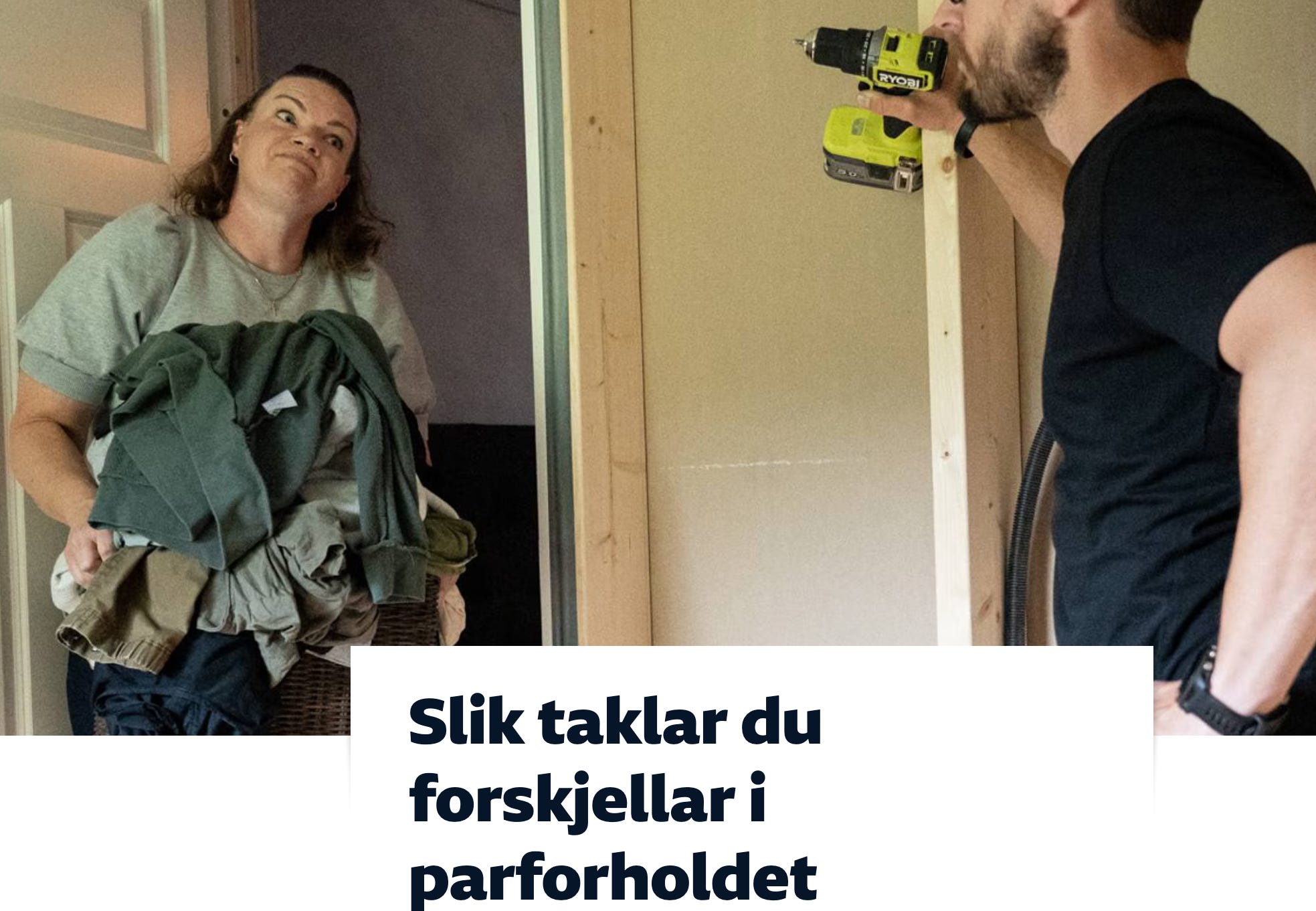
If you want to work on your relationship, you can get some tips here [that’s the translation of the header in the screenshot above; in my view, it’s always in the eyes—just look at the woman’s mad gaze].
Do you have any other suggestions as to how to tackle issues in a relationship? Share them with us below in the comment section 👇
By Hanne Næss Tremoen, NRK, 6 July 2025 [source; archived]
I’m no longer doing your laundry!
Kristin Nordvoll Mork (41) shouted out.
Her partner Aleksander Mork (36) and their three children stood petrified and only looked at her. But that was it [that apparently includes her refusal to do their children’s laundry].
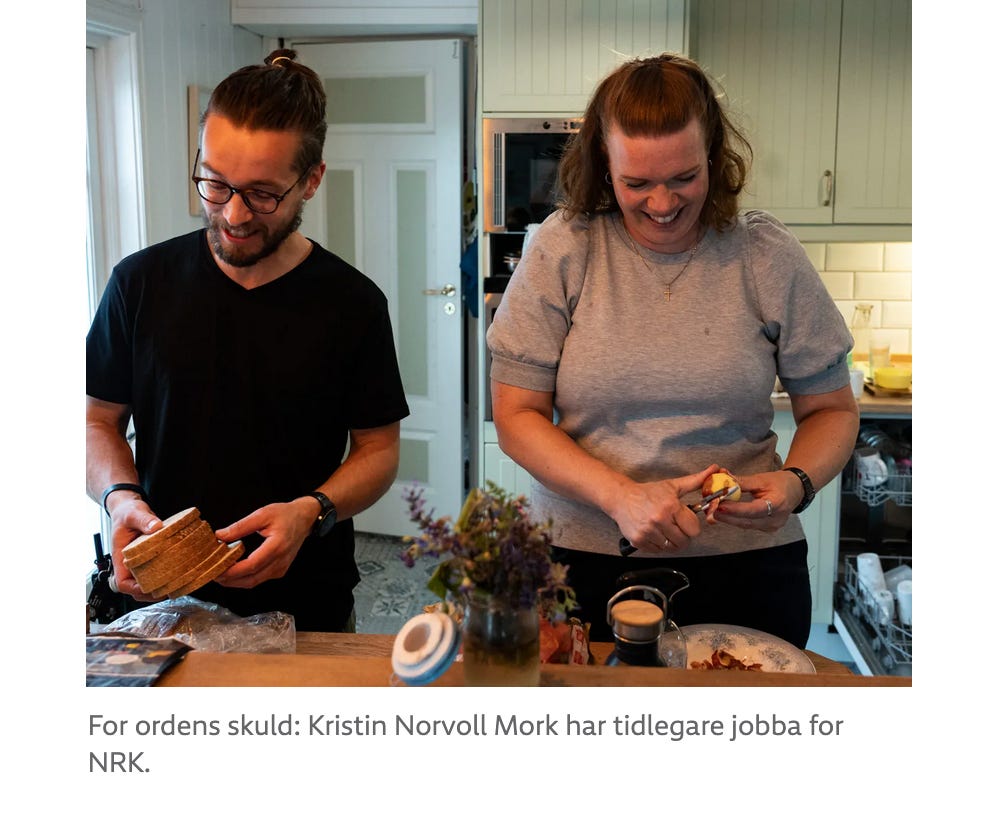
For the whole of six weeks, Kristin refused to do their laundry [that’s her in the above picture, by the way].
The couple was of the same opinion when they bought a house that may be described as a ‘rehabilitation’, or renovation, project. At some point, her vision of a clean and orderly household was confronted by the reality of ongoing renovations [full disclosure: we also bought such a ‘project’ house, and after three years, we’re almost getting things done, but then again, we also have a small farmstead, livestock, and other things to do around the farm].
So, how does one find a solution that works for both of them?
Perhaps the summer holidays and free time [haha, good luck with that: that’s the high season for renovations] permit them to find a good strategy for their everyday life?
In this piece, you can read about [admit it, you’re giddy as I am /sarcasm]:
From chaos to compromise with Kate and Marit
Monika’s strategy with Oskar
Five suggestions from a philosopher [aren’t you getting particularly excited about that one?]
Honest talk about children and housework between Kristin and Aleksander
Fighting Over Self-Defence [sic; orig. sjølvforsvar]
Philosopher Ingun Steen Andersen (55) knows very well why many couples fight over what are the most important things at home.
A good part of the answer derives from how one grows up and what values were important back then [no shit analysis: literally everyone knew 500 years ago, as per the Jesuit way of teaching children].
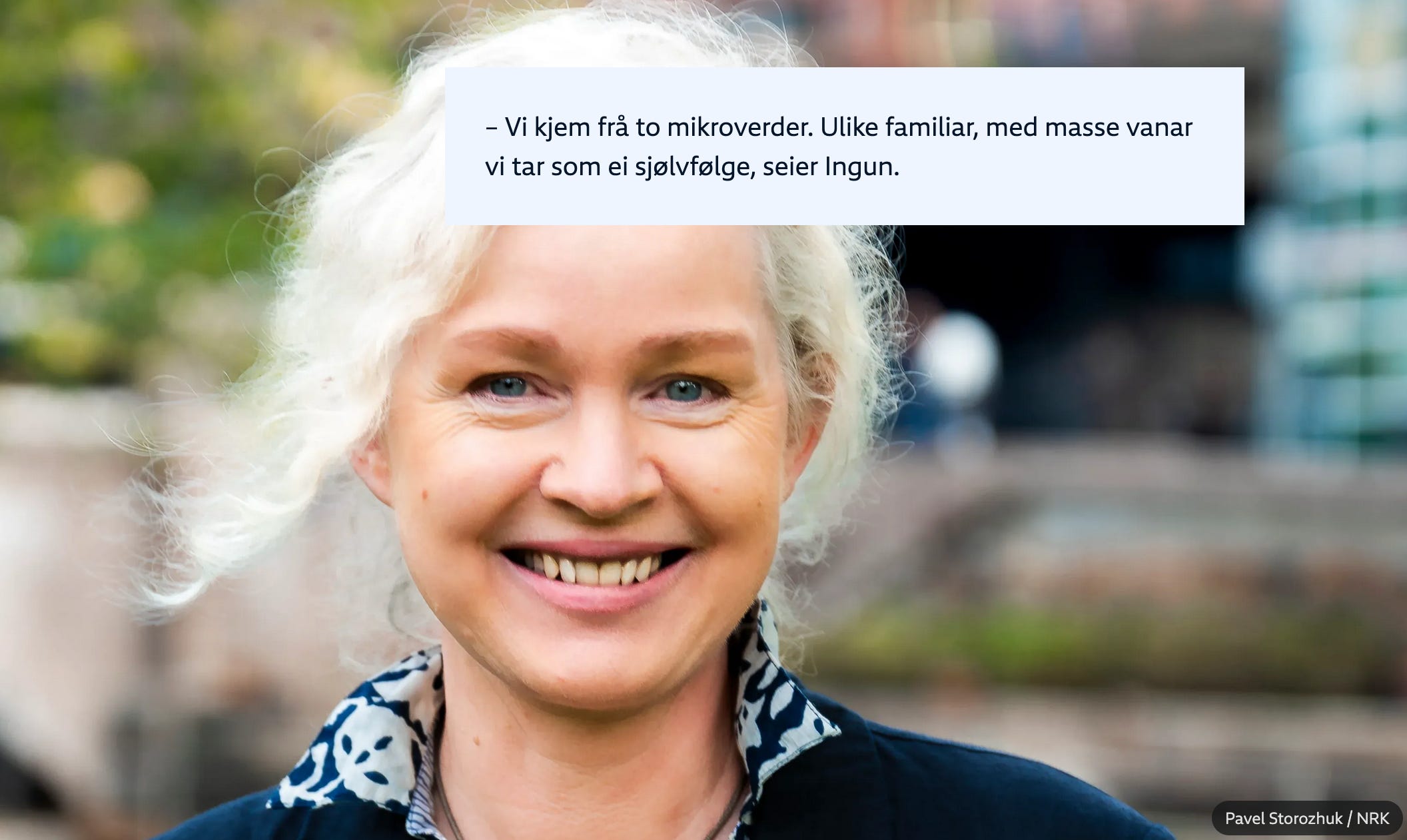
‘We come from to microworlds. Different families, with many habits one takes as given’, says Ingun [in case you’re wondering, Ingun is a self-styled ‘dialogue philosopher’, holds a MA diploma and certain additional certificates, works at the Norwegian Holocaust Centre, and is a section head at the Human-Etisk Forbund, Norway’s premier atheist pressure group (note the discrepancy to what’s described in the piece: Kristin is wearing a cross around her neck—in her midlife crisis, she turned to faith)].
Moreover, these values are also part of one’s identity [of course], and when one faces challenges, it can be perceived as an attack on who you are [alternatively, as a grown-up with a firm sense of knowing who you are, you might also consider such a situation as, well, hedonistic narcissism].
But with a a few simple measures, it can become truly much easier to live with differences, the philosopher believes [no shit analysis there].
That is, as long as you are willing to enquire about the true origins of one’s partner’s behaviour [ah, it’s always a good idea to project one’s own narcissism onto one’s domestic partner and enquire about what may be wrong with him or her: what kind of BS is this?] in order to also learn about one’s own requirements [see how that identitarian nonsense works? Claim your relevant other has a problem™ to figure out what your own desire is—it’s literally the opposite of what being in a relationship means].
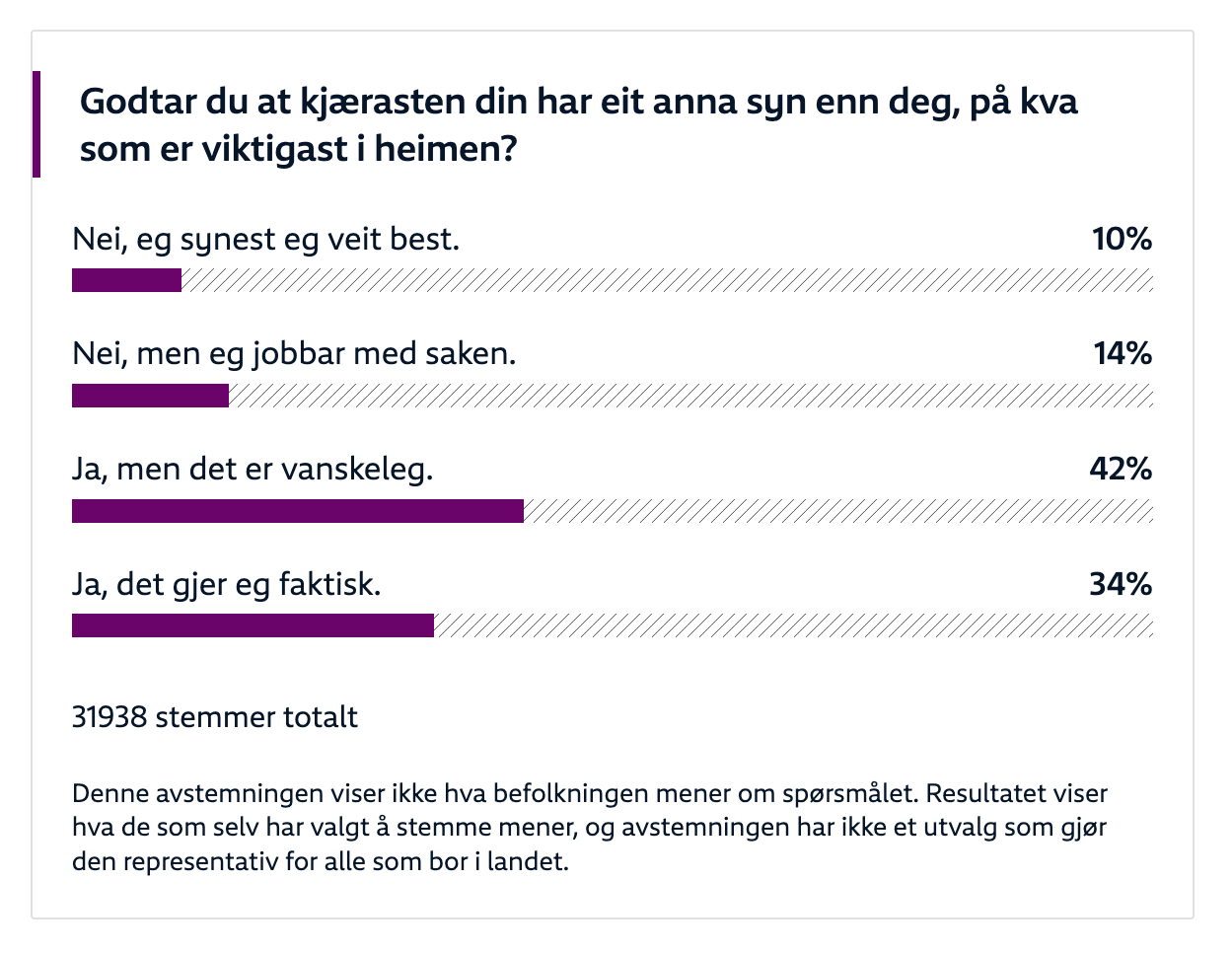
Does you significant other holds different view about what’s the most important thing at home?
‘No, I know what’s best’: 10%
‘No, but I’m working on it’: 15%
‘Yes, but it’s difficult’: 42% [lol]
‘Yes, that’s actually the case’: 34% [this is the most obviously appropriate answer here—it means, ‘so what?’ It also shows that about two thirds of those who clicked on the poll are, in my personal view, gone].
31,938 votes in total; NB that these results do not reflect what the populace at-large things about the question. The results only show the opinions of those who elected to participate, and the results are therefore not representative of society as a whole.
From Chaos to Compromise
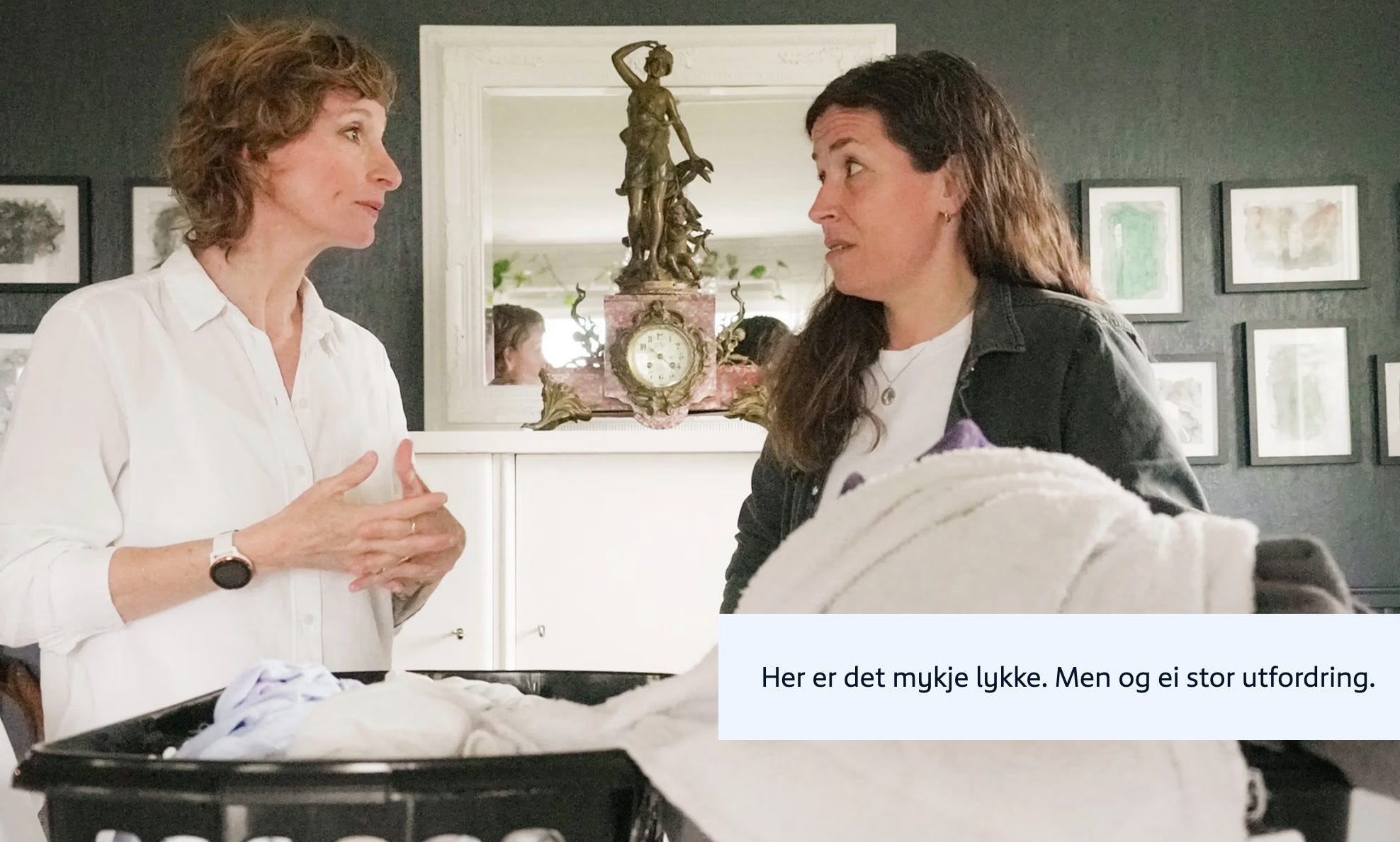
Married couple [orig. ektepar, a designation notably missing from the previous example of Kristin and Aleksander] Marit (45) and Kate (50) Liarbø Showalter live in Bodø, in a house with a garden.
There is a lot of happiness here. But also a great challenge.
For Kate and Marit, they need totally different things to prevent chaos in their own skin.
Good weather trumps everything for Marit. She calms down best when she can be alone with herself in the garden.
Household chores can wait until the next rainy day, thinks Marin.
But for Kate it is difficult to concentrate when their place is a total mess.
‘It’s not that I like cleaning up, but if I don’t do it, it’s difficult for me to go outside and enjoy the sunshine’, says Kate.
Marit is not always happy to help cleaning up whenever Kate things it is necessary. But to go outside and be in the garden with ill feelings isn’t a good solution for Marit either.
Now, they have found a compromise.
They have figured out just how they can make each other’s everyday happier.
The solution is simple: first, Marit and Kate do some household chores together, and afterwards Marit goes outside in high spirits.
And Kate, well, she’s o.k. to defer a full cleaning to another day [i.e., instead of a full cleaning tour a week, they’ll do one every other week: I’m wondering if, say, the good philosopher suggested that solution™].
A Clear Approach
On a big farm in Verdal in Trøndelag, there lives a young couple.
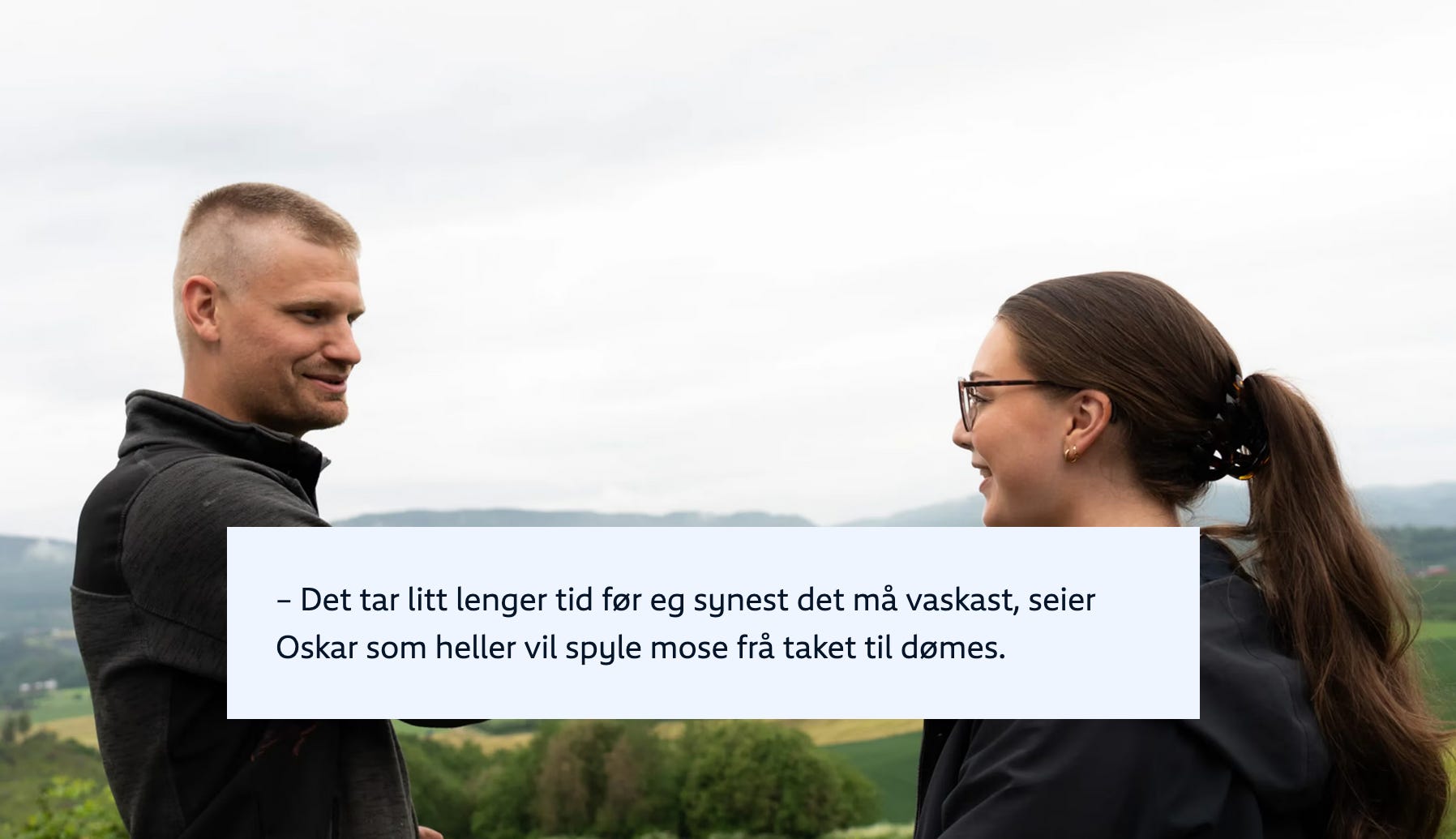
Oskar Hynne (27) took over the family farm [orig. avløysar på slektsgarden]. Together with Monika Ljøkjell (27), they run a business with 115 milk cows.
Living on a farm means work very early in the day and very long days. Monika works ‘only’ during the day [let’s see if these young people are the most sane ones in this piece; also, where’s all the ‘equality’ and ‘gender pay gap’ people now that one would need them? Another full disclosure: I live on a farm, too, and while I try to do my share indoors, too, occasionally, heavy-duty work outside takes precedence according to physical strength (sex)].
She has known this from the get-go [of their relationship], and she’s not at home in her house as often. And both have quite different priorities [hahahaha, if your livelihood depends on your 115 cows, well, here’s an answer].
They have different views of what ‘orderly and clean’ means.
It takes longer for me before I think something needs to be cleaned [says Oskar] who rather cleans the roof of moss, for example.
Yet Monika should do everything in the house on her own either.
Realistic expectations and clear communication, that’s the recipe for a good relationship for them.
‘If there’s something that bothers me, I’ll say that right away without Oskar taking this as personal criticism’, explains Monika.
‘That just shows how fantastic I am’, Oskar chuckles in response [somehow, these two seem to be the most sane persons in this piece: I’m also biased due to roughly general overall comparative circumstances of living on a farm with admittedly much smaller numbers of livestock (9 sheep)].
But that’s how he explains it. If he had said to him, ‘now, you have to clean the dishes’ or something like that, he would not have a whole lot of fun. But that’s not Monika’s method [lol, what’s that NRK journo™ taking? I mean, on a farm after dinner, one goes out to check on the livestock while the other cleans up indoors: it’s not exactly rocket science…].
‘You’re rarely angry when you tell me things like that’, says Oskar while looking at his partner.
[at this point, there’s a link to yet another hilarious piece entitled, ‘How to Prevent Fighting With Your Parents During the Summer Holidays’ that details the plight™ of young adults who travel back home during the summer break: its main lede is a young woman who ‘always cleans up the kitchen after cooking because she’s shared an apartment with many others for years’]
Five Tips From the Philosopher
Philosopher Ingun Steen Andersen just loves a tidy home. But she also knows how one must talk to each other to achieve good co-operation at home.
‘We shall have a tidy home, and you better do it lest you wish to be a bad person.’
If you talk like that, you generalise your own experiences. And that’s a fast track [to unhappiness].
She knows how easy it is to switch to ‘attack mode’.
But if you criticise, disagree, or hector someone else, you are merely achieving one thing: you make the other person feel bad.
And the natural reaction is to defend oneself. And be defiant.
The trick is to talk to each other in a way that makes the interlocutor go the proverbial extra mile [orig. Kunsten er å snakke på ein måte som gjer at den andre får lyst til å strekke seg. To me, this doesn’t sound like a conversation between equals but a form of agit-prop/weaponisation of empathy to make one’s interlocutor move].
Towards yourself [somehow I find it extra-absurd that the philosopher who offers ‘dialogue services’ proposes to resolve such quarrels (sic) by bamboozling one’s significant other into acquiescence, but perhaps that’s just me?]
‘Respectful communication, that’s what this is’, explains the philosopher Ingun Steen Andersen [ready for another rabbit-hole? Check out what that idea means, e.g., here or here], adding:
This is how you take your interlocutor with you, even if you start out moving in different directions.
[here follow the philosopher’s five relationship tips]
Don’t attack
Don’t expect your partner to be someone who they aren’t. Speak in a manner that shows your respect for your interlocutor and his or her values in their own right.
Don’t point fingers Don’t blame others for things you do yourself [rocket science, anyone?]. Rather, talk about your own needs and what a certain situation does to you [which looks to me like the recipe for unbridled and unrestrained hedonism—which will destroy any relationship over time, private or professional].
Let go of demands
Are you upset that your significant other doesn’t do what you tell them to do?. Stop it [you need to be an expert™ to know these things, you know]
Love is work [let that sink in, and keep it in mind until the end of the article below]. To work together with someone and meet no resistance, that’s a way to learn from; and thus be a better person [note the conflation of work™ and being™].
Be curious
Go curiously into someone else’s world. What is important for you? [more narcissism will always provide a win™ in any relationship, private or professional]. You can gauge for yourself what’s important for you and what isn’t; is it really that important for you?
Rather, be with someone’s aims, be with someone’s projects.
Accept imperfect things Accept that your significant other may not be able to live up to your standards. Your values are not absolute and don’t count for everybody [what about live and let live?]. And don’t expect that everything can be justified.
The last and most important tip [I’m counting six now] by the philosopher Ingun Steen Andersen concerns determining when would be the right point in time for a conversation:
Don’t take that conversation in bed. There we should be close to each other [unsure if the philosopher has any inkling about partnerships etc.]. Or relax. Or rest.
Honest Talk and Child Labour [orig. Ærleg snakk og barn i arbeid]
Kristin’s strike was a wake-up call for her and her partner, Aleksander.
She began to bring up things that bother her sooner.
He is trying to be more conscious about how he talks and what else he can do.
And they introduced something new that they didn’t do before.
Disclaimer: Kristin Norvoll Mork used to for at NRK.
They noticed that teachers in schools and kindergartens are very good at making children do things [no irony there; also, this is one of the core problems in this story: the state—in the form of universal daycare from age one and school, incl. after-school daycare—de facto assumed parenting obligations: to me, it very much looks like that if the kids are there, it’s kinda work for them and spare time at home, mainly because many parents in such a generous welfare state™ like Norway refuse to impart on their children anything that reeks of parenting, such as conveying values, inviting them to contribute to household chores, etc.: this is my experience here in Norway after 5 years of living among Norwegians (I’m not saying everyone is like this, but the majority of people I came to know is])].
So they introduced a system of paying wages [orig. lønn] for the children aged 10, 8, and 5. Five crowns for taking out the trash [that’s a nickel in US dollar terms, i.e., literally nothing as five crowns buy you nothing in supermarkets], ten crowns for doing the dishes [a dime].
‘We need to normalise child labour again’, says Kristin Nordvoll Mork with a chuckle.
Do you have any tips on how to tackle trouble in partnerships?
Bottom Lines
I understand that this was a painful read, but I suppose that, by the end of the piece, you understand why I brought this to your attention.
My personal take is this: specifically that couple Kristin-Alexander is both very telling and points squarely to two very important aspects:
Universal daycare is wrecking parenting, esp. if you have crazy-eyed people like Kristin involved: her refusal to do the children’s laundry is, in my view, insane because it shows the abdication of parenting as child-rearing has been effectively taken over and, also in her view, monopolised by the state (via universal daycare).
I’ve lived in Norway for five years now, and I can tell you from my own experiences that this is what most parents do: if the child’s at kindergarten or school (plus after-school daycare), parents get to go to work etc., and parents also behave like being at home is spare time.
The children merely copy their parents’ behaviour, and I do, to a very large degree, blame universal daycare for this. It’s also not surprising once you consider what thinkers and practitioners like Maria Montessori and Rudolf Steiner, among others, knew over a century ago:
Play is the work of the child.
Thus Maria Montessori—and the implication is painfully obvious for everyone to see: parents drop of kids at kindergarten or school, then go to work, and pick up the kids after word. Neither kindergarten or school are ‘free time’ for children. No wonder kids want to relax and enjoy free time once they get home. (As an aside, we’re quite the odd ones out for keeping our kids out of daycare and these after-school hours as much as possible; my wife and I see parenting as the core responsibility of, well, parents, because we desire our values to be handed down to future generations, as opposed to whatever crap state educators™ throw at our children.)
Abandon parenting in favour of indulging in one’s own narcissism and desires, someone and something else will fill the child’s natural desire for role-models.
As a corollary, we shall not refrain from pointing at the willingcollaboration of many parents these days to simply refuse to bear the burden—and enjoy the joys—of parenting in favour of indulging in their own hedonism. For the state and for many parents these days, that’s a win-win situation with a clear loser: the children, but their well-being often comes last as they are often crushed between parental demands and state planning.
Did you notice the anti-family spin? Out of the five examples cited, there was but one family with children, a lesbian couple (also with odd, crazy eyes), and an apparently child-less philosopher who offered tons of good relationship advice™ that borders on both the extremely superficial and uselessness. I suppose that the farmer couple will get children rather sooner than later, for a variety of reasons but also because it’s the family farm they wish to keep in the hands of, well, the family.
The most troubling aspect, to my mind, in this second regard, though, is that weird former NRK journo™ Kristin whose plight™ is featured so prominently. I’ve looked her up, and I’m quite sure about the background to this piece (although the following two paragraphs and my conclusion are based on speculative deduction rather than me knowing for sure):
According to what’s available online (e.g., her LinkedIn profile), ‘Kristin (parent fella) Nordvoll Mork’ who presents herself as follows:
Radio journalist, stand-up comedian, communicator, and writer. Ongoing content producer @foreldrefella on Instagram
I submit that the discrepancy between Ms. Mork’s lived experience (sic) at home and her work as an independent™, powerful™ woman became too stark. In the end, she couldn’t bear the strains between presenting herself as one person in/to the public vs. her a bit less glamorous live at home. Hence, she blamed her partner and their children for her own choices—and made her partner join in her solution™, that is, the push to ‘normalise child labour’.
As I said, I don’t have any proof to support this, but the spin of the piece is both unbearable and revelatory in many regards. And to resolve their grown-up issues, both Aleksander and Kristin resort to paying their children for household chores—now, you don’t have to be an expert™ (like that philosopher, for instance) to understand what this does to the children: they’re at work in school and kindergarten for longer hours than the adults are working. And once they get home, there’s more work for the children.
All this does is—it tells the kids that their parents (sic) prefer exchange value of being, well, the role models children deserve: compassionate, unconditionally loving, and trying to prepare the children for the harsh realities of live outside the safety and protection of their home. Instead, the harsh realities of wage labour (chattel slavery) are imparted on kids aged 5, 8, and 10, of all ages.
Moreover, talking of spin and lies by omission, another weird aspect is that this well-connected (former?) NRK journo™ Kristin sought to resolve her mid-life crisis by—finding a way to the Christian faith (as explained in great detail in this piece in Bladetfrom two years ago); you may have noticed her wearing a necklace with a cross in the first picture, and apparently, Kristin has become very devout, as this ‘prayer’ segment at NRK Radio indicates.
You do wonder as to why that part of her journey isn’t mentioned, eh?
The entire piece is a kind of agit-prop attack on family life, faith, and, of course, a hymnal in praise of state-led parenting via universal daycare.
It is part and parcel of the ongoing normalisation of the gov’t raising kids (and thus imparting quite different values on future generations), the abdication of parental responsibilities in favour of unbridled hedonism, and, of course, the politically über-correct NRK journos couldn’t resist to include a strong pro-homosexuality aspect, too. While I have no problems with adults living out their fetish, you do wonder why it’s lesbian women and not, say, two gay men or any combination involving one ore more Trans™ persons (my guess is because it would turn off most readers).
And thus the dialectic progresses, one attack on family, faith, and sanity at a time.
Thanks for reading Die Fackel 2.0! Subscribe for free to receive new posts and support my work.
I got a headache and a twitch in my left eyebrow from reading that stuff. Funny that it is 100% identical to such articles from the early 1990s; equally retarded reasoning and equally stupid avoidance of the real issue:
Stuff needs doing, and comes with different priorities dep. on circumstances, and said stuff doesn't care about ideology or anything, and the objectively best way of doing stuff is that the one most skilled at it does it, because then it gets done in the fastest and most economical way.
I can't stand - I get so riled I raise my voice - when people equate "equality" with doing the mathematical mean of chores. "I've washed and rinsed six table spoons, now you have to wash and rinse six forks, and the I'll wash and rinse six knives and then..."
That's retarded in extremis.
People sometimes asked (when we lived in the city) how we "got our marriage to work/function" as if it was some kind of machine, relating to chores and such. "We do it the way our grandparents did it" was the reply. The one best suited to the task does it; if it's not obvious who that is, hash it out and decide. You can always re-do who does what as needed, when needed.
But the true problem is the women. Age 50 and younger, they have been brainwashed to think in the way referred to above, that equality means doing the mathematical mean of things. (Except for the heavy, dirty and dangerous stuff, of course.)
I mean, I /could/ technically bake a cake - I'm not too stupid to follow a recipe. But my wife can do it without, because she knows cooking for real, from the basic principles of it. So she does it.
She could, with a lot of effort, swap the tyres of the pickup truck. Sure, she'd need a lot of WD-40, a long lever and mallet to loosen the nuts and maneuvering the tyre into place would be difficult for her, but she could do it if needed.
But since we're not retarded, she bakes a cake and I swap the tyres.
The people in the article, the "philosopher", NRK, and so on - I can only describe them as retarded. Certainly brainwashed, but as a shorthand, retarded - using the original meaning of development into a functioning adult human having been stunted for whatever reason - is the best one I think.
If Kindergartens weren't for indoctrinating, then private such wouldn't have been outlawed when the system of public ones was established. Now, with the islamic invasion it's gotten a bit muddled of course. Moslems may have their own, and you can run a zero-profit parental collective one, but pure for-profit ones are still de facto outlawed, and seen as morally wrong and suspicious.



I got a headache and a twitch in my left eyebrow from reading that stuff. Funny that it is 100% identical to such articles from the early 1990s; equally retarded reasoning and equally stupid avoidance of the real issue:
Stuff needs doing, and comes with different priorities dep. on circumstances, and said stuff doesn't care about ideology or anything, and the objectively best way of doing stuff is that the one most skilled at it does it, because then it gets done in the fastest and most economical way.
I can't stand - I get so riled I raise my voice - when people equate "equality" with doing the mathematical mean of chores. "I've washed and rinsed six table spoons, now you have to wash and rinse six forks, and the I'll wash and rinse six knives and then..."
That's retarded in extremis.
People sometimes asked (when we lived in the city) how we "got our marriage to work/function" as if it was some kind of machine, relating to chores and such. "We do it the way our grandparents did it" was the reply. The one best suited to the task does it; if it's not obvious who that is, hash it out and decide. You can always re-do who does what as needed, when needed.
But the true problem is the women. Age 50 and younger, they have been brainwashed to think in the way referred to above, that equality means doing the mathematical mean of things. (Except for the heavy, dirty and dangerous stuff, of course.)
I mean, I /could/ technically bake a cake - I'm not too stupid to follow a recipe. But my wife can do it without, because she knows cooking for real, from the basic principles of it. So she does it.
She could, with a lot of effort, swap the tyres of the pickup truck. Sure, she'd need a lot of WD-40, a long lever and mallet to loosen the nuts and maneuvering the tyre into place would be difficult for her, but she could do it if needed.
But since we're not retarded, she bakes a cake and I swap the tyres.
The people in the article, the "philosopher", NRK, and so on - I can only describe them as retarded. Certainly brainwashed, but as a shorthand, retarded - using the original meaning of development into a functioning adult human having been stunted for whatever reason - is the best one I think.
If Kindergartens weren't for indoctrinating, then private such wouldn't have been outlawed when the system of public ones was established. Now, with the islamic invasion it's gotten a bit muddled of course. Moslems may have their own, and you can run a zero-profit parental collective one, but pure for-profit ones are still de facto outlawed, and seen as morally wrong and suspicious.
I think I have identified the problem: that cordless drill is comically tiny.