
From China With Slime
Snail Serum is apparently the new hype among skin-care™ products, and as always, have a good laugh--and, given the ingredients, buyer beware

So, this little item on the shelves caught my eye yesterday:
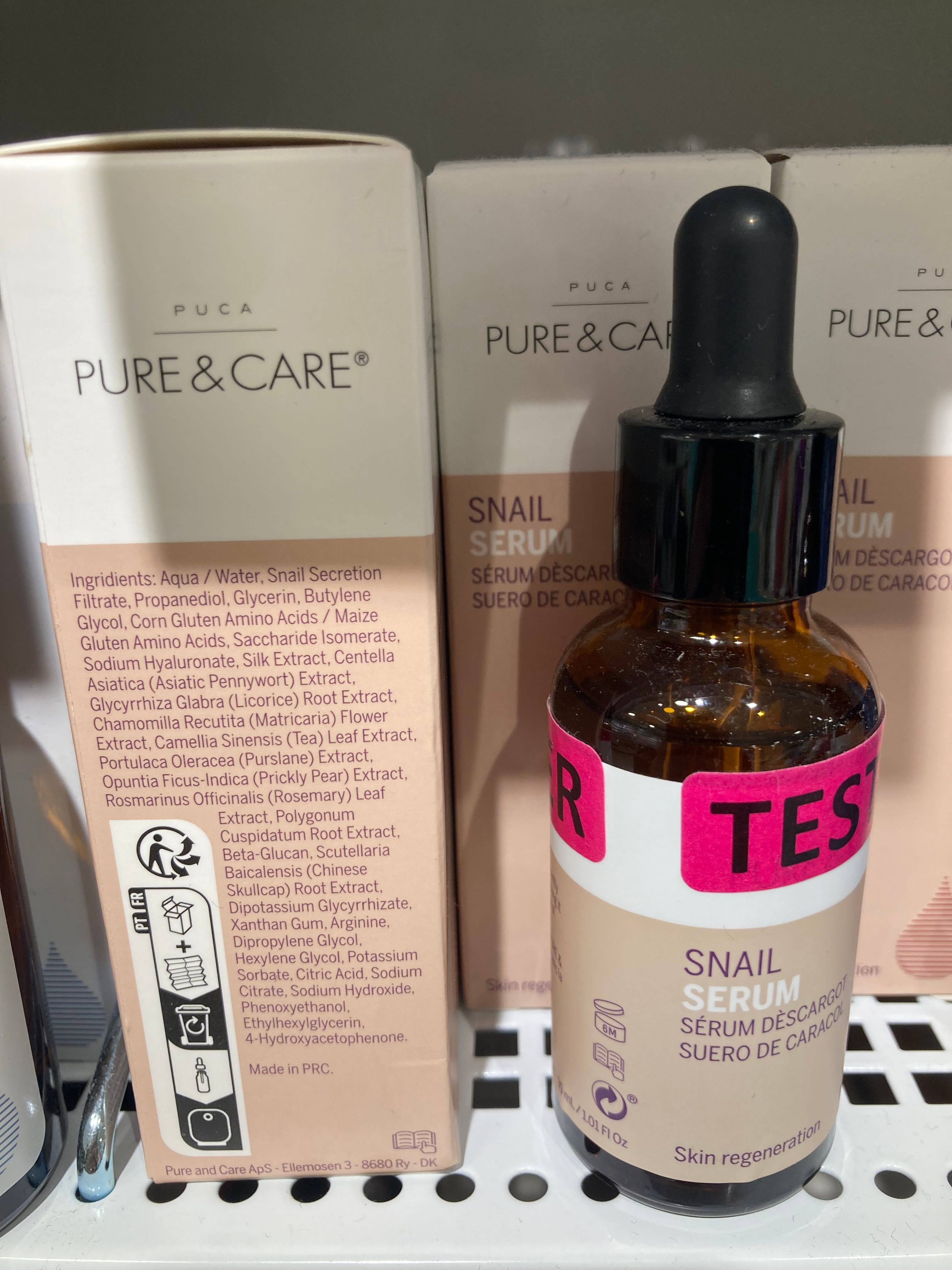
At first, I found it amazingly odd and somewhat hilarious that ‘skin-care™’ (scam) products would now be sold containing snail serum, which is why I took the picture in the first place.
And then then I looked at the ingredients and thought: well, perhaps the snail slime isn’t the worst kind of ingredient here…
Propanediol may refer to a bunch of different things, but I think that it its Propylene glycol (E 490) and not its less-than-healthy 1,3-Propanediol, an anti-freeze and solvent, but the label isn’t conclusive as to that.
Then there’s Butylene Glycol, which is similarly ill-defined and technically refers to four structurally similar isomers, and it is equally guesswork as to which one is used (I’m going for 2,3-Butanediol here as the others come invariably with ‘dangerous labels’ or the like).
As regards Saccharide Isomerate, well, it’s apparently so ‘innovative’ it doesn’t yet have its own Wikipedia entry. Hence here’s some information from a dedicated website:
Saccharide Isomerate is a hydrating ingredient derived from plants, commonly found in skincare products. Sometimes listed as Pentavitin on ingredient labels, it acts as a humectant, which means it helps skin hold onto moisture, keeping it looking plump and dewy…
[Saccharide Isomerate is] a versatile ingredient that’s beneficial for any skin type, whether you have dry, oily, or combination skin. It’s a humectant that helps maintain your skin’s moisture levels, and because it’s gentle and mimics natural skin moisturizers, it’s also suitable for sensitive skin.
Side effects may include ‘mild irritation’ ranging all the way to ‘allergic reaction’, and its transient effect means that ‘one must continue to use the ingredient consistently’.
Sodium hyaluronate is another ingredient that caught my eye: according to Wikipedia, it ‘is is injected to reduce wrinkles on the face’ (references omitted):
As of 2017, the FDA had approved 13 hyaluronate preparations as so called dermal fillers. They are also used as a filler of lips or in other parts of the body, though not FDA approved. The filling effect is temporary and lasts for about six months or longer in most people
Fun fact aside (in the entry’s ‘History’ section):
In the late 1970s and early 1980s the material was used with the brand names of Hylartin and Hylartin Vetused in human and veterinary clinical trials (race horses) to treat osteoarthritis.
I suppose ‘stop it, y’all, you’re not horses’ might be applicable here.
Then there’s Dipropylene glycol, which ‘finds many uses as a plasticizer, an intermediate in industrial chemical reactions, as a polymerization initiator or monomer, and as a solvent. Its low toxicity and solvent properties make it an ideal additive for perfumes and skin and hair care products. It is also a common ingredient in commercial fog fluid, used in entertainment industry fog machines.’
Hexylene glycol, or 2-Methyl-2,4-pentanediol, is found coatings, cleansers, cosmetics, solvents, lubricants, and hydraulic fluids. ‘Although it is an irritant at higher concentrations, it is sometimes used in skin care, hair care, soap, and eye cosmetic products at concentrations ranging from 0.1%-25%’. So, apart from missing indications about concentration of stuff, up to a quarter of the contents of this product may be Hexylene glycol.
Then there’s Phenoxyethanol, which appears to be used as a preservative due to its germicidal qualities. ‘It is a common preservative in vaccine formulations’, Wikipedia informs us.
As to Ethylhexyglycerin, there is virtually no information on Wikipedia, but that piece links to a ‘case report’ about some consequences of testing—people who had to seek medical help due to allergic reactions—this relatively novel compound:
As the culprit products, leave-on cosmetics were identified, including a high number of proclaimed ‘hypo-allergenic’ and ‘preservative-free’ facial creams, sun protection creams, and deodorants…
Ethylhexylglycerin is a rare, but highly relevant, cosmetic sensitizer, even in those products advertised to be safe for consumers.
I’ll stop here, after all, this is supposedly a ‘footnote’.
But we must talk about the advertised main active ingredient, too, hence we’ll now talk about snails.
Snail Slime & Heliciculture
So, here’s what Wikipedia says about the former’s ‘medical uses’ (references removed; emphases mine):
Some of the characteristics of snail slime have shown to be useful in Chinese medicine. Traditional Chinese medicine has used slime in a variety of ways to treat a variety of illnesses and cosmetic issues. It has also been used as skin creams for wrinkles and dry skin in cosmetics. The Chinese also have used the color-fast dry qualities of snail slime as a natural dye that represented wealth and power. The mucus has shown to be proficient in several biological activities including antimicrobial, antioxidant, anti-tyrosinase, and anti-tumoral activities.
A new generation of tissue adhesive has been developed by using natural adhesion phenomena and mechanisms, such as snail mucus gel, which exhibits excellent haemostatic activity, biocompatibility, and biodegradability. It is effective in accelerating the healing of full-thickness skin wounds in both normal and diabetic male rats.
So, Chinese appear to have used snail slime for ages, and although I suppose they mixed it with ‘stuff’, they will likely have done so without the laundry list of chemical compounds listed on the label.
As regards the burning question—how does one harvest (if that’s the right word) such snail slime?—however, the pertinent entry on Wikipedia is mum. (In fact, the entry on Heliciculture focuses exclusively on the ‘farming’ edible snails.) In case you wish to go down that particular rabbit-hole, here’s a piece I found in the Int’l Journal of Agronomy discussing snail farming, albeit it’s also about human consumption, as is this study.
After some searching in the nooks and crannies of the internet, I did find a piece about snail farming for slime in east Asia, which appeared in China Daily (most other such articles, like this one, focus on Chinese snail farmers outperforming European producers, but they are focused on culinary snails).
From a piece dated 23 July 2019, here are some excerpts:
The snails at Phatinisiri Thangkeaw’s farm were once the scourge of rice farmers, loathed for eating the buds of new crops.
“Farmers used to throw them on the road or in the rivers,” Phatinisiri said. “But now they sell them to me to earn extra money.”
With her 1,000 snails, the teacher makes an extra $320 to $650 a month.
It is one of more than 80 farms in Nakhon Nayok Province, two hours from the capital Bangkok, cashing in on the global snail beauty market, estimated at $314 million, according to research group Coherent Market Insights.
The precious slime is patiently “milked” from the glands of the snail by dripping water over a pipette.
Its raw form is sold to Aden International, a Thai-based cosmetics company that primarily ships its products to South Korea and the United States.
The sole snail slime producer in Thailand, Aden was started three years ago as a business-savvy solution to the snail infestation in Nakhon Nayok, said founder Kitpong Puttarathuvanun.
And his bet paid off: Kitpong sells the serum under the Acha brand, but also supplies South Korean and US cosmetic companies with a dried powder at 1.8 million baht ($58,200) per kilogram, he said.
Gold is currently worth $46,300 a kilogram…
“We found that our slime was very intense because the snails eat everything, including vegetables, grains and even mushrooms ... producing good quality slime,” he said, explaining that the mucus can be used to treat sunburn and “heal wounds”.
Somkamol Manchun, the doctor in charge of the purification process, said snail mucus contains collagen and elastin - ingredients that “can make skin firm with less wrinkles”.
It “triggers the skin cells ... and helps heal the skin”.
At the moment, no scientific studies have confirmed the curative qualities of snail serum and slime, but snail farmer Phatinisiri is already feeling the market heat up.
So, here we go: some stuff a business-savvy Thai marketed masterfully, no studies (in 2019) confirming its benefits—and given the laundry list of additives in the above product, it’s unclear whether snail serum is actually conferring whatever advantages or if its one or the other of the listed ingredients—but within a few years, this took of. Good for them, I suppose.
(Essentially the same piece was run by Arab News a few days prior and, apparently, elsewhere.)
And now I at least know the man behind this boom: Kitpong Puttarathuvanun, although I’ve yet to find much more than his snail mucus collection patent and his apparently one paper.
Perhaps I find out ‘more’ before too long, but for now—this stops here.
It is a weird business, but kudos to the savvy Kitpong Puttarathuvanun who is making tons of money with this.
What a strange world.
Ewwww.
Great reporting! I love your curiosity.
Insert PT Barnum-quote here.
Women will buy anything if you market it to them emphasising:
1) Youth and sexual attractiveness
2) Safety
3) Feelings of being right & good
4) Appeal to authority
It doesn't matter what it is you are selling. It doesn't matter what the actual effect is.
I wonder if Western women have always been this way? Today I happened to overhear a man being harangued by his wife about the mowing of the lawn - the garden magazine she reads had an expert stating various things, and so she was scolding her husband for cutting the grass 4mm high instead of 5mm high.
This is a retired couple. Both have at least FilMag or similar educational backgrounds.
Yet, she is for real arguing about the length of the grass as if that mm is visible, measurable and matters.
Can you imagine a man doing that?